Subcision Singapore
Rolling acne scars are held down from below by fibrous bands. Medical Director Dr Sin Yong releases them with subcision and plans surface work around it at Pacific Plaza, Orchard Road.
Subcision before and after: rolling scars are lifted by releasing the bands that tether them, then refined with laser or RF over the following months. Results vary.
WhatsApp to Enquire →Key facts ↓Subcision is a minor procedure that treats rolling acne scars by cutting the fibrous bands that tie the skin to deeper tissue. Under local anaesthetic, a fine needle or blunt cannula is passed beneath each scar through a tiny entry point so the skin can rise, and new collagen forms in the space. Two or three sessions are common, usually followed by CO2 laser or RF microneedling for the surface. See also our guide to tattoo removal before after.
Subcision at a glance
| What it is | A minor procedure that releases rolling acne scars by cutting the fibrous bands that tie the skin to deeper tissue. |
|---|---|
| Used for | Rolling scars and some soft boxcar scars that are tethered from below; little help for ice-pick scars or flat marks. |
| How it works | Under local anaesthetic, a fine needle or blunt cannula is passed beneath each scar through a tiny entry point; the small bleed and healing lay down new collagen that helps hold the scar up. |
| Typical sessions | Two or three sessions, four to eight weeks apart, usually followed by CO2 laser or RF microneedling for the surface. |
| Downtime | Swelling and bruising for about one to two weeks. |
| When results show | Scars may look raised or lumpy at first; the contour is judged against photographs as healing settles. |
| Who should avoid or wait | Active acne, during or soon after oral isotretinoin (as advised individually), pregnancy, bleeding disorders or blood thinners without medical advice. |
| Who performs it | Medical Director Dr Sin Yong maps and releases the scars. |
Dr Sin Yong, Medical Director of IN Eternity Clinic, explains that a tethered scar is pulled down from beneath, so release comes before resurfacing, and that repeat release or support from below helps stop scars re-tethering.
On this page
- What it treats: rolling scars and some soft boxcar scars that are tethered from below; it does little for narrow ice-pick scars (which are treated with TCA CROSS) or flat marks.
- How it works: a fine instrument cuts the fibrous strands under the scar; the small bleed and healing that follow lay down new collagen that helps keep the scar lifted.
- The stretch test: if a scar flattens when the skin beside it is gently stretched, it is likely tethered and may respond to subcision.
- Why combine: subcision lifts the scar floor; fractional CO2 laser or RF microneedling refines the surface and edges. Neither replaces the other.
- Downtime: swelling and bruising for about one to two weeks are common; most people plan around social commitments.
- Where: IN Eternity Clinic, 9 Scotts Road, #12-01 Pacific Plaza, Singapore.
- A widely used classification sorts atrophic acne scars into ice-pick, rolling and boxcar types, each suited to different treatments (J Am Acad Dermatol 2001)
- A review of post-inflammatory hyperpigmentation found it is common after inflammation of the skin and affects darker skin more often and more severely, which shapes how treatment is planned in Asian skin (J Clin Aesthet Dermatol 2010)
Which acne scars respond to subcision?
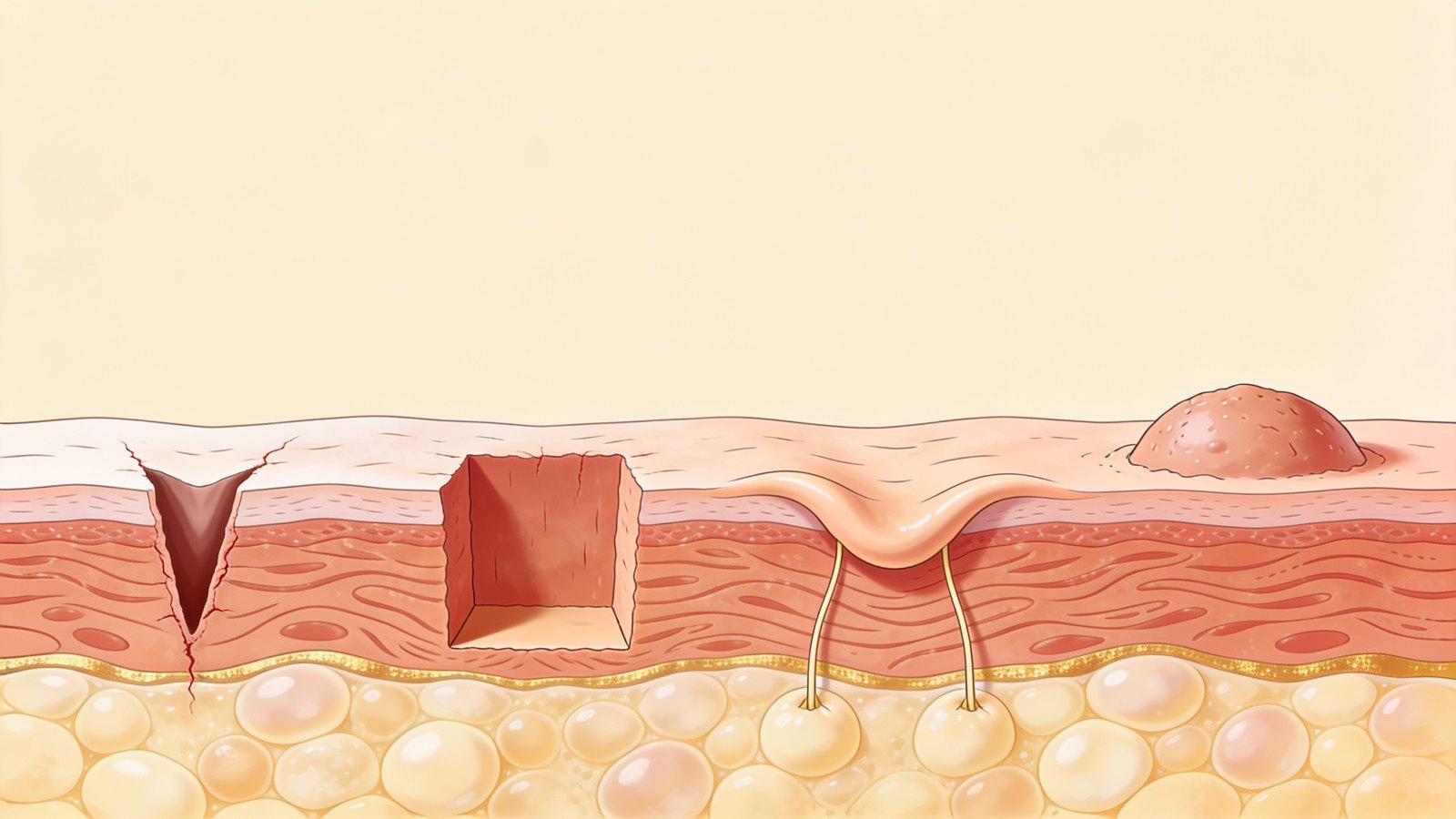
Acne scars come in different shapes. Ice-pick scars are narrow and deep; boxcar scars are wider with steep edges; rolling scars are broad, soft undulations that give the cheek a wavy look in side light. Rolling scars are pulled down by fibrous bands that join the underside of the skin to deeper tissue, so polishing the surface above them changes little.
Dr Sin Yong examines the skin in different lighting and uses the stretch test: if a scar softens when the surrounding skin is stretched, the band underneath is the problem, and subcision is likely to help. Most faces have a mix of scar types, so subcision is usually one part of a wider plan. See acne scar treatment.
Rolling acne scars and subcision: why release comes first
A rolling scar is a broad, soft-edged dip, often 4 to 5 mm or wider, that gives the cheek a wavy, uneven look in side light. The surface skin itself is often fairly normal. The problem lies underneath: during deep inflammation, fibrous strands formed between the underside of the dermis and the fat or deeper tissue below, and as they matured and contracted they pulled the skin down.
That is why resurfacing alone disappoints with rolling scars. A laser or microneedling pass works on the upper layers, but the band keeps pulling, so the dip stays. Cutting the band lets the skin float back up; the small bleed and healing response that follow lay down new collagen in the space, which helps keep it lifted. Reviews of the clinical trials report improvement in rolling scars after subcision, most often as part of a combined plan with resurfacing.
The stretch test at home gives a first clue: rolling scars soften or flatten when the skin beside them is gently pulled apart, while ice pick and boxcar scars stay visible. Ice pick scars need treatment inside each pit instead; see ice pick scar treatment.

How subcision is done, step by step
- Step 1: MappingEach rolling scar is marked in side light with the skin relaxed, because scars can be hard to see once the area is numb and swollen.
- Step 2: NumbingNumbing cream, then local anaesthetic injected into each area; the injection stings briefly, then the area is numb.
- Step 3: ReleaseThrough a tiny entry point, a fine needle or blunt cannula is passed under the scar at the level of the bands and moved in a fan pattern to cut them, until the skin moves freely.
- Step 4: CompressionFirm pressure and a cool compress limit bleeding and swelling; the entry points need no stitches.
- Step 5: ReviewAt about four to six weeks the scars are compared in the same light, and resurfacing or a further release is planned.

How is subcision combined with CO2 laser and RF microneedling?
Subcision lifts the floor of a tethered scar; resurfacing works on the surface and the scar edges. A common sequence is subcision first, then fractional CO2 laser on the DEKA platform or RF microneedling weeks later once bruising has settled, repeated across a course. Some plans place them in the same session; Dr Sin Yong decides by scar depth, skin type and how much downtime you can take.
For mixed scarring, these steps may sit inside IN Eternity Clinic’s layered 4D Scar Reconstruction protocol. Where scars have lost volume, a collagen stimulator placed beneath them after release can add support. For a comparison of the resurfacing options, read CO2 vs RF microneedling vs pico for acne scars.
Why rolling scars can re-tether, and how the result is held
As a released scar heals, new fibrous tissue can form along the same path and pull it down again. Several things help the result hold:
- Repeat release. A second or third session, four to eight weeks apart, catches bands that re-form or were not fully cut.
- Filling the space. A small amount of hyaluronic acid filler or a collagen stimulator placed in the released plane can act as a spacer while new collagen forms; combined protocols of this kind are described in the literature.
- Resurfacing afterwards. Fractional CO2 or RF microneedling remodels the dermis above, which adds structure over the released scar.
How these are combined for mixed scarring is set out in the layered 4D Scar Reconstruction protocol, and the whole pathway on acne scar treatment in Singapore.
Subcision with filler or a collagen stimulator
Some rolling scars rise well once released. Others stay slightly hollow because volume was lost along with the tethering. In those, support from below can be added: a soft hyaluronic acid filler, which can be dissolved if needed, or a collagen stimulator such as Radiesse, which builds structure over months and cannot be dissolved. Filler on its own, without release, tends to push a tethered scar up around the band rather than lift it, so it is used after or with subcision, not instead of it.
How many subcision sessions, and what changes?
| Scar picture | Typical subcision sessions | Usually combined with | Realistic aim |
|---|---|---|---|
| A few shallow rolling scars | 1–2 | RF microneedling or fractional CO2 | A smoother contour in side light |
| Widespread rolling scars on both cheeks | 2–3 | Resurfacing between sessions; sometimes filler support | Visibly less wave; some unevenness may remain |
| Rolling with deep boxcar scars | 2–3 | Fractional CO2, focal treatment of walls, volume support | Meaningful change over many months |
“Laser polishes the surface. A rolling scar is held down from below, so the band has to be released first.”
Does it hurt? Comfort and numbing
Numbing cream is applied first, then local anaesthetic is injected into each treated area, which stings briefly. After that, most people feel pressure and a dull scraping or tugging sensation rather than sharp pain. The face can feel tender and swollen for some days afterwards; simple painkillers such as paracetamol are usually enough.
What to expect: day by day
Day 0: scars are mapped and marked, local anaesthetic is given, and subcision is performed through tiny entry points. A firm, cool compress helps limit swelling.
Days 1–3: swelling and bruising are at their most visible; the treated scars may look raised or lumpy. Keep the entry points clean and avoid strenuous exercise.
Week 1: bruising changes colour and starts to fade; make-up can usually be used once entry points have closed.
Weeks 2–4: bruising resolves for most people; early collagen formation begins under the released scars.
Review at about four to six weeks: scars are reassessed in the same lighting, and resurfacing or a further subcision session is planned.
What do subcision results look like over time?
Subcision looks worse before it looks better: the first one to two weeks are about bruising and swelling.
| Stage | What usually happens |
|---|---|
| Day 0 | Scars mapped, released through tiny entry points and compressed. |
| Days 1 to 3 | Swelling and bruising are most visible; treated scars may look raised or lumpy. |
| One to two weeks | Bruising and swelling settle. |
| Four to eight weeks | A further release catches bands that re-form or were not fully cut, where needed. |
| Across the course | Resurfacing with CO2 laser or RF microneedling follows once bruising has settled. |
How long do subcision results last?
Released scars can re-tether as they heal, so the result is held by repeat release where needed, by filling the space with filler or a collagen stimulator in some scars, and by resurfacing; how much each scar holds varies between people.
Is subcision suitable for Asian skin?
Usually, yes, as it works beneath the skin. Post-inflammatory pigmentation can follow in darker skin, so sun protection is part of aftercare and resurfacing steps are spaced rather than stacked.
Risks, and who should wait
Bruising and swelling are expected. Less often, a firm lump (a small collection of blood or excess collagen) can form and usually settles with time or simple treatment. Infection is uncommon. Post-inflammatory pigmentation can follow in darker skin, so sun protection is part of aftercare. Subcision is deferred while acne is active, during or soon after oral isotretinoin as advised individually, in pregnancy, and in people with bleeding disorders or taking blood thinners without medical advice.
How much does subcision cost in Singapore?
Subcision cost depends on how many scars or areas are released, how many sessions are needed, and whether resurfacing, filler or a collagen stimulator is combined with it. Clinics also price it in different ways (per area, per scar or per session), so a single figure tells you little until the scars have been mapped. IN Eternity Clinic gives a written quote after assessment; the consultation fee is S$120, waived with any medical treatment.
Frequently asked questions
How successful is subcision?
Subcision works well for rolling acne scars that are tethered down by fibrous bands, and studies report meaningful improvement in many patients. It works less well for ice pick or boxcar scars, which usually need other treatments. Results build over weeks as collagen forms, and many people need two or three sessions, often combined with laser or RF microneedling.
How should I care for my skin after subcision?
Keep the tiny entry points clean, use a cool compress to limit swelling, and avoid strenuous exercise for the first few days. Make-up can usually be used once the entry points have closed, around the end of the first week. Do not pick, use sunscreen daily, and return for review at about four to six weeks, when resurfacing or a further session is planned.
Can subcision be done if I still have active acne?
It is usually deferred while acne is active, because inflamed spots raise the risk of infection and new acne can create new scars. Acne is brought under control first, and timing during or after oral isotretinoin is decided individually. Scar mapping and planning can still start at the assessment.
Is subcision safe for darker or Asian skin?
Yes. It is commonly done in Asian and darker skin, because it works beneath the surface rather than on the skin's pigment. The main skin-colour risk is temporary darkening around entry points or bruised areas, so sun protection is part of aftercare. Bruising usually fades over two to four weeks.
Are subcision results permanent?
A released scar does not usually return to how it was, but new fibrous tissue can form along the same path and pull part of it down again. That is why a second or third session four to eight weeks apart, a spacer such as a small amount of hyaluronic acid filler or a collagen stimulator, or resurfacing afterwards is often planned to hold the result. Ageing and new acne can still change how skin looks over the years.
What does subcision before and after look like over time?
Subcision before and after changes are gradual. Bruising and swelling settle over one to two weeks, then tethered rolling scars look shallower as new tissue forms over the following months. Most people need more than one session, often with laser or RF microneedling.
How many subcision sessions are needed?
Usually one to three, six to eight weeks apart; tethered rolling scars often improve after the first and are refined in later sessions.
What is the downtime after subcision?
Bruising and swelling for five to ten days, sometimes small lumps that settle within weeks. Make-up can be worn after two to three days.
What are the risks of subcision?
Bruising and swelling are expected for one to two weeks. Less common risks include lumps from over-healing, temporary darkening, infection and, rarely, scars becoming more depressed or a small nerve being irritated. Risk is reduced by choosing scars that suit subcision, using the right instrument and depth, and good aftercare. The doctor reviews your scars and medical history first.
Will rolling scars go away?
Not on their own. Rolling scars are caused by bands of scar tissue tethering the skin downwards, so creams and time do little. They respond well to subcision, which releases the bands, often combined with fractional laser, RF microneedling or filler. Most people see a clear improvement over a few sessions, though rarely complete removal. Results vary between people.
What causes rolling scars?
Rolling scars form after deep or long-lasting inflammatory acne, when healing creates fibrous bands that pull the skin down to deeper tissue. This gives the wave-like, rolling surface that is more visible in side lighting. Picking, delayed treatment of acne and the natural loss of fat and collagen with age can make them more noticeable.
Does subcision work for ice pick or boxcar scars?
Subcision suits rolling scars and some soft boxcar scars that are tethered from below. It does little for narrow ice-pick scars, which are treated with TCA CROSS, or for flat marks. Many faces have a mix of scar types, so subcision is often one part of a plan, with CO2 laser or RF microneedling refining the surface afterwards.
How can I tell if my acne scars are suitable for subcision?
A simple guide is the stretch test: if a scar flattens when the skin beside it is gently stretched, it is likely tethered by fibrous bands and may respond to subcision. Scars that stay put when stretched are often narrow or sharp-edged and need other methods. Dr Sin Yong examines each scar before deciding, and suitability is confirmed at assessment.
Is subcision done with a needle or a cannula?
Either can be used. Through a tiny entry point, a fine needle or a blunt cannula is passed under the scar at the level of the bands and moved in a fan pattern until the skin moves freely. The choice depends on the scars and the area. Local anaesthetic is used first, and firm pressure with a cool compress afterwards limits bleeding and swelling.
Does subcision work for rolling acne scars?
Rolling scars are the type most likely to improve with subcision, because they are caused by fibrous bands pulling the skin down. Releasing those bands lets the skin rise, and new collagen forms underneath. Results vary with scar depth and skin, and improvement builds over a course rather than a single session.
How many subcision sessions will I need?
Many people need two or three sessions, spaced about four to eight weeks apart, often alternating with laser or RF microneedling. Some scars re-tether as they heal and need a repeat release. Dr Sin Yong reviews the scars after each session before planning the next.
How long does bruising last after subcision?
Bruising and swelling usually last about one to two weeks, peaking in the first few days. Avoiding blood-thinning supplements beforehand where medically safe, using cold compresses and resting from strenuous exercise for a few days can help. It is sensible to plan around important events.
Can subcision be done with CO2 laser on the same day?
Sometimes. Combining them in one session shortens the overall timeline but adds to swelling and downtime. Often subcision is done first, with resurfacing a few weeks later. The choice depends on your scar types, skin type and schedule, and is made at assessment.
How much does subcision cost in Singapore?
Cost depends on how many scars or areas are treated, whether subcision is combined with laser or RF microneedling, and how many sessions are planned. Dr Sin Yong explains the full plan and its cost after mapping your scars, rather than quoting a single procedure in isolation.
Who should not have subcision?
People with active inflammatory acne, a current skin infection, a bleeding disorder, or who are pregnant should wait. Those on blood-thinning medicine, recent oral isotretinoin, or with a tendency to keloid scarring need individual advice first. Your medical history is reviewed at consultation.
Subcision or filler for rolling scars?
Release first. Filler alone tends to push a tethered scar up around the band rather than lift it. Subcision cuts the band; filler or a collagen stimulator can then support a scar that stays hollow after release.
Is subcision painful?
Numbing cream and local anaesthetic make it manageable for most people. The anaesthetic injection stings for a few seconds; after that, the release is felt as pressure, tugging or a dull scraping rather than sharp pain. The area can feel tender and bruised for some days afterwards, and simple painkillers such as paracetamol are usually enough.
How long does a subcision session take?
It depends on how many scars and areas are released. Numbing cream usually goes on for about 45 to 60 minutes first, and the release itself often takes less time than the numbing. A session that also includes laser or filler takes longer. How long to set aside for your visit is given when it is booked.
When will I see results from subcision?
Swelling can make scars look better for a few days, then they may look lumpy while bruising settles. Real change is judged from about four to six weeks, once new collagen has started to form under the released scars, and it keeps building for months. Progress is compared on photographs taken in the same light; see acne scars for how scar types respond.
Can subcision make scars worse?
Uncommonly. Possible problems include a firm lump under a treated scar, which usually softens over weeks, temporary darkening in Asian skin, infection and, rarely, a scar that sits higher than the skin around it. Choosing scars that are truly tethered, careful technique and review at four to six weeks keep these risks low (Ahramiyanpour et al., 2023).
Is subcision used for chickenpox or injury scars?
Yes, when the scar is tethered. Any depressed scar held down by fibrous strands, including some chickenpox and injury scars, can rise after release. Scars that are not tethered, such as narrow pits or flat marks, need other approaches; see scar removal in Singapore for how each type is treated.
Subcision or punch elevation for deep scars?
They treat different problems. Subcision releases a tethered scar from below so it can rise; punch elevation cuts the floor of a steep-walled boxcar scar free and lifts it. Both are offered at IN Eternity Clinic. For many deep boxcar scars, S3 (SCAR3) resurfacing on the DEKA Tetra Pro is nowadays more often used, because it usually gives a smoother result; see boxcar scars treatment.
Can I exercise after subcision?
Light walking is fine. Strenuous exercise, heavy lifting, hot yoga and saunas are usually avoided for several days, because raised blood pressure and heat can increase bruising and swelling. Swimming waits until the entry points have closed. How resurfacing options compare is set out in CO2 vs RF microneedling vs pico for acne scars.
How risky is subcision?
Subcision is a minor procedure done under local anaesthetic. Bruising and swelling for one to two weeks are common. Less common risks include infection, a temporary lump where scar tissue reforms, and uneven results needing a further session. Choosing the right scars, rolling scars that lift when the skin is stretched, matters more than anything for a good outcome.
Book an assessment
IN Eternity Clinic, 9 Scotts Road, #12-01 Pacific Plaza, Singapore 228210. By appointment with Medical Director Dr Sin Yong. Monday to Saturday, 11am to 8pm. WhatsApp or call +65 8815 3008.
International KOL — CLASSYS · HIRONIC · DEKA · ALMA · FOTONA · LUTRONIC
References
- Orentreich DS, Orentreich N. Subcutaneous incisionless (subcision) surgery for the correction of depressed scars and wrinkles. Dermatol Surg 1995;21(6):543-549. doi:10.1111/j.1524-4725.1995.tb00259.x
- Jacob CI, Dover JS, Kaminer MS. Acne scarring: a classification system and review of treatment options. J Am Acad Dermatol 2001;45(1):109-117. doi:10.1067/mjd.2001.113451
- Davis EC, Callender VD. Postinflammatory hyperpigmentation: a review of the epidemiology, clinical features, and treatment options in skin of color. J Clin Aesthet Dermatol 2010;3(7):20-31. PMID 20725554
- Singapore Medical Council. Guidelines on Aesthetic Practices for Doctors (2016 edition). healthprofessionals.gov.sg/smc
- Ahramiyanpour N, Rastaghi F, Parvar SY, et al. Subcision in acne scarring: a review of clinical trials. J Cosmet Dermatol 2023;22(3):744-751 (online 2022). doi:10.1111/jocd.15480
- Kravvas G, Al-Niaimi F. A systematic review of treatments for acne scarring. Part 1: non-energy-based techniques. Scars Burn Heal 2017;3:2059513117695312. doi:10.1177/2059513117695312
- Goodman GJ, Baron JA. Postacne scarring: a qualitative global scarring grading system. Dermatol Surg 2006;32(12):1458-1466. doi:10.1111/j.1524-4725.2006.32354.x
- Rullan P, Monheit G, Lee KC. How we do it: combination CROSS, subcision, fractionated Er:YAG, and filler for treatment of acne scars. Dermatol Surg 2026;52(5):500-502 (online 2025). doi:10.1097/dss.0000000000004869
These sources describe mechanisms and general evidence. They are not a promise of any individual result; suitability is decided at an in-person assessment.
Preparation, the consultation and which areas can be treated
How should I prepare for subcision?
Avoid blood thinners such as aspirin, fish oil and some supplements for about a week if your doctor agrees, and stop retinoids and exfoliating acids a few days before. Avoid sunburn. Plan for bruising for one to two weeks, so time it away from events. Tell the doctor about cold sores, keloids or isotretinoin use.
What happens at a subcision consultation?
The doctor examines your scars under angled light, stretches the skin to see which scars are tethered, and grades them. You discuss your goals, downtime and the plan, which often combines subcision with laser or RF microneedling. Photographs are taken to track progress. Results vary.
Which areas can subcision treat?
Subcision is most often used on the cheeks and temples for rolling acne scars. It can also be used for depressed scars on the forehead, chin and jaw, and for some scars after chickenpox or injury. The forehead and temples have important vessels and nerves, so the technique and depth are adjusted carefully.