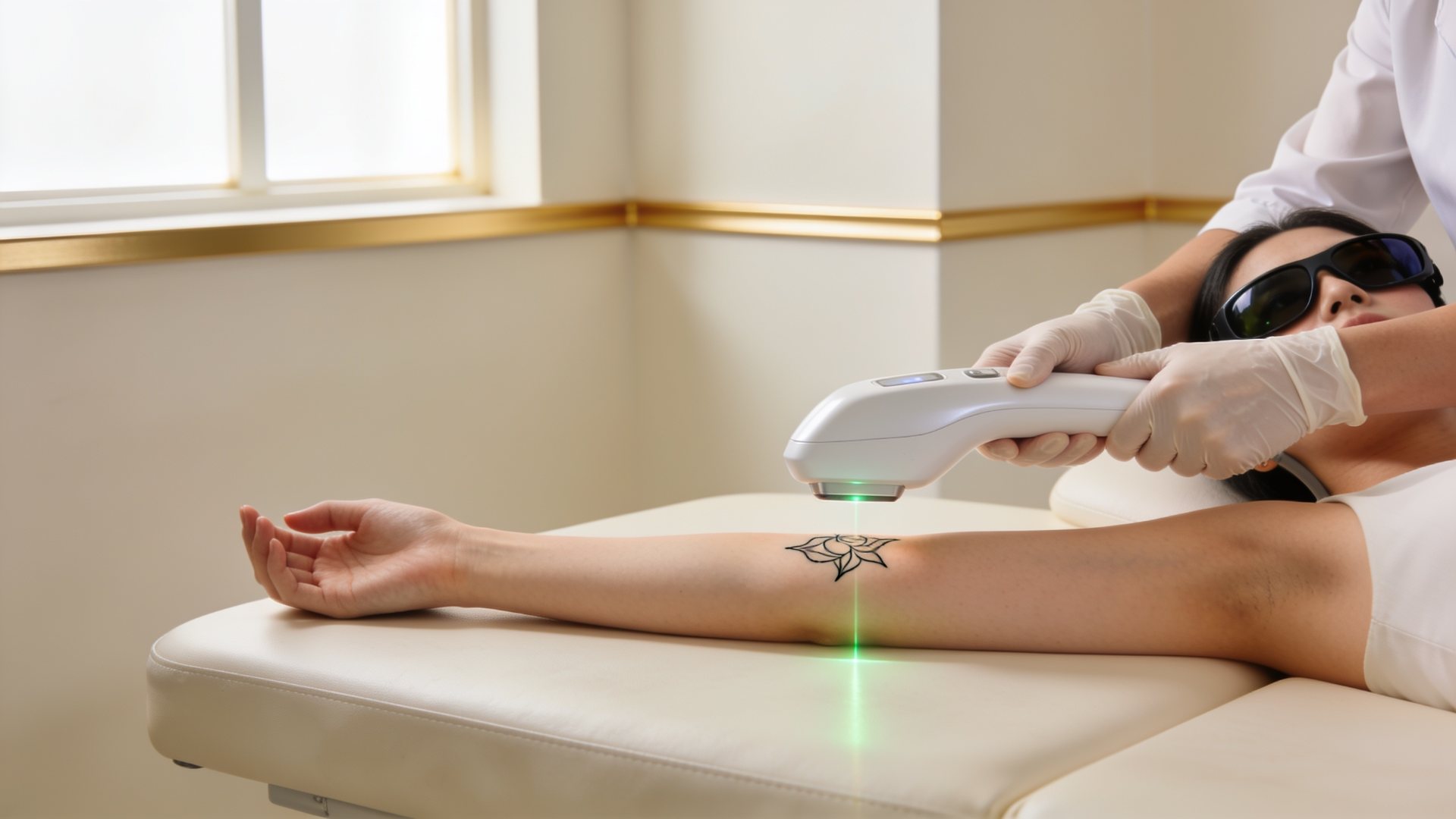
Laser Tattoo Removal in Singapore: T2 Pico & Q-Switched Laser
T2 (Targeted Tattoo) is IN Eternity Clinic’s tattoo removal protocol on the DEKA TORO: 1064, 532 and 785 nm matched colour by colour, assessed and planned by Dr Sin Yong.
Laser tattoo removal in Singapore takes several sessions spaced weeks apart; the number depends on ink colour, depth and the age of the tattoo.
WhatsApp to Enquire →Key facts ↓Tattoo removal at IN Eternity Clinic in Singapore uses T2 (Targeted Tattoo), the clinic’s multi-wavelength protocol on the DEKA TORO, matching 1064, 532 or 785 nm to each ink colour. Very short pulses break ink into fragments that the body clears between sessions, usually six to eight weeks apart. Fading is gradual, the number of sessions varies, and complete clearance is not always possible. If a tattoo has gone wrong, such as a blowout, a mistake or a cover-up that shows through, see tattoo gone wrong: removal and correction.
- What T2 is: IN Eternity Clinic’s name for its multi-wavelength tattoo removal protocol on the DEKA TORO laser; it is a way of planning treatment, not a separate machine.
- Colour by colour: 1064 nm for black and dark blue, 532 nm for red, and 785 nm picosecond for blue, green and purple, in the same session when a tattoo has several colours.
- A course, not one visit: sessions are usually six to eight weeks apart; the likely number is estimated from six Kirby-Desai factors and revised at each review.
- Some inks need a test spot: white, flesh, pink and cosmetic inks (brows, eyeliner, lips) can turn darker when hit by a laser.
- Asian skin: settings are kept conservative and sun protection matters, because temporary light or dark patches can follow.
- Who: every tattoo is assessed and the plan set by Dr Sin Yong, Medical Director, at 9 Scotts Road, Orchard.
Tattoo removal at a glance
| Question | Tattoo removal |
|---|---|
| What it is | Laser tattoo removal with T2 (Targeted Tattoo), IN Eternity Clinic’s multi-wavelength protocol on the DEKA TORO laser. |
| Used for | Black, dark blue, red, blue, green and purple inks; cosmetic tattoos on brows, eyeliner and lips after a test spot. |
| How it works | Very short pulses at 1064, 532 or 785 nm, chosen per ink colour, break ink into fragments that the body clears between sessions. |
| Typical sessions | A course, usually six to eight weeks apart; the likely number is estimated from the Kirby-Desai factors and revised at each review. |
| Downtime | Redness, swelling and sometimes blistering or crusting that settle over about one to two weeks; the area is kept clean and out of the sun. |
| When results show | Fading is gradual across the course; complete clearance is not always possible. |
| Who should avoid or wait | Pregnancy, a recent tan, active skin infection in the area or a tendency to keloid scars; these are reviewed at assessment. |
| Who performs it | Dr Sin Yong, who assesses every tattoo and sets the plan. |

What is T2 laser tattoo removal?
T2, short for Targeted Tattoo, is IN Eternity Clinic’s name for how it removes tattoos on the DEKA TORO: each ink colour is treated with the wavelength it absorbs, colour by colour.
DEKA describes the TORO as a Q-switched Nd:YAG platform with three wavelengths: 785 nm delivered as picosecond pulses, and 532 nm and 1064 nm delivered as nanosecond pulses, plus a longer thermal mode that is not used for ink. DEKA lists square handpieces in six sizes from 2 to 7 mm for tattoos, which spread energy evenly across each spot (DEKA). Full specifications are on the DEKA TORO device page.
The name is the clinic’s own. It is not a brand of laser and not a promise of fewer sessions; it describes a plan in which wavelength, pulse and spot are chosen per colour and per skin type, then revised at each review. It is separate from T2 Frax Radiance (Tighten and Tone), the clinic’s pigment-and-collagen protocol on the same laser. Where a picosecond pulse at 1064 nm suits dense black ink, the clinic’s Fotona StarWalker PQX can be used alongside.
Which laser wavelength removes which tattoo colour?
Each ink colour absorbs light most strongly at particular wavelengths, so T2 matches the wavelength to the colour rather than using one setting for the whole tattoo.
On the TORO, 1064 nm is the wavelength used for black ink and 532 nm for red; 785 nm picosecond pulses reach the blues, greens and purples that respond less well to either (Bernstein 2021; Bernstein 2018). A multicoloured tattoo is, in effect, several treatments in one sitting: each colour is passed with its own wavelength.
| Ink colour | T2 wavelength on the DEKA TORO | How it tends to respond | Source |
|---|---|---|---|
| Black, grey | 1064 nm, nanosecond (Q-switched) | Usually the most responsive colour; amateur black work often fades sooner than dense professional work | Bernstein 2021 |
| Dark blue, blue-black | 1064 nm; 785 nm picosecond if it lags | Often fades alongside black; blue and black tattoos were treated at 1064 nm in a 130-patient review | Chen 2026; Bernstein 2018 |
| Red | 532 nm, nanosecond (Q-switched) | Often responds; itching or raised areas in red ink are asked about first, because a reaction can flare as fragments are released | Bernstein 2021 |
| Orange, yellow | 532 nm, then judged at review | Variable; yellow is often resistant to Q-switched 532 nm and may lighten only partly | Bernstein 2021 |
| Blue, green, purple, turquoise | 785 nm, picosecond | In a study of a 785 nm picosecond laser, purple, blue and green cleared most, while red and yellow responded poorly | Bernstein 2018 |
| White, flesh, pink, some browns | Test spot first; wavelength by what the test shows | Can turn darker immediately; some of these inks contain iron oxide, which blackened when tested | Anderson 1993; Kirby 2010 |
| Cosmetic brows, eyeliner, lip liner | Test spot first | Cosmetic pigments may darken; treated cautiously and away from the eye | Anderson 1993 |
| Multicoloured designs | Two or three wavelengths in one session | Colours fade at different rates, so the mix of wavelengths changes as the course goes on | Bernstein 2018; 2021 |
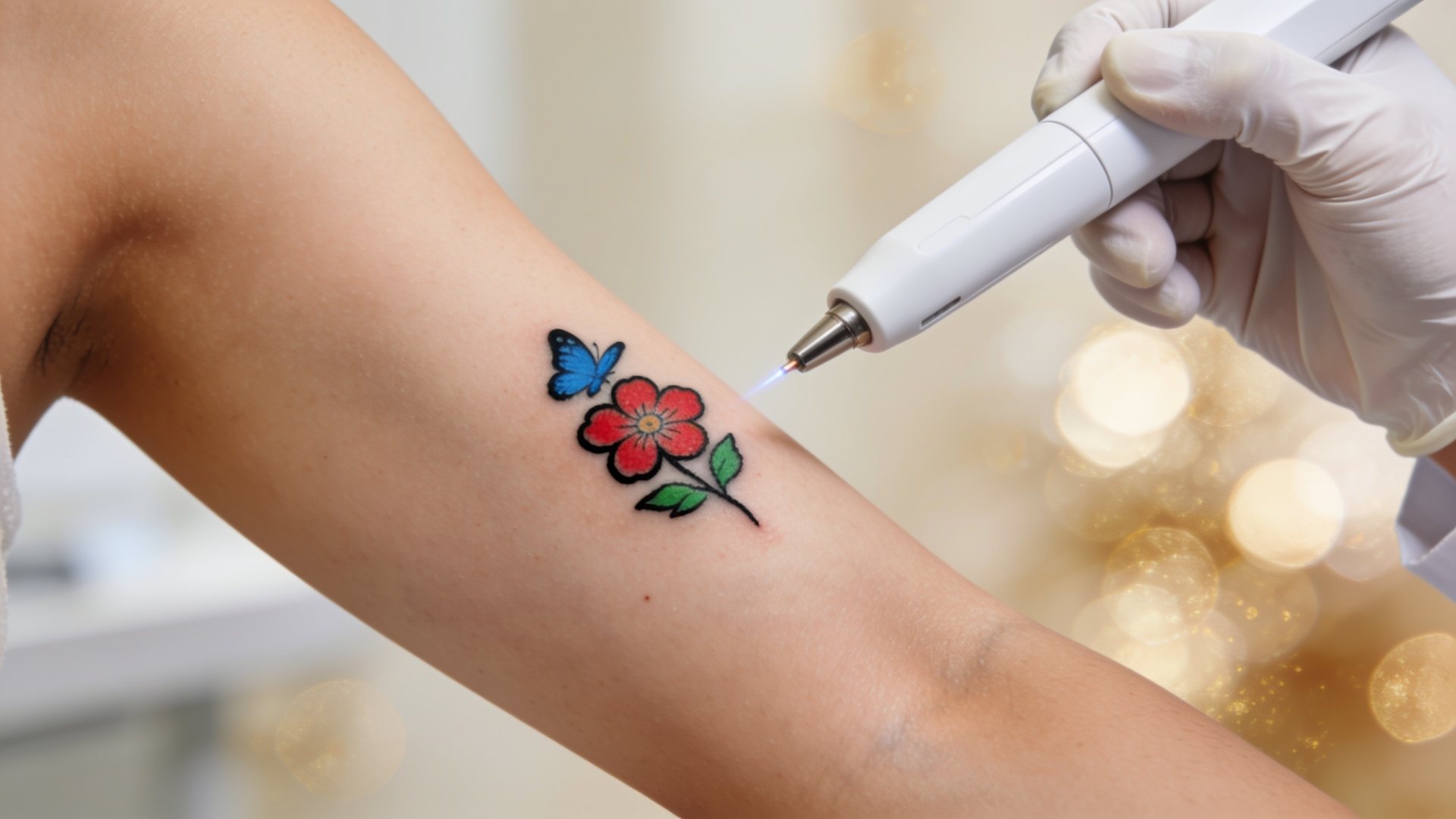
More wavelengths do not remove a tattoo faster on their own. What they allow is matching: a green or blue ink that lags at 1064 nm has another option at 785 nm, and a red-and-black design can be treated in one appointment. Shorter wavelengths are also absorbed by the skin’s own melanin, which is why they are used more cautiously on darker skin. A colour-by-colour guide is in colour tattoo removal.
How does laser tattoo removal work?
A laser pulse is absorbed by ink particles and breaks them into fragments small enough for the body’s immune cells to carry away over the following weeks.
Tattoo ink stays because its particles are too large for the cells that engulf them to break down. A pulse lasting nanoseconds or picoseconds heats each particle faster than it can release that heat, so it cracks. The white frosting seen straight after a pass is gas released in the skin as ink is hit; it fades within about 20 minutes and is not a burn. The visible fading happens later, between sessions, which is why treating more often does not speed the result.
Laser is the usual method because it leaves the skin surface intact. Cutting a small tattoo out leaves a linear scar, and sanding, salt rubbing or removal creams cannot reach ink in the dermis without injuring the skin above it.
What happens during a T2 tattoo removal session?
A session starts with assessment and photographs, then colour-by-colour laser passes with eye protection and cooling; a small tattoo may take only a few minutes. How size changes session length, sections and healing is explained in small vs large tattoo removal.
- Assessment with Dr Sin Yong. every colour, the density and age of the ink, the location, your skin type, any itching or swelling in the tattoo and your goal (full removal or fading) are recorded, and an estimated range of sessions is given.
- Photographs and, where needed, a test spot. standard photographs are taken in fixed light. White, flesh, pink and cosmetic inks are tested on a small area and reviewed weeks later before the rest is treated.
- Numbing and protection. numbing cream can be applied beforehand for larger or more sensitive tattoos; protective eyewear is worn by everyone in the room.
- Colour-by-colour passes. black and dark blue are treated at 1064 nm, red at 532 nm, and blue, green or purple with 785 nm picosecond pulses, using the square spot that fits the design. The ink whitens as it is hit.
- Cooling and dressing. cold air or compresses settle the heat, then an ointment and a dressing are applied.
- Home care and review. written aftercare follows; the next session is usually six to eight weeks later, once healing and fading have been reviewed.
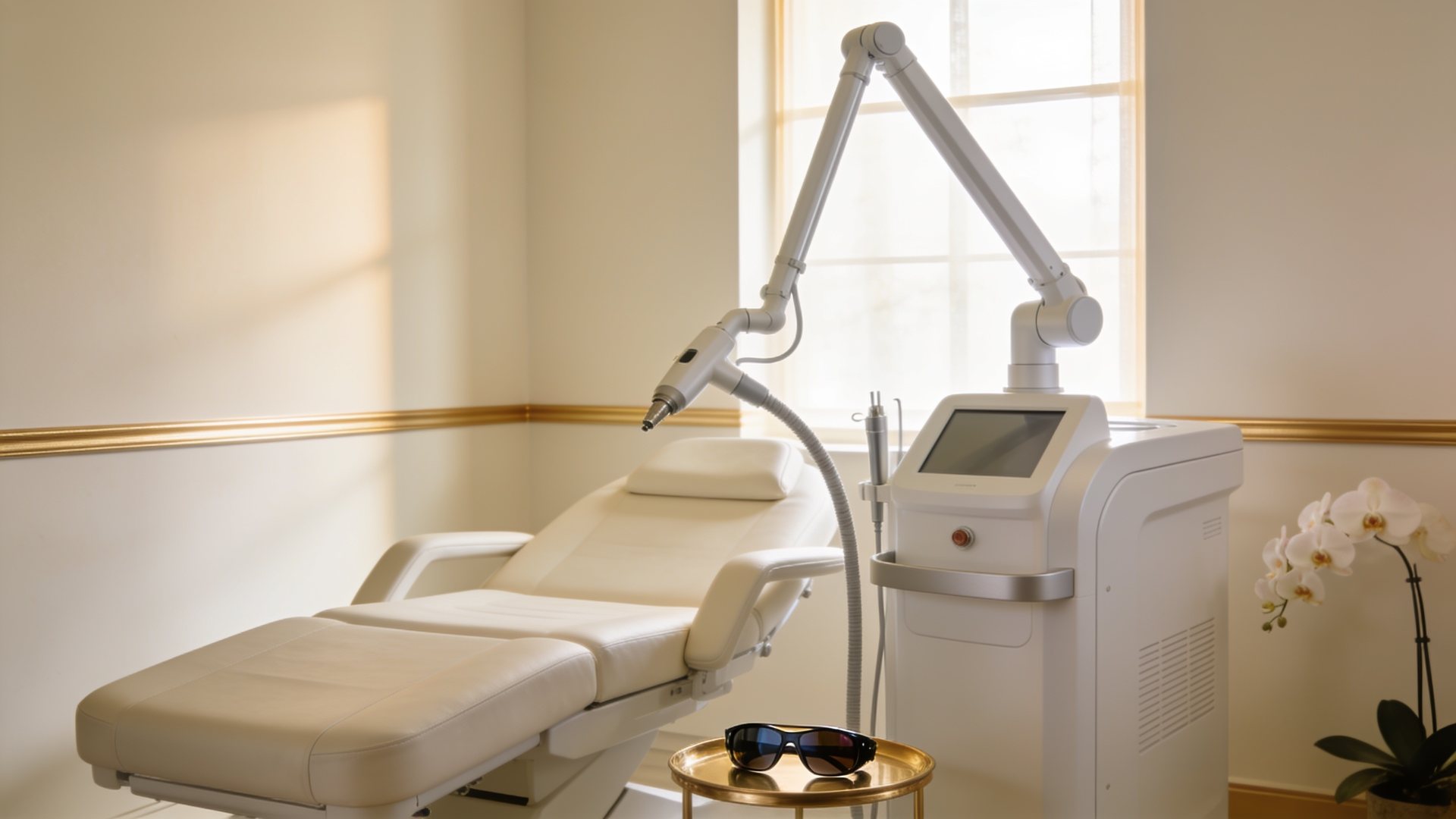
Settings can be lowered during the session if the skin reacts strongly, and a session can be stopped part-way; the plan is built around the skin, not a fixed number of passes.
How many tattoo removal sessions will you need?
There is no honest single number: it depends mainly on skin type, location, colours, amount of ink, scarring and layering, and is estimated at assessment.
Those six factors make up the Kirby-Desai scale. In the 100 patients it was first tested on, the total score correlated with the number of sessions needed (r = 0.757) (Kirby 2009). Dr Sin Yong uses the same factors to give a range, then narrows it after the first one or two sessions, when the way your ink fades can be seen.
| Kirby-Desai factor | Fewer sessions | More sessions |
|---|---|---|
| Skin type | Fair skin | Darker skin, treated more gently |
| Location | Head and neck | Hands, feet and lower legs, further from the heart |
| Colour | Black only | Several colours |
| Amount of ink | Amateur, sparse | Dense professional work |
| Scarring or tissue change | None | Marked |
| Layering | None | A cover-up over an older tattoo |
Two more things change the count. The goal matters: fading for a cover-up usually needs fewer sessions than full removal. Spacing matters too: sessions are usually six to eight weeks apart, so even a short course runs for months. More on planning a course is in how many tattoo removal sessions.
Picosecond or Q-switched: which is used for tattoo removal?
Both are: T2 uses picosecond pulses at 785 nm and Q-switched nanosecond pulses at 1064 and 532 nm, chosen by colour rather than by which pulse is newer.
Picosecond pulses are about a thousand times shorter than nanosecond pulses and can break ink into finer fragments with less heat spreading into the skin. A systematic review of 77 studies rated the evidence for picosecond tattoo removal at level I (Wu 2021). In a 2026 review of 130 patients treated at 1064 nm, the picosecond group needed a median of 3 sessions and the Q-switched group 4 at three-month follow-up, while overall effectiveness did not differ significantly (Chen 2026).
Those are group figures from one hospital, mostly for black and blue ink, not a prediction for your tattoo. Q-switched pulses remain useful, and the colour, depth and age of the ink still decide the course. The trade-offs are set out in pico vs Q-switched tattoo removal.
Head-to-head trials agree more on comfort and skin safety than on speed:
| Study | What was compared | What it found |
|---|---|---|
| Pinto 2017, randomised trial (Pinto 2017) | Picosecond vs Q-switched 1064 nm on black tattoos, two sessions | No difference in clearance; picosecond was less painful (3.8 vs 7.9 out of 10) |
| Lorgeou 2018, randomised, 49 patients (Lorgeou 2018) | Two picosecond lasers vs a nanosecond laser | Fading of 75% or more in 33% of picosecond-treated tattoos vs 14% with nanosecond |
| Ma 2026, randomised split-tattoo trial (Ma 2026) | Picosecond vs nanosecond 755 nm on the same tattoo | Satisfactory clearance in 73% vs 23%, with fewer blisters and crusts on the picosecond side |
| Wu 2025, meta-analysis (Wu 2025) | Picosecond vs nanosecond across published studies | Similar clearance overall; fewer lighter or darker patches with picosecond, shown most clearly in Asian patients |
For Asian skin, a lower rate of pigment change matters as much as speed, which is one reason the pulse and wavelength are chosen per colour and per skin type, then reviewed at every session.
Does laser tattoo removal hurt?
Most people describe quick rubber-band snaps with heat; it is uncomfortable rather than unbearable, and numbing cream and cooling make it easier.
Dense black ink and tattoos over bone or thin skin, such as the ankle, ribs and wrist, tend to feel the most. Numbing cream can be applied beforehand, cold air cooling runs during treatment, and sessions are short. The area then stings like sunburn for a few hours. Later sessions are often easier, because there is less ink left to absorb the energy.
Tattoo removal aftercare, day by day
Keep the area clean, covered as advised and out of the sun, leave blisters and scabs alone, and avoid soaking it until it has healed.
| When | What is usual | What to do |
|---|---|---|
| Day 0 | Whitening fades in about 20 minutes; redness, swelling, possible pinpoint bleeding | Keep the dressing on as advised; cold compress for heat |
| Days 1–3 | Blisters can form on denser ink; this is expected | Leave blisters intact; wash gently, apply the ointment given; no pools, sea, sauna or soaking |
| Days 4–7 | Light scabs and itching | Let scabs fall off; avoid tight clothing and heavy sweating over the area; keep it out of the sun |
| Weeks 2–4 | Skin heals; ink fragments are cleared gradually | Sunscreen once healed; tell the clinic about any lasting itch or raised areas |
| Weeks 6–8 | Fading continues between sessions | Review with photographs before the next session |
Singapore’s heat and humidity make sweat and friction the usual problems: loose clothing over the area and a break from hard exercise for a few days help. Most texture or colour change after tattoo removal follows broken blisters, picking or sun on healing skin rather than the laser itself. A fuller guide is in tattoo removal aftercare. Sensation by body area and every comfort option are covered in is tattoo removal painful.
What are the risks of laser tattoo removal?
Redness, swelling, blisters and scabs are expected; the less common risks are pigment change, ink darkening, allergic reactions and, rarely, scarring.
- Blistering and crusting in the first week, more likely on dense ink; usually settles with aftercare.
- Lighter or darker skin where the tattoo was, more likely in darker skin; usually temporary but can last months.
- Ink darkening of white, flesh, pink and cosmetic inks, which can be immediate and irreversible; in a report of five cases, two needed surgical excision (Anderson 1993). This is why a test spot comes first.
- Allergic reaction as ink fragments are released, uncommon and mainly in people already sensitised to a colour.
- Texture change or scarring, uncommon, and most often after infection, picked blisters or sessions too close together.
Call the clinic if redness spreads, pain increases after the first days, or there is pus or fever. How scarring risk is lowered is explained in tattoo removal scarring.
Who should not have tattoo removal, or should wait?
Treatment waits during pregnancy and breastfeeding, over a fresh tan or sunburn, and where the skin is infected or inflamed; some histories need extra caution.
- Pregnancy and breastfeeding: elective removal is deferred; see pregnancy and breastfeeding safety.
- A tan or sunburn on the tattoo in the past few weeks: treatment waits or is more cautious.
- Active infection, eczema or cold sores in the area: settled first.
- A history of keloids or thick scars: mentioned beforehand, because it changes the plan.
- Recent acne tablets, blood-thinning medicines or a history of ink allergy: tell the doctor; do not stop prescribed medicines without advice.
- A changing or irregular spot inside the tattoo: examined first, not lasered.
Is tattoo removal safe for Asian and darker skin?
It can be done with care: settings are more conservative, intervals may be longer and sun protection matters, because darker skin reacts to heat with pigment change.
Melanin in the skin absorbs laser light too, and absorbs shorter wavelengths more strongly. The authors of a 730 nm picosecond study note that strong melanin absorption makes such wavelengths less suited to very dark skin (Bernstein 2021), so on darker skin 532 nm and 785 nm are used cautiously, often after a test spot, while 1064 nm passes the surface with less absorption. Skin type is one of the six Kirby-Desai factors, so a darker skin type usually means a longer, gentler course (Kirby 2009).
A faded outline can also stay more visible on Asian skin, because the skin around it may lighten or darken as it heals (HealthXchange). Strict sun avoidance around each session, and reporting any darkening early, lower that risk. The types of pigment that behave this way are covered in pigmentation types in Asian skin.
Can eyebrow, eyeliner and lip tattoos be removed?
Often, but cautiously: cosmetic pigments can darken when hit by a laser, so a small test spot is treated and reviewed before the rest.
Brow embroidery, eyeliner and lip liner pigments often contain iron oxide; in reported cases, white, flesh and pink-red cosmetic inks turned darker on the first pulse (Anderson 1993), and darkened pink ink has also been cleared with continued treatment (Kirby 2010). Eyeliner sits next to the eye, so it is approached with particular care, and some cases are better left or referred. The details for brows are on eyebrow tattoo removal in Singapore.
If the aim is new brow or lip work afterwards, it can be planned in the same clinic; see eyebrow embroidery and lip blush.
How much does tattoo removal cost in Singapore?
Cost depends on the size of the tattoo, how many colours and therefore wavelengths it needs, and how many sessions, so it is given after assessment.
- Size sets the time and energy per session.
- Colours: a black-only tattoo uses one wavelength; a multicoloured one may need two or three per session and more sessions.
- Ink density, layering and location change the likely number of sessions.
- Cosmetic or pale inks add a test-spot visit before the course.
- The goal: fading for a cover-up usually costs less than full removal.
Each factor is explained in our guide to tattoo removal cost in Singapore. At IN Eternity Clinic a consultation fee applies, and it is waived if you go ahead with any medical treatment; the fee is S$120. See fees.
What Dr Sin Yong looks for
- Every ink colour, and which wavelength each one needs: 1064, 532 or 785 nm.
- White, flesh, pink or cosmetic inks that could darken and need a test spot.
- How dense the ink is, whether it is professional or amateur work, and whether there is a cover-up.
- Your skin type and recent sun exposure, which set the energy and spacing.
- Raised, itchy or scarred areas within the tattoo, including signs of an ink allergy.
- What you want: full removal, part of a design, or fading for a new tattoo.
General clinical observations used at consultation; they describe what is checked, not any individual result.
“T2 is not about firing more wavelengths. It is about giving each colour the one it absorbs, and stopping when the skin, not the schedule, says so.”
- Wavelength by colour: a 785 nm picosecond laser cleared purple, blue and green inks most in 15 subjects over four treatments, while red and yellow responded poorly (Source: Bernstein 2018).
- Black and red: 1064 nm is the wavelength used for black ink and 532 nm for red; yellow is often resistant to Q-switched 532 nm (Source: Bernstein 2021).
- Estimating sessions: the Kirby-Desai scale scores skin type, location, colour, amount of ink, scarring and layering; in 100 patients the total correlated with sessions needed (r = 0.757) (Source: Kirby 2009).
- Pico vs Q-switched: in a 2026 review of 130 patients treated at 1064 nm, the picosecond group needed a median of 3 sessions and the Q-switched group 4 at three months; overall effectiveness did not differ significantly (Source: Chen 2026).
- Cosmetic ink darkening: five cases of immediate, irreversible darkening of white, flesh and pink-red cosmetic tattoos were reported after short-pulse lasers; two needed surgical excision (Source: Anderson 1993).
- Evidence base: a systematic review of 77 studies rated the evidence for picosecond tattoo removal at level I (Source: Wu 2021).
- In a study of a picosecond laser on 21 multicoloured tattoos, blinded raters measured clearance of 85% for purple, 81% blue, 74% green and 61% black ink, but only 11% for red and 5% for yellow, with no scarring (Lasers Surg Med 2018)
- A second picosecond study found 70% clearance for black, 77–83% for green, blue and purple, and 26% and 8% for red and yellow; side effects were limited to pinpoint bleeding, redness and crusting for up to two weeks (Lasers Surg Med 2021)
- The Kirby-Desai scale, which scores skin type, location, colour, amount of ink, scarring and layering, correlated with the number of sessions needed (r = 0.757) in 100 people, which is why session estimates are given at assessment (J Clin Aesthet Dermatol 2009)
Suitability is decided at an in-person assessment with Dr Sin Yong. Treatment is usually deferred or an alternative is suggested in these situations:
- A recent tan on the area
- A tendency to keloid scars
- Pregnancy
- Immune suppression, which slows pigment clearance
Why sessions vary, pregnancy and skin colour changes
Why do some tattoos need more sessions than others?
The number depends on ink colour, ink depth and amount, the age of the tattoo, where it is on the body and your skin type. Professional tattoos with dense, layered ink and colours such as green and blue need more sessions than older amateur tattoos. Tattoos on the hands and feet clear more slowly.
Can I have tattoo removal while pregnant?
Tattoo removal is postponed during pregnancy and breastfeeding. Laser breaks ink into particles that the body clears, and there is not enough safety data in pregnancy. Treatment can start after breastfeeding has finished.
Can tattoo removal change my skin colour?
Yes. The treated skin can become temporarily darker or lighter, especially in darker skin or after sun exposure. Most changes fade over months. Strict sun protection, adequate spacing between sessions and settings matched to the skin type lower the risk. Results vary.
Tattoo removal in Singapore: frequently asked questions
Is removing a tattoo painful?
Laser tattoo removal stings, often described as being flicked with a rubber band. Numbing cream and cooling keep it tolerable, and each session is short, often a few minutes for a small tattoo. Afterwards the area may feel like sunburn for a day or two, and any blistering usually heals within one to two weeks.
Is it possible to 100% remove a tattoo?
Many tattoos can be faded until they are hard to see, but complete removal cannot be guaranteed. Black ink responds well; some colours, such as green, light blue and yellow, are harder to clear. Professional tattoos usually need more sessions than amateur ones. Faint ghosting or a change in skin texture may remain. Results vary.
Is it worth getting a tattoo removed?
It is worth it when the tattoo bothers you enough to commit to a course of sessions. Most tattoos need several laser sessions spaced weeks apart, some colours fade slowly, and full clearance cannot be promised. At the assessment Dr Sin Yong looks at the ink, the colours, the age of the tattoo and your skin type, and tells you honestly whether removal or fading for a cover-up is the realistic goal. Results vary.
What are the disadvantages of tattoo removal?
It takes several sessions spaced six to eight weeks apart, so a course runs for months. Each session stings, and the area can blister, crust or swell for a few days. Lighter or darker patches can follow, more often in darker skin, and some colours such as green, light blue or yellow may not clear fully. Scarring is uncommon with careful settings. Results vary.
Can a tattoo be removed completely?
Many tattoos fade until they are hard to see, but complete removal is not always possible. Dense professional work, some colours such as yellow and light blue, and some cosmetic inks may leave a faint outline or a colour change. How far your tattoo is likely to fade is discussed at assessment.
How many sessions does tattoo removal take?
Most tattoos need several sessions, often six to ten or more, spaced six to eight weeks apart. Black ink fades fastest; colours, older or professional tattoos and those far from the heart take longer. See tattoo removal sessions.
How much does tattoo removal cost in Singapore?
It depends on the size of the tattoo, how many colours and wavelengths it needs and how many sessions it is likely to take, so IN Eternity Clinic gives an estimate after assessing it. A multicoloured tattoo may need two or three wavelengths per session. The cost guide explains each factor, and the consultation fee is listed on the fees page.
Can you remove a 20-year-old tattoo?
Yes. Older tattoos often fade faster than new ones, because some ink has already broken down and been cleared over the years. The number of sessions still depends on ink colour, depth and density, and where the tattoo is. A test patch helps estimate how it will respond.
Does laser tattoo removal hurt?
It feels like quick rubber-band snaps with heat, strongest over bone and on dense black ink. Numbing cream can be applied beforehand, cold air cooling is used during treatment, and sessions are short. The area stings like sunburn for a few hours afterwards.
Does laser tattoo removal leave scars?
Rarely, when done with picosecond or Q-switched lasers at correct settings and with good aftercare; the main risks are temporary lightening or darkening of the skin.
Which tattoo colours are hardest to remove?
Yellow, light blue, turquoise and some greens tend to be the slowest, and white, flesh, pink and cosmetic inks can darken. Black usually responds most readily. Having 1064, 532 and 785 nm available lets each colour be matched, but some may still fade only partly.
Is pico laser better than Q-switched for tattoo removal?
Neither is better for every tattoo. Picosecond pulses can break ink into finer fragments, and one 2026 review found a median of 3 sessions with picosecond against 4 with Q-switched at 1064 nm, with similar overall effectiveness. T2 uses both, chosen by colour.
How long should I wait between tattoo removal sessions?
Usually six to eight weeks, sometimes longer. Most fading happens between sessions as immune cells carry ink away, and the skin needs to heal fully, so shorter gaps do not speed the result and can raise the risk of skin changes.
Can laser fade a tattoo for a cover-up?
Yes. Fading an old tattoo so a new design can cover it usually needs fewer sessions than full removal, because the aim is to lighten the ink rather than clear it. The tattoo artist's needs and your skin type are discussed at assessment, and the number of sessions is reviewed as the ink responds.
Do tattoo removal creams or salt rubbing work?
Not safely. Tattoo ink sits in the dermis, below the surface, and creams, sanding or salt rubbing cannot reach it without injuring the skin above, which risks scarring. Cutting a small tattoo out leaves a linear scar. Laser is the usual method because it breaks up the ink while leaving the skin surface intact.
Can I use MediSave for tattoo removal in Singapore?
Generally, no. MediSave is limited to approved medical treatments under Ministry of Health rules, and cosmetic procedures such as tattoo removal are generally excluded. If you think your case is medical, ask before treatment; see the MediSave and insurance FAQ.
Book an assessment
IN Eternity Clinic, 9 Scotts Road, #12-01 Pacific Plaza, Singapore. By appointment with Medical Director Dr Sin Yong. WhatsApp or call +65 8815 3008.
International KOL — CLASSYS · HIRONIC · DEKA · ALMA · FOTONA · LUTRONIC
References
- DEKA. TORO, product page (dekalaser.com). Read 28 October 2026. dekalaser.com
- Bernstein EF, Bhawalkar JD, Schomacker KT. A novel titanium sapphire picosecond-domain laser safely and effectively removes purple, blue, and green tattoo inks. Lasers Surg Med 2018;50(7):704-710. doi:10.1002/lsm.22942
- Bernstein EF, Schomacker KT, Shang X, Alessa D, Algzlan H, Paranjape A. The first commercial 730 nm picosecond-domain laser is safe and effective for treating multicolor tattoos. Lasers Surg Med 2021;53(1):89-94 (online 2020). doi:10.1002/lsm.23237
- Chen J, Liu Y, Gong Y, Ma S, Liang B, Zhu H. Q-switched 1064-nm laser versus picosecond 1064-nm laser in tattoo removal. J Cosmet Dermatol 2026;25(8). doi:10.1111/jocd.71098
- Kirby W, Desai A, Desai T, Kartono F, Patel G. The Kirby-Desai scale: a proposed scale to assess tattoo-removal treatments. J Clin Aesthet Dermatol 2009;2(3):32-37. PMC2923953
- Wu DC, Goldman MP, Wat H, Chan HHL. A systematic review of picosecond laser in dermatology: evidence and recommendations. Lasers Surg Med 2021;53(1):9-49 (online 2020). doi:10.1002/lsm.23244
- Anderson RR, Geronemus R, Kilmer SL, Farinelli W, Fitzpatrick RE. Cosmetic tattoo ink darkening: a complication of Q-switched and other short-pulse laser treatment. Arch Dermatol 1993;129(8):1010-1014. doi:10.1001/archderm.1993.01680290082012
- Kirby W, Kaur RR, Desai A. Paradoxical darkening and removal of pink tattoo ink. J Cosmet Dermatol 2010;9(2):149-151. doi:10.1111/j.1473-2165.2010.00493.x
- Kent KM, Graber EM. Laser tattoo removal: a review. Dermatol Surg 2012;38(1):1-13. doi:10.1111/j.1524-4725.2011.02187.x
- Kasai K. Picosecond laser treatment for tattoos and benign cutaneous pigmented lesions (secondary publication). Laser Ther 2017;26(4):274-281. doi:10.5978/islsm.17-RE-02
- SingHealth HealthXchange. The truth about tattoo removal. healthxchange.sg
- Singapore Medical Council. Guidelines on Aesthetic Practices for Doctors (2016 edition). healthprofessionals.gov.sg/smc
- Health Sciences Authority, Singapore. Infosearch — registered medical devices and health products. hsa.gov.sg
- Pinto F, Große-Büning S, Karsai S, et al. Neodymium-doped yttrium aluminium garnet (Nd:YAG) 1064-nm picosecond laser vs. Nd:YAG 1064-nm nanosecond laser in tattoo removal: a randomized controlled single-blind clinical trial. Br J Dermatol 2017. PubMed 27518129
- Lorgeou A, Perrillat Y, Gral N, et al. Comparison of two picosecond lasers to a nanosecond laser for treating tattoos: a prospective randomized study on 49 patients. J Eur Acad Dermatol Venereol 2018. PubMed 28758261
- Ma G, et al. 755-nm picosecond vs. nanosecond alexandrite lasers for tattoo removal: a randomized, split-tattoo clinical trial. Plast Reconstr Surg 2026. PubMed 41729109
- Wu W, et al. Comparative appraisal with meta-analysis of picosecond versus nanosecond lasers for hyperpigmented disorders and tattoos. Lasers Med Sci 2025. PubMed 41184656
These sources describe mechanisms and general evidence. They are not a promise of any individual result; suitability is decided at an in-person assessment.