Skip to content
Time Freeze Laser Lift · Skin Tightening Treatment Singapore · Dual Wavelength LCLR® · Face & Body · Dr Sin Yong

Time Freeze Laser LCLR®

Laser Collagen Lipo Remodelling

Time Freeze Laser LCLR® is a laser protocol for a non-surgical facelift in Singapore: dual-wavelength laser energy that tightens sagging skin along the jowls and jawline, usually with little downtime. An LCLR Bodylift version is used for the body. Planned and directed by Medical Director Dr Sin Yong.

Minimal
Downtime
2–3 Months
Collagen Build
LCLR®
Protocol
45 min
Per Session
Reviewed by Dr Sin Yong, Medical Director, IN Eternity Clinic · Last reviewed

Consultations in English and Mandarin (面诊可使用英语或华语). This page is also available in: 中文.

Assessed and planned by Dr Sin Yong, Medical Director · MBBS (NUS) · MRCS (Edinburgh) · MSc Aesthetic Medicine (London) · MSc Practical Dermatology (Cardiff) · Professional Diploma in Obstetrics & Gynaecology (RCPI) · Designated DEKA Centre of Excellence
In short

Time Freeze Laser LCLR® (Laser Collagen Lipo Remodelling) is a dual-wavelength laser protocol used at IN Eternity Clinic for three things. First, lifting: the jowls and jawline, nasolabial folds, mid-face, brow and eyelids, under-eye, neck and double chin, with energy placed at several skin depths in one session. Second, correction: where excess filler or a collagen stimulator such as Sculptra or Ellansé cannot be dissolved, the area is mapped by ultrasound and in selected cases the excess is reduced in the same session. Third, lipo-modelling: loose superficial fat in sagging zones is reduced while the overlying skin is tightened, an alternative to micro-liposuction for small zones without surgery. Results build over 4–8 weeks and vary between people; suitability is decided at an in-person assessment by Dr Sin Yong. Related: fat grafting correction. All IN Eternity protocol names explained. See also our guide to laser resurfacing in Singapore. See also our guide to R2 glow.

Reviewed by Dr Sin Yong, Medical Director, IN Eternity Clinic · Updated

中文介绍:Time Freeze Laser LCLR® 激光胶原塑形

“I use the same laser for three jobs: to lift every zone of the face and neck, to reduce filler that cannot be dissolved once I have mapped it, and to thin loose fat in a sagging zone while tightening the skin over it. Which job a zone needs is decided at the assessment, not before.”
Dr Sin Yong, Medical Director
Before & after
Want to see Time Freeze before and after?

Treatment photos are not published on this website in line with Singapore’s guidelines for medical clinics. Tap the button and our clinic will send you the one-page Time Freeze before-and-after PDF privately on WhatsApp.

I want to see the Time Freeze before and after →
Opens WhatsApp to +65 8023 7170 with the message ready to send.
At a glance

Time Freeze Laser LCLR® at a glance

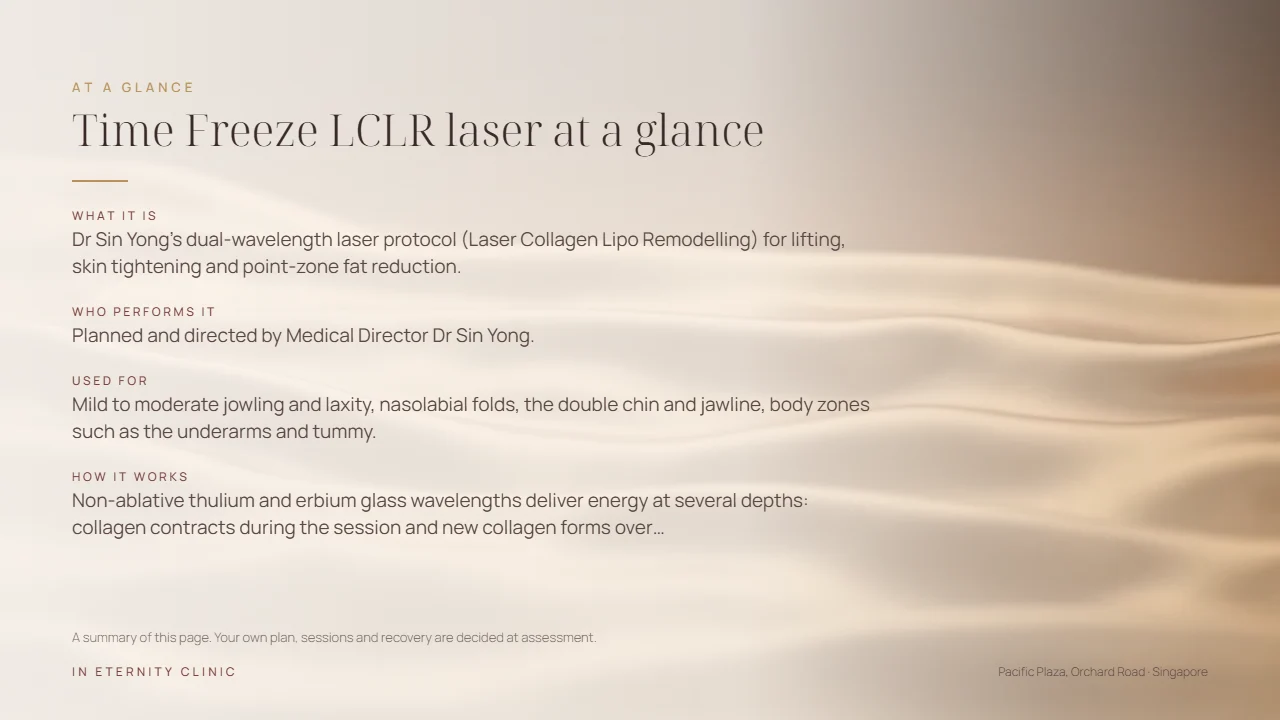
Time Freeze Laser LCLR® at a glance: a summary of this page. Your own plan, sessions and recovery are decided at assessment.
Time Freeze Laser LCLR® at IN Eternity Clinic
What it isDr Sin Yong’s dual-wavelength laser protocol (Laser Collagen Lipo Remodelling) for lifting, skin tightening and point-zone fat reduction, with no injections for the lift.
Used forMild to moderate jowling and laxity, nasolabial folds, the double chin and jawline, body zones such as the underarms and tummy, and excess after Sculptra or Ellansé.
How it worksNon-ablative thulium and erbium glass wavelengths deliver energy at several depths: collagen contracts during the session and new collagen forms over the following weeks.
Typical sessionsA spaced course, with the number of sessions set at assessment and reviewed as you respond.
DowntimeMild redness for one to two hours; lipo-modelling zones can feel warm or tender for a few days.
When results showSome tightening is often felt on the day; the main change builds over four to eight weeks as collagen forms, and continues over about three months.
Who should avoid or waitAdvanced laxity with a lot of excess skin, where surgery would do more; recent tanning is a reason to wait.
Who performs itPlanned and directed by Medical Director Dr Sin Yong.

Dr Sin Yong, Medical Director of IN Eternity Clinic, explains that hyaluronidase dissolves only hyaluronic acid filler, so where Sculptra, Ellansé or fat-graft excess is the problem he maps it by ultrasound first and uses Time Freeze laser energy to take the excess away.

Time Freeze LCLR laser at a glance: what it is, who performs it, used for, how it works. Summary graphic from IN Eternity Clinic.
Time Freeze LCLR laser at a glance: a summary of this page. Background artwork made with Higgsfield AI; no patients or devices are shown.
Minimal
Downtime
2–3 Months
Collagen Build
LCLR®
Protocol
45 min
Per Session
About This Treatment

Time Freeze LCLR® — Dual Wavelength Lifting at Multiple Skin Depths

The Time Freeze Laser Lift works at several depths of the skin in one session, with collagen change building over the following weeks to months; how much, and how quickly, varies between people. How it differs from Ultherapy and Thermage is set out below. LCLR® (Laser Collagen Lipo Remodelling) is a dual wavelength laser protocol that simultaneously delivers energy at multiple depths of the skin — combining immediate collagen contraction during the session with progressive collagen neogenesis over 4–8 weeks. The dual wavelength approach is what enables the strong multi-depth lifting that single-wavelength devices cannot replicate.

Time Freeze is used across two primary categories: facial lifting (sagging jowls, nasolabial folds, droopy eyelids, under-eye region and general skin laxity) and body lifting and contouring (underarms, tummy, breasts, buttocks, thighs, love handles, back and intimate areas — across the full body). When the lifting occurs, it physically improves hollowness in deficient areas by repositioning descended tissue — reducing the need for filler in many patients.

The LCLR component targets skin integrity comprehensively: reducing fine lines, refining pore size, improving skin texture and boosting overall skin integrity. The lipo-modelling phase of LCLR targets superficial fat with precision — reducing point-zone fat deposits in specific zones selected by Dr Sin Yong. These zones mirror the areas conventionally treated by liposuction on the face and body, without surgery and with little downtime.

“Lifting starts below the skin. A cream never reaches the layer that holds the face up.”
Dr Sin Yong, Medical Director · IN Eternity Clinic

LCLR® Protocol Components

01
Collagen Contraction — Dual Wavelength at Multiple Depths
Thermal dual wavelength laser energy contracts existing collagen fibres at multiple skin depths simultaneously during the session — producing visible tightening and lifting before you leave. This multi-depth approach differentiates Time Freeze from single-wavelength devices: energy reaches the superficial dermis, mid-dermis and deep dermis in a single pass, producing a stronger and more uniform lifting response across the full treatment zone.
02
Progressive Collagen Neogenesis & Skin Integrity
The dual wavelength laser stimulus triggers new collagen production over 4–8 weeks — the result continues compounding after the session. Alongside structural collagen neogenesis, the protocol comprehensively improves skin integrity: reducing fine lines, refining pore size, improving skin texture and boosting overall skin quality. Each successive session builds on the previous result, producing progressive skin tightening treatment outcomes that cannot be achieved in a single session.
03
LCLR Lipo-Modelling — Point-Zone Fat Reduction
The lipo-modelling component of LCLR targets specific zones of superficial fat selected by Dr Sin Yong — reducing fat in the targeted area session by session. These zones mirror the areas conventionally treated by liposuction: submental area, jowls, buccal fat regions on the face; and underarms, love handles, tummy, inner thighs and other body zones. The reduction tends to hold while weight is stable. Unlike surgical fat removal, LCLR lipo-modelling needs no anaesthesia, bruising is uncommon and downtime is little — the fat reduction occurs through controlled thermal disruption of adipocytes at the selected point zones.
04
Real-Time Calibration per Zone
Dr Sin Yong calibrates wavelength, fluence and treatment vector in real time based on tissue response in each zone — applying lifting parameters where tissue needs elevation, lipo-modelling parameters where point-zone fat reduction is targeted, and skin quality parameters for fine line and pore refinement. This zone-by-zone personalisation is unavailable from fixed-protocol devices that apply the same energy regardless of the underlying anatomy.
05
Little Downtime — 45 Minutes Per Session
Return to work, social events and all activities immediately. Mild redness for 1–2 hours at most. Each session takes approximately 45 minutes for a full face and neck protocol — longer for body treatment areas. No anaesthesia, no needles for the lifting component, no recovery period.

Face Treatment Zones — Time Freeze LCLR®

Sagging Jowls & Jawline

Time Freeze delivers targeted lifting energy to the jowl zone — contracting collagen and repositioning descended lower face tissue. Change builds progressively over the following three months as collagen remodels, and varies between people.

Nasolabial Folds

Nasolabial fold depth is driven by midface descent, not just volume loss. Time Freeze lifts the midface tissue that creates the fold — reducing fold depth from above rather than filling from below. When lifting is addressed first, less filler is required to treat the remaining fold.

Droopy Eyelids & Brow Ptosis

Periorbital LCLR® delivers precise lifting energy to the upper eyelid and brow zone — producing a visible non-surgical eyelid lift. Thulium and erbium glass wavelengths contract the fine collagen structures of the eyelid skin, aiming to lift the brow and open the upper eyelid region without surgery and with little downtime.

Under-Eye Region

The under-eye zone benefits from dual wavelength energy that tightens the fine skin of the lower eyelid, reduces the skin laxity causing tear trough shadow depth, and improves skin texture in the periorbital area. A delicate zone requiring precise calibration — Dr Sin Yong customises energy parameters specifically for this region.

Skin Quality — Fine Lines, Pores & Texture

Beyond lifting, Time Freeze aims to improve overall facial skin integrity — refining pore size, smoothing fine surface lines and improving skin texture through progressive collagen remodelling. The result is a face that not only appears lifted but is genuinely improved in skin quality from within.

Hollow Improvement

When Time Freeze lifts descended tissue back to its natural position, the hollowness in adjacent areas visibly improves — because descended tissue was previously creating shadow and depth. This positional correction may reduce the amount of filler a patient needs, and in some cases filler may not be needed at all.

Turkey Neck & Loose Neck Skin

Time Freeze LCLR® is a non-surgical treatment option for turkey neck — the loose, crepey, horizontally banded neck skin that develops with age. Dual wavelength energy directly contracts lax neck skin, softens platysmal bands and improves the cervicomental angle. Tightening builds progressively over four to eight weeks as new collagen forms. Often combined with BTX Nefertiti lift for a comprehensive lower face and neck result.

Time Freeze LCLR laser in Singapore: ablative fractional laser vaporises microscopic columns of skin, while non-ablative fractional laser places columns of heat beneath an intact surface, thulium shallower and erbium glass deeper
Both build new collagen; the choice depends on the concern, skin type and downtime. Simplified illustration, not to scale.

Body Lifting & Contouring — LCLR® Across the Full Body

Time Freeze LCLR® is not confined to the face. The same dual wavelength protocol delivers skin tightening treatment and lipo-modelling across the full body — addressing the same zones conventionally treated by liposuction and surgical body lifting, without surgery or anaesthesia, and with little downtime.

Underarms

Loose skin tightening treatment Singapore for the underarm region — LCLR® tightens the skin of the axillary fold and reduces superficial underarm fat. A highly requested area for patients who avoid sleeveless clothing.

Tummy & Love Handles

Abdominal skin laxity and periumbilical fat reduction. LCLR lipo-modelling targets the waist and love handle zone with point-zone reduction per session — mirroring the treatment zones of liposuction without the surgery.

Breast Lifting

Time Freeze delivers skin tightening to the breast region — lifting the overlying breast skin and improving the breast silhouette contour. A non-surgical alternative for patients seeking mild to moderate breast lift without surgical augmentation or mastopexy.

Buttocks

Gluteal skin tightening and LCLR lipo-modelling for the perigluteal zone. Improves the banana fold region and lifts loose skin of the lower buttock — a complement to the 4K Body Lift for patients seeking comprehensive body contouring results.

Thighs & Inner Legs

Inner thigh loose skin tightening treatment and fat reduction — one of the most difficult zones to address without surgery. LCLR® contracts the skin of the inner thigh while targeting superficial fat deposits, improving thigh gap and reducing skin redundancy without incisions.

Back & Intimate Areas

LCLR® can be applied to the upper and lower back for skin tightening and bra-line fat reduction. Intimate area treatment follows the same protocol — skin tightening and tissue lifting in regions where energy delivery is judged appropriate at assessment. All body treatments follow the same LCLR® calibration approach.

Interactive Treatment Map

Explore Every Zone Time Freeze Treats

Click any glowing dot on the figure to see what Time Freeze LCLR® addresses at that location — lifting, lipo-modelling and skin tightening across the full face and body.

Treatment zone figure – Time Freeze laser LCLR in Singapore, for the face and LCLR Bodylift

Time Freeze LCLR®

Face & Body Treatment Zones

Select Body or Face, then click any glowing dot to explore what Time Freeze treats at that zone.

Lifting Lipo-modelling Skin tightening

← CLICK A ZONE TO EXPLORE

Correction

Excess filler: what can be dissolved and what LCLR does

Hyaluronidase dissolves hyaluronic acid and nothing else. When the excess is a collagen stimulator or a fat graft, or an HA lump that has not responded, the area is first mapped by ultrasound to see the material, its depth and its spread. In selected cases the excess is then fragmented with the laser in the same session, zone by zone, and the area is re-mapped before any further session.

By material
MaterialDissolvable with hyaluronidase?Route at IN Eternity
Hyaluronic acid (HA) fillerYesHyaluronidase, staged; LCLR for lumps that do not respond
PCL (Ellansé)NoUltrasound mapping; LCLR fragmentation in selected cases
PLLA (Sculptra) nodulesNoMapping; LCLR; time and massage where early
Inter-layered PDLLA products (Juvelook, Lenisna)Partly (HA component only)Mapping; HA dissolved; LCLR for the residual layer
Fat graftNoMapping; LCLR for small excess; surgery for large volumes
Permanent fillers (silicone, PMMA)NoSpecialist referral; LCLR is not used

Correction is never rushed: swelling in the first two weeks after filler is not excess, and some products soften on their own. What is removed cannot be put back, so the aim is balance, not emptiness.

How the whole process is planned, from ultrasound mapping to dissolving and rebalancing, is set out under filler correction in Singapore.

Dissolve filler, and what happens when it cannot be dissolved

The distinction that matters: hyaluronidase can dissolve filler only when the filler is hyaluronic acid. Collagen-stimulating agents — Ellansé (PCL), Sculptra (PLLA) — and fat grafts are not hyaluronic acid, so hyaluronidase does nothing to them. That is precisely the gap Time Freeze LCLR® was developed to address: Dr Sin Yong maps the affected deposits by ultrasound first, then uses laser energy to fragment them, with settings matched per mapped area. Anyone told that an injection will simply dissolve a non-HA product has been misinformed about what the material is.

Tear trough filler gone wrong

The commonest presentations are overfilling, persistent puffiness, a bluish-grey cast from the Tyndall effect where product sits too superficially, and migration away from the intended plane. Where the product is hyaluronic acid it can usually be dissolved. Where a collagen-stimulating agent was placed in this thin-skinned area, hyaluronidase is not an option and the deposits are mapped before anything is attempted.

Lip filler gone wrong

Lumps, asymmetry, an overfilled appearance, and migration above the vermillion border are the usual complaints. Hyaluronic acid lip filler is dissolvable, and often the right answer is to dissolve fully and start again rather than add more to camouflage. Repeated layering over migrated product is how a lip becomes progressively harder to correct.

Chin filler gone wrong

Chin filler gone wrong usually means overprojection, asymmetry, migration along the jaw, or a hard nodule where a stimulating agent has clumped. Because the chin is frequently built with PCL or PLLA rather than hyaluronic acid, it is one of the areas where the “just dissolve it” assumption fails most often, and where ultrasound mapping before treatment changes the plan.

Inter-layered filler and stacked products

Where hyaluronic acid has been layered with a collagen stimulator, or with agents such as Juvelook or Lenisna, dissolving removes only part of what is there and can leave the remainder more obvious. Establishing what was injected, when, and in which plane comes before any correction.

Lipo-modelling

LCLR lipo-modelling or micro-liposuction for small fat zones?

Micro-liposuction removes a small pocket of fat through a tiny incision under local anaesthesia. LCLR lipo-modelling reduces the same kind of pocket from the outside, by heating the superficial fat in a mapped zone until fat cells are disrupted and cleared over the following weeks, while the same pass tightens the skin above. The two are not interchangeable: liposuction removes more fat in one go; LCLR suits smaller zones where skin laxity is part of the problem.

A factual comparison; suitability is decided at assessment
LCLR lipo-modellingMicro-liposuction
Incision / anaesthesiaNone; topical numbing and coolingSmall incision; local anaesthesia
Fat volume per sessionSmall, point zonesLarger, in one procedure
Skin tighteningYes, in the same passNo; loose skin may remain
DowntimeRedness 1–2 hours; lipo zones tender 1–2 daysBruising, swelling and a compression garment for days to weeks
SessionsA spaced course, reviewed as you respondUsually one
Typical zonesJowl pad, under the chin, lower face, small body zonesChin, jowls, abdomen, flanks
RisksPost-inflammatory darkening, tenderness; rarely blisteringSurgical risks: infection, contour irregularity, nerve bruising, scarring

Dr Sin Yong assesses whether a zone is fat, laxity or both before choosing. Weight that is still changing (for example on a GLP-1 programme) is a reason to wait, so that the contour result is not overtaken by further loss.

Why results differ

The device is only a device: technique decides the result

A lifting device is a tool, in the same way a suture is a tool. In the hands of an experienced plastic surgeon a suture produces a clean facelift; in inexperienced hands the same suture can leave scarring or a poor result. The suture did not change. What changed was the judgement of where to place it, how deep, under what tension, and when to stop.

Fillers follow the same rule. Two people can receive the same product and one looks natural while the other develops a bulge or an abnormal fold. The difference lies in where and how it was placed and how much was used, not in the syringe. It is never the product alone.

Dr Sin Yong regularly assesses people who have had ultrasound or radiofrequency lifting elsewhere with little visible change. In most of these cases the device was sound; the treatment was not matched to that face, the energy was placed at the wrong depth for the zone, or the same settings were applied across every area. Time Freeze LCLR® is a protocol rather than a single setting: wavelength, depth, energy and treatment vector are chosen zone by zone, for each face, during the session, and the plan is adjusted as the face responds. Results still vary between people and are never promised; what the protocol removes is the one-size-fits-all approach.

People from Singapore and from overseas come for assessment of filler complications and for lifting. Every one of them starts in the same place: an in-person assessment that decides what each zone needs before any energy is delivered.

Comfort

Does it hurt? Comfort and numbing

Most people describe Time Freeze Laser LCLR® as warm or lightly prickling as the dual-wavelength energy is delivered across each zone. Cooling is used throughout, and Dr Sin Yong adjusts wavelength and fluence zone by zone, so lifting, lipo-modelling and skin-quality passes each feel slightly different. Lipo-modelling zones and areas over bone tend to feel warmer.

There are no injections for the lifting component. Numbing cream can be applied for 20 to 30 minutes beforehand where helpful. Protective eyewear or eye shields are used, particularly when the eyelid and under-eye zones are treated. A full face and neck session takes about 45 minutes. Afterwards the skin feels warm and looks flushed for an hour or two. Tell the clinic about recent filler or collagen-stimulator injections, as these affect how zones are planned.

On the day

Your Time Freeze Laser LCLR® treatment day, step by step

  1. Assessment with Dr Sin Yong. Laxity, fat pads and skin quality are examined zone by zone. If you have had fillers, collagen stimulators or fat grafting, what was injected, where and when is established, and the area is mapped by ultrasound before any energy is planned.
  2. Preparation. The skin is cleansed and photographed. Numbing cream is applied for 20 to 30 minutes where helpful, and eye shields are used if the eyelid zones are treated.
  3. The treatment. The dual-wavelength laser energy is delivered zone by zone, with lifting, lipo-modelling and skin-quality settings adjusted as the tissue responds. A full face and neck session takes about 45 minutes; body zones take longer.
  4. Straight after. Mild redness for one to two hours and a tightened feel; you can return to work.
  5. The next days. Lipo-modelling zones may feel tender for a day or two. Avoid saunas and very hot exercise briefly.
  6. Review. Collagen builds over four to eight weeks. Results are compared with baseline photographs, and any treated collagen-stimulator deposits are mapped again before the next session.
What to expect

What to expect, day by day

Time Freeze Laser LCLR® is planned as a course, so this timeline repeats with each session.

  • Day 0. Mild redness for one to two hours and a tightened feel on the day. You can return to work and normal activities.
  • Days 1–3. Lipo-modelling zones can feel slightly warm or tender to touch, and mild swelling is possible. Keep skincare gentle and use sunscreen.
  • Week 1. Any tenderness settles. The skin looks like your own; the collagen response is just starting.
  • Weeks 2–4. New collagen forms over four to eight weeks, so firmness and texture continue to change. The next session follows your plan.
  • Review. Results are compared with baseline photographs. Where excess collagen-stimulator product was treated, the area is mapped again by ultrasound before further sessions.
Sessions and timeline

How many Time Freeze Laser LCLR® sessions are needed, and what do results look like over time?

Time Freeze is planned as a spaced course, and the number of sessions is set at assessment.

A general pattern, not a promise. Results vary between people.
WhenWhat usually happens
Day of a sessionMild redness for one to two hours and a tightened feel
First daysLipo-modelling zones can feel slightly warm or tender; mild swelling is possible
Four to eight weeksNew collagen forms, so firmness and texture continue to change
Around three monthsChange in the jowl zone continues to build as collagen remodels
Before further sessionsAreas treated for collagen-stimulator excess are mapped again by ultrasound
Safety

Time Freeze Laser LCLR® side effects and risks

The thulium and erbium glass wavelengths are non-ablative, so the skin surface stays intact. Reported effects in Asian skin are mostly mild and short-lived, but pigment change is possible.

Common, and usually settling within days

  • Redness and warmth for one to two hours.
  • Mild swelling, especially around the eyes.
  • Tenderness in lipo-modelling zones for a day or two.

Uncommon

  • Post-inflammatory darkening, more likely in tanned or darker skin.
  • Acne-like bumps or milia.
  • A cold sore flare in people prone to them.
  • Rarely, blistering.

When to call the clinic

  • Swelling or pain that is increasing after the second day.
  • Blisters or crusting.
  • Eye discomfort or any change in vision after eyelid treatment.
  • A cold sore starting.

Who suits laser tightening, and who is better served by other options, is set out on skin laxity.

Cost

What affects the cost of Time Freeze Laser LCLR® in Singapore

Time Freeze is planned zone by zone; these factors shape the cost:

FactorWhy it changes the plan
AreasFace, neck, eyelid zones, or body zones such as the underarms, tummy or thighs
SessionsA spaced course, with the number set at assessment and reviewed as you respond
Lipo-modelling zonesPoint-zone fat reduction adds zones to the plan
Correction workUltrasound mapping and treatment of earlier Sculptra, Ellansé or fat graft excess
CombinationPlanned with the VF Lift – Vertical Facelift, HIFU or skin boosters
Assessment findingsAdvanced laxity may be better served by surgery, and you are told so

The plan and its cost are explained at consultation, before anything is agreed. How consultation and treatment fees work is set out on our fees page. At IN Eternity Clinic a consultation fee applies, and it is waived if you go ahead with any medical treatment; the fee is S$120.

Myths and facts

Common myths, answered

  • Myth: If filler cannot be dissolved, nothing can be done.
    Fact: Hyaluronidase does not work on Sculptra or Ellansé. Time Freeze Laser LCLR® maps those deposits by ultrasound and uses laser energy to take away the excess. Not every laser can do this.
  • Myth: Laser lifting is only for the face.
    Fact: The same protocol is used on the underarms, tummy, love handles, thighs, buttocks and back, calibrated to each area.
  • Myth: A single session gives the full result.
    Fact: Some tightening is felt on the day, but collagen remodelling builds over weeks and a spaced course is usual.
  • Myth: Lifting with laser means more filler later.
    Fact: Repositioning descended tissue often reduces how much filler a face needs, because part of the hollow was a shadow cast by descent.
Who it may not suit

Suitability is decided at an in-person assessment with Dr Sin Yong. Treatment is usually deferred or an alternative is suggested in these situations:

  • Pregnancy
  • Active infection in the area
  • Permanent fillers (silicone, PMMA) in a zone being corrected
  • Weight that is still changing, for lipo-modelling, since the contour would be overtaken
Questions

More questions answered

Is Time Freeze laser in Singapore used for the face and body?

Yes. Patients having Time Freeze laser in Singapore use the Time Freeze LCLR facelift protocol for jowls, jawline and neck, and the Time Freeze LCLR bodylift protocol for loose skin and small fat zones on the arms, abdomen and thighs.

Is Time Freeze LCLR used as a facelift and a bodylift?

Yes. Time Freeze LCLR is used as a facelift protocol for the jowls, jawline, mid-face and neck, and as a bodylift protocol for loose skin and small fat zones such as the arms, abdomen and thighs. Time Freeze laser in Singapore is planned per area after assessment.

How much does Time Freeze Laser LCLR® cost in Singapore?

Cost depends on whether the face, neck or body is treated, how many zones need lifting or lipo-modelling, how many sessions the plan involves, and whether ultrasound mapping and correction of earlier collagen-stimulator treatment are part of it. Because these vary, IN Eternity Clinic sets out the plan and its cost at consultation after assessment.

Can I go back to work the same day after Time Freeze Laser LCLR®?

Yes. Most people have mild redness for one to two hours and return to work, social plans and normal activities straight away. Make-up can usually be applied the same day. Lipo-modelling zones may feel slightly tender to touch for a day or two.

Will people notice I had Time Freeze Laser LCLR®?

Not as a sudden change. People tend to notice that your jawline looks cleaner or your skin firmer over the following weeks as collagen builds. Because there are no injections for the lift and downtime is brief, many patients do not mention it at all.

Is Time Freeze Laser LCLR® safe for darker skin?

It can be used in skin types III to V with care. The thulium and erbium glass wavelengths are non-ablative, so the surface is not removed, which lowers the risk of pigment change compared with ablative lasers. Energy is still adjusted for your skin type, recent tanning is a reason to wait, and sun protection between sessions matters.

Can I have Time Freeze after fillers or skin boosters?

Usually, with timing. What was injected, where and when is established first. Hyaluronic acid filler and skin boosters are usually left to settle for a few weeks before laser over the same area, while Sculptra, Ellansé or fat graft excess is mapped by ultrasound and may itself be the target. Tell the clinic about every injectable you have had.

How soon will I see results from Time Freeze?

Some tightening is often felt on the day, from collagen contraction. The main change builds over four to eight weeks as new collagen forms, and continues across a spaced course, improving over about three months. How much changes, and how quickly, varies between people.

Who is not suitable for Time Freeze Laser LCLR®?

People with advanced laxity and a lot of excess skin, where surgery would do more, are told so at consultation; the options are compared in the non-surgical facelift guide. Treatment is usually postponed in pregnancy, over active infection or inflammation, after recent tanning, or with an undiagnosed lump. Keloid tendency and light-sensitising medicines are discussed first.

Can Time Freeze reduce excess filler on the same day?

In selected cases, yes. After ultrasound mapping shows where the material sits, the excess is fragmented with the laser in the same session and the zone is re-mapped before any further session. Hyaluronic acid is still dissolved with hyaluronidase first; LCLR is for material that cannot be dissolved or lumps that have not responded.

Does Time Freeze remove fat like liposuction?

It reduces small pockets of superficial fat from the outside by controlled heating, while tightening the skin above, so it is an alternative to micro-liposuction for small zones such as the jowl pad or under the chin. It removes less fat per session than liposuction and suits zones where laxity is part of the problem.

Can it treat the jowls and the double chin in one session?

Yes. A full face and neck session takes about 45 minutes and covers the jowls, jawline, submental area and neck, with the wavelength and energy adjusted zone by zone.

Can it reduce Sculptra or Ellansé lumps?

Often, in selected cases. Neither PLLA nor PCL can be dissolved, so the lump is mapped by ultrasound and then fragmented with the laser. Early PLLA nodules sometimes settle with massage and time, so timing is part of the decision.

Is it the same as HIFU or Thermage?

No. HIFU focuses ultrasound heat at the SMAS layer, Thermage heats the dermis with radiofrequency, and LCLR uses two laser wavelengths at several dermal depths and can also treat fat zones and excess filler. They can be combined over time; Dr Sin Yong chooses by what the zone needs.

Will the skin sag after the fat is reduced?

The same pass that disrupts the fat also contracts and remodels the collagen above it, which is the reason lipo-modelling is used where the skin is already lax. Large volumes of excess skin are not suitable and would need surgery.

How soon after filler can LCLR be done?

For lifting, hyaluronic acid filler and skin boosters are usually left to settle for two to four weeks first. For correction, swelling in the first two weeks is not treated as excess; mapping is done once the product has settled.

Is it suitable after a thread lift or a surgical facelift?

Usually, once healing is complete (about three months after surgery, six to eight weeks after threads). It is used to maintain the result and treat skin quality, not to replace what the procedure did.

If HIFU or Thermage did little for me, will Time Freeze be different?

Often the device used before was sound and the limitation was in how it was applied: the same settings across every zone, energy at the wrong depth for that area, or no plan for fat versus laxity. Time Freeze LCLR is adjusted zone by zone for each face. Dr Sin Yong will say at assessment whether your face is likely to respond, and results are not guaranteed.

Why do some people get bulges or folds after filler?

Because of where and how the product was placed and how much was used, far more than which product it was. Correction starts with ultrasound mapping to see the material and its depth, then dissolving (for hyaluronic acid) or laser fragmentation (for material that cannot be dissolved), followed by rebalancing with lifting rather than adding more filler.

Frequently Asked Questions

Time Freeze Laser Lifting is a signature non-surgical laser protocol at IN Eternity Clinic that uses calibrated laser energy to tighten sagging jowls, nasolabial folds and the double chin for a lifted, more defined jawline — with no surgery, no injectables and little downtime for most people. It is planned by Medical Director Dr Sin Yong.

Little downtime. Mild redness may be present for 1–2 hours. Patients return to work, social events and all activities immediately after treatment.
Yes — the LCLR® protocol addresses the full face and neck in the same session, including jowls, nasolabial folds, cervicomental angle and neck skin laxity.
Yes — periorbital LCLR® delivers dual wavelength laser energy precisely to the upper eyelid, brow and under-eye zones. The thulium and erbium glass wavelengths contract the fine collagen structures of the eyelid skin, producing a visible non-surgical eyelid lift and brow elevation. The under-eye region also benefits from skin tightening and texture improvement in the delicate periorbital area. Parameters are carefully customised for this sensitive zone.
Yes — LCLR® is applied across the full body: underarms, tummy, love handles, breasts, buttocks, thighs, back and intimate areas. The protocol delivers both skin tightening treatment and LCLR lipo-modelling for point-zone fat reduction — mirroring the treatment zones of liposuction without surgery or anaesthesia, and with little downtime. How long the change lasts varies between people.
Beyond lifting, the LCLR® protocol aims to improve overall skin integrity — refining pore size, reducing fine lines and improving skin texture through collagen remodelling. This skin quality improvement is additional to the structural lifting and lipo-modelling effects, making Time Freeze a comprehensive skin tightening treatment Singapore that addresses multiple aspects of skin ageing in one protocol.
When Time Freeze lifts descended facial tissue back toward its natural position, hollowness in adjacent areas visibly improves — because descended tissue was casting shadow and creating apparent volume deficit. By correcting the positional cause of the hollow first, the amount of filler required is significantly reduced. Many patients who previously needed large filler volumes find they require considerably less — or none — once the tissue has been properly repositioned through lifting.

Most patients describe a warm or light prickling sensation during treatment, managed with cooling and adjustable settings. Numbing can be applied where helpful. The sensation passes quickly, and what to expect is explained beforehand.

Laser work is usually delivered as a spaced course so the skin can respond and remodel between sessions. The number depends on your concern and its depth, and is estimated at consultation by Medical Director Dr Sin Yong.

Results from Time Freeze Laser Lifting build in the weeks after each session as the skin renews, and are commonly maintained with periodic treatment. The interval depends on your skin and concern, and is planned individually.

No. Hyaluronidase breaks down hyaluronic acid and nothing else. Collagen-stimulating agents such as Ellansé (polycaprolactone) and Sculptra (poly-L-lactic acid), and fat grafts, are not affected by it. This is the single most common misunderstanding in filler correction, and it is why Time Freeze Laser LCLR® is built to target Sculptra and Ellansé and take away the excess, rather than relying on dissolving. What was injected is established first, because it determines whether dissolving is even possible.
It depends what went wrong and what was used. Overfilling, persistent puffiness, a bluish Tyndall cast from superficial placement and migration are the usual findings. Hyaluronic acid in this area can generally be dissolved. Where a collagen-stimulating agent was placed, dissolving is not available and the deposits are mapped by ultrasound before any correction is planned. Rushing to add more product to balance an overfilled tear trough usually compounds the problem.
Migration above the vermillion border is a common reason people seek correction. Where the product is hyaluronic acid, full dissolving and allowing the tissue to settle before reassessing is frequently a better answer than layering more product to disguise the shape. An honest assessment includes how many prior sessions were placed and when, because repeated layering over migrated product makes each subsequent correction harder.
Usually, but the method depends entirely on the material. Overprojection, asymmetry, migration along the jawline and firm nodules are the typical findings. Chin augmentation is often built with PCL or PLLA rather than hyaluronic acid, which means hyaluronidase will not help. Ultrasound mapping establishes deposit size and depth first, and correction is then planned per mapped area rather than treating the chin as one block.

Managing Complications of Collagen-Stimulating Agents

Time Freeze LCLR® — Laser Collagen Lipo Remodelling — is also used to address complications arising from collagen-stimulating agents. These are treatments patients have often had elsewhere, and they present as a distinct clinical problem rather than as ordinary ageing.

The presentations commonly seen include an overfilled or overly heavy appearance, palpable nodules, excess volume following poly-caprolactone (Ellansé) or poly-L-lactic acid (Sculptra), and inter-layered filler combined with a collagen-stimulating agent such as Juvelook or Lenisna. Where different materials have been placed at different depths over time, the result is not a single uniform problem and cannot be treated as one.

The same approach is applied to fat graft complications. Transferred fat does not always remain where it was placed: it can migrate, settle unevenly, or persist in excess where more was grafted than the area could accommodate. The result may be an overfilled contour, a firm or palpable area, or asymmetry that appears months after the original procedure as the graft takes and stabilises.

Fat behaves differently from injected biomaterials — it is living tissue with its own blood supply — so mapping matters more here, not less. Imaging establishes whether what is felt is retained graft, fibrosis around it, or a separate material placed alongside it.

Mapping before targeting

Dr Sin Yong uses ultrasound to map the affected areas before any energy is delivered — establishing where the deposits sit, at what depth, and how large they are. Treating what cannot be seen is guesswork; imaging first means the laser is directed at a mapped target rather than an assumed one.

Laser energy is then used to fragment the excess deposits, working within the layer identified on imaging. Because the material lies at varying depths depending on what was placed and when, the settings are matched to each mapped area rather than applied uniformly across the face.

A proprietary protocol

Time Freeze LCLR® is a proprietary protocol developed by Dr Sin Yong, Medical Director of IN Eternity Clinic, and has been presented to and discussed with international key opinion leaders in aesthetic medicine. Dr Sin Yong is an international Key Opinion Leader for CLASSYS, HIRONIC, DEKA, ALMA, FOTONA and LUTRONIC, and is invited internationally to share his clinical expertise on device protocols.

Whether this approach is appropriate depends on what was placed, where, how long ago, and what the imaging shows. Suitability is established at an in-person assessment, and not every presentation is suitable for laser-based management.

How the Time Freeze LCLR® Works

LCLR stands for Laser Collagen Lipo Remodelling. The protocol works across four phases — laxity correction, collagen remodelling, lifting response and refinement — each targeting a different depth and function. Each phase targets a different depth and function within the skin and superficial soft tissue (SMAS).

Unlike HIFU, which delivers energy to discrete focal points at fixed depths, the Time Freeze LCLR® uses a scanning laser protocol delivering controlled thermal energy across a broader treatment zone. This creates a diffuse, progressive lifting response rather than isolated coagulation points. The difference lies in the tissue response: laser heat contracts collagen fibres during treatment, and new collagen is laid down over the following 2–3 months. The degree of change varies between people.

Non-Surgical Facelift Comparison

HIFU (Ultherapy/Ultraformer): Focuses heat at the SMAS for structural lifting. Change develops over around three months, so it suits patients comfortable with gradual results.

Radiofrequency (Thermage): Heats the dermis for skin tightening; it does not focus energy at the SMAS.

Thread Lift: A mechanical lift with absorbable threads. Results depend on thread integrity. Complications include thread migration and palpability.

Time Freeze LCLR®: Dual-wavelength laser at several depths, built to target Sculptra and Ellansé and take away the excess — not every laser can do this. No threads, no injections for the lift. Works across multiple tissue depths in one session. Little downtime. Results improve progressively over 3 months.

Skin Tightening Treatment Singapore — Ideal Candidates

Typically suited to patients aged 35–60 with mild to moderate jowling, deepening nasolabial folds, marionette lines, brow heaviness, loss of jawline definition, or loose skin requiring tightening treatment — without significant skin excess that would require surgical correction. Time Freeze is a skin tightening treatment in Singapore that aims to address lifting, lipo-modelling and skin quality in a single session. It is not appropriate for patients with very advanced laxity where surgical facelift would be the more effective option — Dr Sin Yong provides an honest assessment at consultation.

Frequently combined with the VF Lift – Vertical Facelift for patients needing both SMAS lifting and biological volume restoration — a comprehensive non-surgical facelift programme addressing all components of facial ageing.

SY
Dr Sin Yong
MBBS (NUS, Singapore) · MRCS (Royal College of Surgeons, Edinburgh)
MSc Practical Dermatology (University of Cardiff, UK) · MSc Aesthetic Medicine (University of London)
Graduate Diploma Sports Medicine (Singapore)
International Key Opinion Leader — CLASSYS | HIRONIC | DEKA | ALMA | FOTONA | LUTRONIC

Time Freeze is a dual-wavelength skin tightening treatment in Singapore, delivering lifting and lipo-modelling for a non-surgical facelift in Singapore experience without downtime.

Considering facelift in Singapore? At IN Eternity Clinic on Orchard Road, every consultation begins with listening — never a treatment menu. Whether your interest is non surgical facelift, non surgical facelift laser or facelift laser treatment, Medical Director Dr Sin Yong shapes a plan to your face, your skin and your life, for restoration that looks natural and timeless. Founded by AYA, IN Eternity Clinic pairs the care of a doctor-led aesthetic clinic in Singapore with genuine, unhurried care.

Book Your Time Freeze Laser Lift

Every session is planned by Dr Sin Yong · 9 Scotts Road, #12-01 Pacific Plaza, Singapore

Book My Appointment

Related: Non Surgical Facelift Singapore

References

  1. Manstein D, Herron GS, Sink RK, Tanner H, Anderson RR. Fractional photothermolysis: a new concept for cutaneous remodeling using microscopic patterns of thermal injury. Lasers Surg Med 2004;34(5):426-438. doi:10.1002/lsm.20048
  2. Li X, Qin S, Shi S, et al. Prospective study of efficacy and safety of non-ablative 1927 nm fractional thulium fiber laser in Asian skin photoaging. Front Surg 2023;10:1076848. doi:10.3389/fsurg.2023.1076848
  3. Metelitsa AI, Alster TS. Fractionated laser skin resurfacing treatment complications: a review. Dermatol Surg 2010;36(3):299-306. doi:10.1111/j.1524-4725.2009.01434.x
  4. Chan HH, Manstein D, Yu CS, et al. The prevalence and risk factors of post-inflammatory hyperpigmentation after fractional resurfacing in Asians. Lasers Surg Med 2007;39(5):381-385. doi:10.1002/lsm.20512

These sources describe mechanisms and general evidence. They are not a promise of any individual result; suitability is decided at an in-person assessment.

Quick answers

Time Freeze LCLR: quick answers

What is Time Freeze LCLR?

Time Freeze LCLR is a laser-based treatment used at IN Eternity Clinic for skin tightening, lifting and small areas of fat on the face and body, including the body-lift protocol. Sessions have little downtime and results build over weeks.

WhatsApp us