
Ice Pick Scar Treatment Singapore
Ice pick scars are too narrow and deep for a laser pass to reach. Medical Director Dr Sin Yong treats them inside each scar with TCA CROSS or CO2 at IN Eternity Clinic on Orchard Road.
Ice pick scars treatment usually starts with TCA CROSS to lift the narrow, deep base, followed by resurfacing or RF microneedling for the surrounding skin. The plan depends on scar depth.
WhatsApp to Enquire →Key facts ↓Ice pick scars are narrow, deep acne scars, usually under 2 mm wide, that a laser pass across the face barely reaches. Treatment goes inside each scar: TCA CROSS or CO2 point shots, repeated every four to six weeks, then a fractional pass to blend the surface. Very deep scars may need a punch technique. They become shallower and narrower; complete removal is not promised.
Ice pick scar treatment at a glance
| Ice pick scar treatment at IN Eternity Clinic | |
|---|---|
| What it is | Treatment of ice pick scars, narrow and deep acne scars usually under 2 mm wide, from inside each scar. |
| Used for | Ice pick acne scars on the cheeks, nose or forehead that a laser pass across the face barely reaches. |
| How it works | TCA CROSS places high-strength trichloroacetic acid into the base of each scar, or CO₂ point shots ablate its walls, then a fractional pass blends the surface; very deep scars may need a punch technique. |
| Typical sessions | About two to six sessions depending on depth, repeated every four to six weeks. |
| Downtime | Each treated scar shows a white dot, then a small dark crust that sheds in about a week; make-up can usually cover it after a day or two. |
| When results show | Change builds for months after each session, as collagen keeps forming in the treated channels. |
| Who should avoid or wait | Active acne is settled first, because deep spots make new ice pick scars; a pit with a pearly, rolled edge, or one that bleeds, is examined as a different diagnosis. |
| Who performs it | Medical Director Dr Sin Yong maps and treats each scar. |
Dr Sin Yong, Medical Director of IN Eternity Clinic, explains that an ice pick scar is a shaft, not a dent, so it is treated from the inside, one scar at a time, rather than by polishing the skin around it.
On this page
- What they are: narrow (usually under 2 mm), deep V-shaped acne scars reaching the deep dermis.
- Why laser alone struggles: the opening is too narrow and the base too deep for a pass across the face.
- Usual first treatment: TCA CROSS placed inside each scar, or CO2 point shots on the DEKA Tetra Pro.
- Sessions: commonly three to six, four to six weeks apart; about a week of small crusts each time.
- Punch techniques: excision, elevation and grafting are offered; nowadays S3 (SCAR3) resurfacing on the DEKA Tetra Pro is more often used, as it usually gives a smoother result.
- Asian skin: temporary darkening around treated scars is the main risk; sun care and spacing reduce it.
- Consultation: S$120, waived with any medical treatment. IN Eternity Clinic, 9 Scotts Road, #12-01 Pacific Plaza.
- A review notes acne affects over 90% of adolescents and persists into adulthood in about 12–14%, and that scars are mainly atrophic or hypertrophic (Dermatol Res Pract 2010)
- A widely used classification sorts atrophic acne scars into ice-pick, rolling and boxcar types, each suited to different treatments (J Am Acad Dermatol 2001)
- A review of post-inflammatory hyperpigmentation found it is common after inflammation of the skin and affects darker skin more often and more severely, which shapes how treatment is planned in Asian skin (J Clin Aesthet Dermatol 2010)
What are ice pick scars?
Ice pick scars are the narrowest and, for their size, the deepest acne scars. At the surface they are usually less than 2 mm across, often less than 1 mm, and they run down through the dermis like a V-shaped shaft, sometimes reaching the fat below. From a normal distance they look like large open pores or tiny punctures, most often on the cheeks and temples.
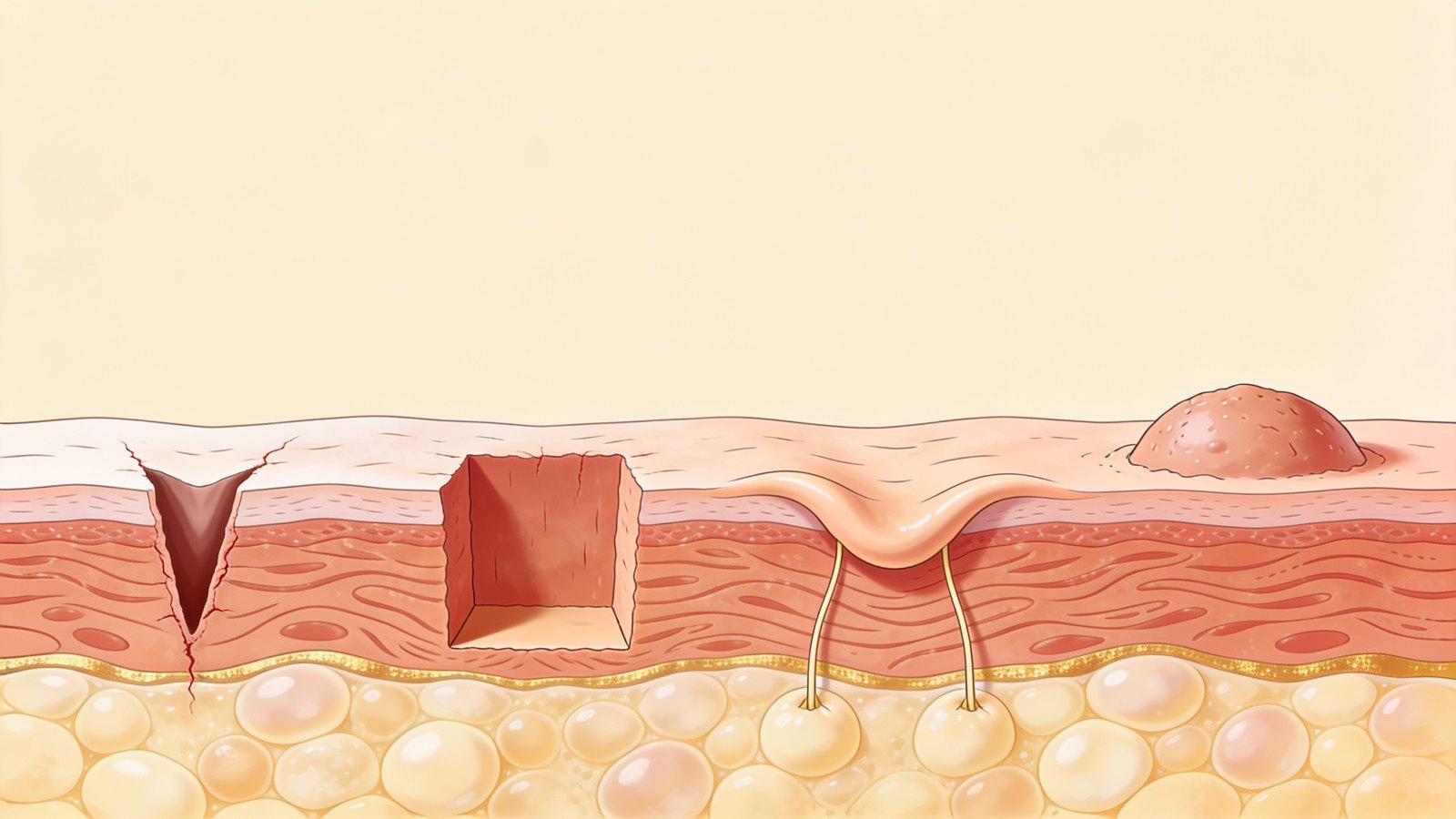
They form when a deep, inflamed spot, often a cyst or nodule, breaks down a narrow column of collagen and the channel heals as a tract rather than filling in. Picking and squeezing deep spots makes this more likely. Ice pick scars rarely appear alone: most people with them also have boxcar or rolling scars, and the full mix is set out in types of acne scars.
Their shape is the whole problem. The opening is narrow, so there is little to resurface; the depth is great, so a laser pass across the face barely touches the base. Treatment therefore goes inside each scar.

Ice pick scar or enlarged pore? How to tell
| Feature | Ice pick scar | Enlarged pore |
|---|---|---|
| Edge | Sharp, often slightly irregular | Soft, round, often with a visible oily plug |
| Depth | Deep; casts a dark dot in side light | Shallow funnel |
| Pattern | Scattered where deep spots were | Evenly spread over the nose and central cheeks |
| When you stretch the skin | Stays visible | Often becomes less obvious |
| History | A deep spot or cyst in that place | Oily skin, sun damage, ageing |
| Usual first treatment | TCA CROSS or CO2 point shots | Skin care, peels, fractional or pico laser |
The distinction matters because the treatments differ. Pores respond to skin-quality treatments, covered on enlarged pores treatment; ice pick scars need focal treatment.
TCA CROSS for ice pick scars: how it works
TCA CROSS stands for chemical reconstruction of skin scars. A high-strength trichloroacetic acid (TCA) is placed with a fine applicator into the base of each ice pick scar, and only there, until the scar frosts white. The acid creates a controlled injury inside the narrow channel. As it heals, new collagen forms along the walls, and over successive sessions the scar becomes shallower and narrower. Because the skin around the scar is not treated, the surface heals quickly. How treated ice-pick scars heal after CROSS is set out in TCA CROSS healing.
- During: a brief sting in each scar; numbing is usually not needed.
- Days 1–7: each treated scar shows a white dot, then a small dark crust that sheds in about a week. Make-up can usually cover it after a day or two.
- Sessions: commonly three to six, spaced four to six weeks apart. Deeper scars usually need more.
- Asian skin: the main risk is temporary darkening around treated scars; it is reduced with sun protection, careful placement and spacing, and treated early if it appears.
Studies of the CROSS method, including in darker skin types, have reported improvement in ice pick scars over several sessions with few complications when the acid is confined to the scar. It is a medical procedure, not a peel, and it does little for rolling scars or flat marks. More on the procedure is on TCA CROSS in Singapore.
CO2 laser for ice pick scars: point shots, then a fractional pass
A CO2 laser can also be used inside the scar. With a focused setting, single deeper pulses are placed into individual pits to ablate the walls and stimulate remodelling, an approach used in the SCAR3 (S3) protocol on the DEKA Tetra Pro at IN Eternity Clinic. A lighter fractional pass is then used over the surrounding skin to blend the edges, so the scar and its surroundings are not treated as if they were the same.
CO2 point shots suit scars that are slightly wider at the opening or sit among boxcar scars that are being resurfaced in the same session. TCA CROSS suits very narrow, deep channels. Many plans use both, in different sessions. The device and its settings are explained on CO2 laser in Singapore, and the acne-scar protocol on CO2 laser for acne scars.
“An ice-pick scar is a shaft, not a dent. You treat it from the inside, one scar at a time, or you are polishing the skin around it.”
Punch excision, punch elevation and punch grafting explained
Punch techniques are small surgical procedures for scars too deep or too wide-walled for chemical or laser treatment alone. A circular blade of a size matched to the scar is used under local anaesthetic.
| Technique | What is done | Suits | Trade-off |
|---|---|---|---|
| Punch excision | The scar is cut out and the edges are closed with a fine stitch | Deep ice pick scars, narrow deep boxcar scars | Leaves a fine line scar instead of a pit; stitches for about a week |
| Punch elevation | The scar floor is cut free and lifted level with the surrounding skin | Boxcar scars with a normal-looking flat floor | The edge can still show; often followed by resurfacing |
| Punch grafting | The scar is removed and replaced by a small plug of skin, usually from behind the ear | Very deep ice pick scars | Colour or texture mismatch is possible; resurfacing later blends it |
Punch techniques trade a deep pit for a flatter, finer mark, and the area is usually resurfaced weeks later to blend it. They are considered when a scar is unlikely to respond enough to TCA CROSS or CO2 point shots. At IN Eternity Clinic punch excision, elevation and grafting are all offered. Nowadays, though, Dr Sin Yong more often treats deep ice pick scars with S3 (SCAR3) resurfacing on the DEKA Tetra Pro CO2 alongside TCA CROSS, because in his experience it usually gives a smoother, more even result without stitches. A punch technique is still used where a particular scar calls for it.
An ice pick scar treatment plan, step by step
- Step 1: Map the scarsEach ice pick scar is marked under side light and photographed, and the other scar types around it are named.
- Step 2: Settle active acneDeep spots make new ice pick scars, so breakouts are controlled first; see acne treatment.
- Step 3: Treat inside the scarsTCA CROSS or CO2 point shots, repeated every four to six weeks.
- Step 4: Blend the surfaceA fractional CO2 or RF microneedling session smooths the edges and the skin around the treated scars.
- Step 5: ReviewPhotographs in the same light at each visit decide whether more sessions are worthwhile.
Where ice pick scars sit among rolling and boxcar scars, they become one part of a wider plan with subcision and resurfacing, described on acne scar treatment in Singapore and, for mixed scarring, in the 4D Scar Reconstruction protocol.

How much can ice pick scars improve?
Ice pick scars can usually be made shallower and narrower, so they cast less shadow and look more like fine pores than pits. Very deep scars may improve only partly and may need punch techniques. Change builds for months after each session, as collagen keeps forming in the treated channels.
| Scar depth | Typical sessions | Realistic aim |
|---|---|---|
| Shallow ice pick scars | About 2–4 | Much less visible in normal light |
| Moderate depth | About 3–5 | Shallower and narrower; some still visible in side light |
| Very deep or wide-walled | About 4–6, sometimes with a punch technique | Partial improvement; a fine mark may remain |
What Dr Sin Yong looks for
- Width at the opening. Very narrow channels suit TCA CROSS; slightly wider ones may suit CO2 point shots.
- Depth in side light. How dark the dot is gives a guide to how far down the scar runs.
- Pit or pore. Enlarged pores are separated from scars so they are not treated as scars.
- Neighbouring scars. Boxcar and rolling scars around the pits change the order of the plan.
- Pigment history. How easily your skin darkens decides spacing and aftercare.
- Active spots. Deep spots still forming mean acne control comes first.
General clinical observations used at consultation; they describe what is checked, not any individual result.
When a pit is not an acne scar
Most small pits on the cheeks are acne scars or pores. A few need a different diagnosis.
- A single pit or bump with a pearly, rolled edge, or one that bleeds or crusts: examined first; some skin cancers can look like a scar.
- Pits that appeared without any acne: other causes, such as chickenpox, injury or skin conditions, are considered.
- A pit that discharges or keeps forming a blackhead: it may be a sinus or dilated pore that needs a different procedure.
Where any of these apply, the first step is a diagnosis.
How much does ice pick scar treatment cost in Singapore?
Cost depends on how many scars are treated, the method (TCA CROSS, CO2 point shots or a punch technique), how many sessions are needed and whether other scar types are treated in the same plan. How the cost factors add up is explained in acne scar removal cost in Singapore. At IN Eternity Clinic the plan is quoted after assessment; the consultation fee is S$120, waived with any medical treatment.
What ice pick scar results look like over time
Ice pick scars become shallower and narrower gradually; complete removal is not promised.
| When | What usually happens |
|---|---|
| Day of treatment | Each treated scar shows a white dot |
| First week | A small dark crust forms and sheds in about a week |
| Four to six weeks | The next session is usually due; the scar is reassessed |
| Months after each session | Collagen keeps forming in the treated channels, so the scar continues to change |
| After the course | Shallow scars are often much less visible in normal light; very deep scars may improve only partly |
Side effects and risks of ice pick scar treatment
Because treatment goes inside each scar, most side effects stay small and local. TCA CROSS has been reported as well tolerated in darker skin when the acid stays inside the scar (Khunger et al., 2011); the main problems come from acid or heat spreading beyond it.
Common and expected
- A brief sting in each scar, then a white frost that fades within hours.
- Small dark dots or crusts for about a week, then pinkness that fades over weeks.
- Crusting for about a week after CO2 point shots.
- After a punch technique, a stitch for about a week and a fine line as it heals.
Uncommon
- Brown spots around treated scars; see post-inflammatory pigmentation.
- Lighter spots where acid or heat was applied.
- A scar that widens, if acid is used in a scar that is too wide.
- Infection if crusts are picked.
- After punch grafting, a small colour or texture difference at the graft.
When to contact the clinic
- Pain, swelling or pus around a treated scar.
- A spot that is still open after about ten days.
- Darkening around several treated scars.
- A stitch line that becomes raised, red and itchy.
WhatsApp the clinic on +65 8815 3008, ideally with a photograph, or call during opening hours; if you are unwell or the problem is severe out of hours, go to a GP or an emergency department. How marks differ from scars is set out in PIE vs PIH.
Which device is used, and why
Two lasers cover resurfacing here. The DEKA SmartXide Tetra PRO is an ablative fractional CO2 laser; its S3 (SCAR3) mode lets Dr Sin Yong place point shots into individual scar pits before a fractional pass over the area. It gives more remodelling per session, with redness and peeling for several days. The FSX laser (thulium and erbium glass) is non-ablative: recovery is usually milder, and more sessions are usually needed. In darker skin types, energy and density are lowered on either device to reduce pigment risk.
Ice-pick scars are narrow and deep, so they often start with TCA CROSS, with the Tetra PRO S3 point shots or a fractional pass used afterwards to smooth the surrounding skin. Which device is used is decided at assessment, after Dr Sin Yong has examined your skin.
What ice pick scars look like, prevention and ageing
What do ice pick scars look like?
Ice pick scars are narrow, deep pits, usually less than 2 mm wide, that look like the skin was pricked with a sharp tool. They are often on the cheeks and are wider at the surface and narrow as they go deeper. They do not flatten when the skin is stretched, unlike rolling scars.
Can ice pick scars be prevented?
The most useful step is to treat acne early, especially deep, inflamed spots and cysts, which are most likely to scar. Avoid squeezing or picking spots. If over-the-counter products have not helped within two to three months, see a doctor, because prescription treatment can reduce new scarring.
Do ice pick scars get deeper with age?
Ice pick scars can look more obvious with age, because the skin loses collagen and fat, and becomes thinner and less firm. Treating scars earlier and building collagen with laser, RF microneedling or TCA CROSS may help them look less visible over time. Results vary.
Frequently asked questions about ice pick scars
Will ice pick scars go away?
Ice pick scars do not go away on their own because the tissue loss is deep. They can be made much less noticeable with TCA CROSS, which uses a strong acid applied inside the scar to rebuild it from the base, sometimes followed by laser or RF microneedling. Several sessions are usually needed, and results vary.
What causes an ice pick scar?
Ice pick scars form when deep, inflamed acne, such as cysts or nodules, destroys tissue and leaves a narrow, deep tract that reaches the dermis or below. Picking or squeezing spots and delaying treatment of severe acne raise the risk. They are narrow at the surface and wider underneath, which is why surface treatments alone have limited effect.
What treatment works for ice pick scars?
Treatment usually goes inside the scar: TCA CROSS or CO2 point shots over several sessions, followed by a fractional pass to blend the surface. Very deep scars may need a punch technique. The choice follows the width and depth of each scar.
Can ice pick scars be removed completely?
Usually not completely. They can be made shallower and narrower so they cast less shadow. Very deep scars may improve only partly, and a fine mark can remain after a punch technique.
How many TCA CROSS sessions do ice pick scars need?
Commonly three to six sessions, spaced four to six weeks apart. Deeper scars usually need more, and progress is judged on photographs in the same light.
Does laser work on ice pick scars?
A laser pass across the face reaches the base of an ice pick scar poorly. Focused CO2 point shots placed into each pit can help, usually alongside TCA CROSS and followed by a fractional pass.
Is TCA CROSS safe for Asian skin?
Because only the scar is treated, TCA CROSS is often well suited to Asian skin. Temporary darkening around treated scars can occur, so sun protection and spacing are planned and darkening is treated early if it appears.
What is the downtime after TCA CROSS?
Each treated scar shows a white dot, then a small dark crust that sheds in about a week. Make-up can usually cover it after a day or two.
How much does ice pick scar treatment cost in Singapore?
The total depends on the number of scars, the methods used and the number of sessions. At IN Eternity Clinic the plan is quoted after assessment; the consultation fee is S$120, waived with any medical treatment.
Is punch excision better than TCA CROSS for ice pick scars?
Neither is better for every scar. Punch excision removes a deep scar in one step but leaves a fine stitched line; TCA CROSS builds collagen inside the scar over several sessions without a stitch. At IN Eternity Clinic punch excision, elevation and grafting are offered, but nowadays S3 (SCAR3) resurfacing on the DEKA Tetra Pro with TCA CROSS is more often used, because it usually gives a smoother result.
Can ice pick scars be treated with RF microneedling?
RF microneedling remodels collagen across an area and helps the boxcar and rolling scars that often sit beside ice pick scars, but it is less precise for individual narrow shafts. It is usually used to blend the surface after TCA CROSS or CO2 point shots, particularly in skin that darkens easily. See RF microneedling.
How long after TCA CROSS can I have laser?
Usually a few weeks, once the small crusts have shed and the pinkness has begun to fade. Many plans alternate: TCA CROSS in one session, then a fractional CO2 or RF microneedling session four to six weeks later. In the layered 4D Scar Reconstruction protocol the steps may be planned together; the order for your scars is set at assessment.
Can ice pick scars on the nose or forehead be treated?
Yes. The same principles apply, though skin thickness and oil differ by area. Nose skin has large pores that can be mistaken for scars, so each pit is checked first. Forehead scars often sit among boxcar scars and may be treated with point shots and a fractional pass. Settings are adjusted for each area at the time of treatment.
Will ice pick scars come back after treatment?
Treated scars do not usually return, because the change comes from new collagen laid down inside the scar. New deep spots can create new ice pick scars, though, so acne control continues. The skin around the scars keeps ageing, which can make old scars a little more visible over the years; daily sun protection helps. See acne scars.
How are ice-pick scars different from rolling scars?
Ice-pick scars are narrow and deep, like a pinhole, and are usually treated with TCA CROSS. Rolling scars are broad and shallow, held down by bands under the skin, and are usually released with subcision first. See rolling scars treatment.
Can I get rid of ice pick scars at home?
Not really. Ice pick scars are narrow and deep, reaching into the dermis, so creams, serums, scrubs and at-home microneedling cannot rebuild them. Retinoids and sunscreen can improve the surrounding skin and marks. Treatments that work on the scar itself, such as TCA CROSS or punch techniques, are done in clinic. At-home needling devices can cause infection and scarring.
Book an assessment
IN Eternity Clinic, 9 Scotts Road, #12-01 Pacific Plaza, Singapore 228210. By appointment with Medical Director Dr Sin Yong. Monday to Saturday, 11am to 8pm. WhatsApp or call +65 8815 3008. The consultation fee is waived with any medical treatment.
International KOL — CLASSYS · HIRONIC · DEKA · ALMA · FOTONA · LUTRONIC
References
- Jacob CI, Dover JS, Kaminer MS. Acne scarring: a classification system and review of treatment options. J Am Acad Dermatol 2001;45(1):109-117. doi:10.1067/mjd.2001.113451
- Lee JB, Chung WG, Kwahck H, Lee KH. Focal treatment of acne scars with trichloroacetic acid: chemical reconstruction of skin scars method. Dermatol Surg 2002;28(11):1017-1021. doi:10.1046/j.1524-4725.2002.02095.x
- Khunger N, Bhardwaj D, Khunger M. Evaluation of CROSS technique with 100% TCA in the management of ice pick acne scars in darker skin types. J Cosmet Dermatol 2011;10(1):51-57. doi:10.1111/j.1473-2165.2010.00526.x
- Fabbrocini G, Annunziata MC, D'Arco V, et al. Acne scars: pathogenesis, classification and treatment. Dermatol Res Pract 2010;2010:893080. doi:10.1155/2010/893080
- Kravvas G, Al-Niaimi F. A systematic review of treatments for acne scarring. Part 1: non-energy-based techniques. Scars Burn Heal 2017;3:2059513117695312. doi:10.1177/2059513117695312
- Omi T, Kawana S, Sato S, Bonan P, Naito Z. Fractional CO2 laser for the treatment of acne scars. J Cosmet Dermatol 2011;10(4):294-300. doi:10.1111/j.1473-2165.2011.00587.x
- Davis EC, Callender VD. Postinflammatory hyperpigmentation: a review of the epidemiology, clinical features, and treatment options in skin of color. J Clin Aesthet Dermatol 2010;3(7):20-31. PMID 20725554
- Singapore Medical Council. Guidelines on Aesthetic Practices for Doctors (2016 edition). healthprofessionals.gov.sg/smc
These sources describe mechanisms and general evidence. They are not a promise of any individual result; suitability is decided at an in-person assessment.