Boxcar Scars Treatment Singapore
Boxcar scars have sharp walls and a flat floor. Medical Director Dr Sin Yong matches resurfacing, release and support to their depth at IN Eternity Clinic on Orchard Road.
WhatsApp to Enquire →Key facts ↓Boxcar scars treatment is a course that softens round or oval acne scars with steep walls and a flat floor, 1.5 to 4 mm across. Shallow ones respond to fractional CO2 or RF microneedling, which soften the edge. Deep ones need more: subcision if the floor is tethered, focal treatment of the walls and sometimes filler support. Most people need three to six sessions; scars soften, they are not erased.
Boxcar scars treatment at a glance
| Question | Boxcar scars treatment |
|---|---|
| What it is | A course of treatment that softens boxcar acne scars: round or oval scars with steep walls and a flat floor, about 1.5 to 4 mm across. |
| Used for | Shallow and deep boxcar scars from acne or chickenpox, often alongside rolling and ice pick scars. |
| How it works | Fractional CO2 (DEKA Tetra Pro) or RF microneedling softens the edge; CO2 point shots or TCA treat the walls; subcision frees a tethered floor; filler or a collagen stimulator supports a low floor. |
| Typical sessions | Usually three to six sessions, four to eight weeks apart: shallow scars often three or four, deep or tethered scars more. |
| Downtime | About 5–7 days of redness and crusting after CO2; 2–4 days of redness after RF microneedling; bruising for 1–2 weeks after subcision. |
| When results show | Collagen remodels for months after each session; scars become shallower and softer-edged, judged on photographs at six to eight weeks; they are softened, not erased. |
| Who should avoid or wait | A tan, active spots or a cold sore (treatment is postponed); active acne is controlled first; skin that darkens easily may be steered to RF microneedling. |
| Who performs it | Dr Sin Yong, who maps the scars and places the point shots. |
Dr Sin Yong, Medical Director of IN Eternity Clinic, explains that a boxcar scar has an edge and a floor: softening the edge fades the shadow, but if the floor is tied down the laser alone will not lift it.
On this page
- What they are: round or oval acne scars with steep walls and a flat floor, about 1.5 to 4 mm across.
- Shallow vs deep: shallow scars (up to about 0.5 mm) suit resurfacing; deeper ones need more than one step.
- Usual tools: fractional CO2 (DEKA Tetra Pro), RF microneedling, subcision, focal TCA or CO2 to the walls, filler support.
- Sessions: usually three to six, four to eight weeks apart.
- Asian skin: density, spacing and sun care are planned around the risk of darkening.
- Consultation: S$120, waived with any medical treatment. IN Eternity Clinic, 9 Scotts Road, #12-01 Pacific Plaza.
- In a split-scar comparison, 55% of Er:YAG-treated and 65% of CO2-treated sites had more than 50% scar improvement at six months, with no significant difference between the two lasers (Dermatol Surg 2013)
- A review notes acne affects over 90% of adolescents and persists into adulthood in about 12–14%, and that scars are mainly atrophic or hypertrophic (Dermatol Res Pract 2010)
- In a study of fractional radiofrequency microneedling, acne scar grade and large pores improved in more than 70% of patients, with measured gains in skin roughness and dermal density (Dermatol Surg 2012)
What are boxcar scars?
Boxcar scars are round or oval depressions with steep, almost vertical walls and a broad, fairly flat floor, a little like the outline of a railway boxcar seen from the side. They are usually 1.5 to 4 mm across, wider than ice pick scars, and they are most common on the cheeks and temples. In side light the sharp edge throws a crisp shadow, which is what makes them visible; in flat light they can almost disappear.
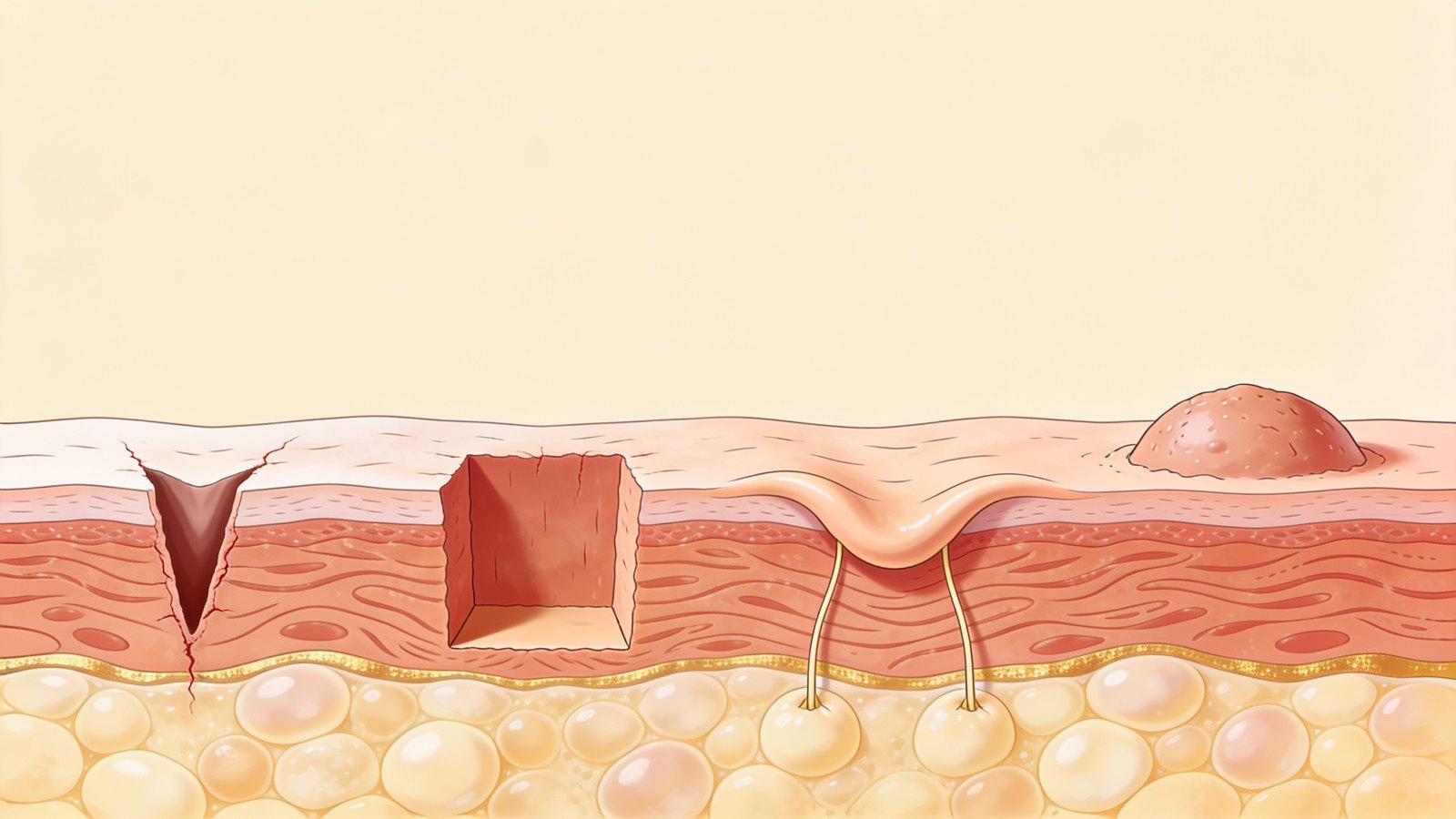
Doctors divide them by depth because depth changes the plan. Shallow boxcar scars (roughly 0.1 to 0.5 mm deep) sit within reach of resurfacing. Deep boxcar scars (deeper than about 0.5 mm) usually need more than one step, because the floor lies below what a resurfacing pass can remodel and is sometimes tethered by fibrous strands.
Most people with boxcar scars also have rolling or ice pick scars nearby. How the types differ is set out in types of acne scars.

What causes boxcar scars?
A boxcar scar starts as an inflamed spot that sits deep enough, and lasts long enough, to break down collagen across a wider area than an ice pick scar. As the spot heals, the lost collagen is not fully replaced and the floor settles lower than the skin around it, leaving a sharp-edged step.
- Deep, inflamed acne: papules, pustules, nodules and cysts that last weeks rather than days.
- Delay in treatment: the longer inflammation continues, the more collagen is lost.
- Picking and squeezing: pushes inflammation deeper and widens the injury.
- Chickenpox: also leaves boxcar-shaped scars, which are treated the same way.
- Tendency: some people scar more readily than others with similar acne, and a family history of scarring is common.
The single most useful prevention is early, effective acne treatment, because each deep spot that is controlled is a scar that does not form.
Boxcar vs rolling vs ice pick scars
| Boxcar | Rolling | Ice pick | |
|---|---|---|---|
| Shape | Steep walls, flat floor | Soft, sloping edges; wave-like | Narrow V-shaped shaft |
| Width | About 1.5–4 mm | Often 4–5 mm or wider | Under about 2 mm |
| Stretch test | Stays visible | Softens or flattens | Stays visible |
| What holds it down | Lost collagen; sometimes tethering at the floor | Fibrous bands tethering the skin | A deep narrow tract |
| Usual first tool | Fractional CO2 or RF microneedling; subcision if tethered | Subcision | TCA CROSS or CO2 point shots |
Rolling scars are covered on rolling acne scars and subcision, and ice pick scars on ice pick scar treatment.
Boxcar scars treatment: shallow vs deep
| Scar | Usually first | Often added | Typical sessions |
|---|---|---|---|
| Shallow boxcar | Fractional CO2 (S3 protocol) or RF microneedling to soften the edge | Pico laser for texture; skin boosters for skin quality | About 3–4, four to eight weeks apart |
| Deep boxcar, not tethered | CO2 point shots or TCA CROSS to the walls, then a fractional pass | A filler or collagen stimulator under the floor | About 4–6 |
| Deep boxcar, tethered floor | Subcision to free the floor | Resurfacing four to six weeks later; support where volume is lost | About 4–6 across the steps |
- Fractional CO2. Ablates microscopic columns and remodels collagen, softening the step at the edge so it throws less shadow. At IN Eternity Clinic it runs on the DEKA Tetra Pro; see CO2 laser in Singapore and CO2 laser for acne scars.
- RF microneedling. Insulated needles deliver heat at a set depth beneath the surface, remodelling the scar with less surface injury and a lower risk of darkening. See RF microneedling.
- Focal treatment of the walls. CO2 point shots or TCA placed along the walls of deeper scars help bring the floor and edge closer.
- Subcision. Where the floor is tied down, it is released first, so later resurfacing has something to work with.
- Volume support. A hyaluronic acid filler or a collagen stimulator such as Radiesse can lift a broad floor that stays low after release.
- Punch elevation. For a deep boxcar scar with a normal-looking floor, the floor can be cut free and lifted. Punch elevation is offered at IN Eternity, but nowadays S3 (SCAR3) resurfacing on the DEKA Tetra Pro CO2 is more often used, because in Dr Sin Yong’s experience it usually gives a smoother result.
“A boxcar scar has an edge and a floor. Soften the edge and the shadow fades; if the floor is tied down, the laser alone will not lift it.”
Boxcar scars in Asian skin: getting the balance right
Boxcar scars respond to heat-based resurfacing, and heat is what raises the risk of post-inflammatory darkening in skin types III to V. The balance is struck with settings and sequence rather than by avoiding treatment. Density is kept moderate, sessions are spaced six to eight weeks apart, heavy steps are not stacked, and RF microneedling is often used where the skin darkens easily. Sun protection that also covers visible light continues every day of the course.
Fractional CO2 has been studied in Asian patients with atrophic acne scars, with improvement over several sessions and darkening as the main side effect, usually temporary. Your own pigment history, how your skin darkened after spots or sun, is the most useful guide to how conservative the plan should be.

How many sessions do boxcar scars need, and what changes?
Collagen remodels for months after each session, so boxcar scars are treated as a course and judged on photographs taken in the same light. Shallow scars often need three or four sessions; deep or tethered scars more, across several methods. The realistic aim is a softer edge, a shallower floor and less shadow in side light, not skin that was never scarred. For narrow boxcar scars treated with CROSS, see TCA CROSS healing.
| Step | Visible recovery | Spacing |
|---|---|---|
| Fractional CO2 | About 5–7 days of redness and crusting | 6–8 weeks |
| RF microneedling | About 2–4 days of redness | 4–6 weeks |
| TCA or CO2 to the walls | Small crusts for about a week | 4–6 weeks |
| Subcision | Bruising and swelling for 1–2 weeks | Then 4–6 weeks before resurfacing |
| Filler or collagen stimulator | Small bumps or bruising for a few days | Product-dependent |
Can creams, peels or facials improve boxcar scars?
Only a little, and mostly around the scars rather than in them. A retinoid used at night and regular superficial peels can make the skin surface finer and more even, which slightly softens how the edges catch the light. They do not rebuild the lost collagen under a boxcar floor, so the step remains. Facials and skin boosters improve hydration and skin quality and can make shallow scarring look less obvious, but they do not lift a scar; see what an acne scar facial can do and skin boosters for acne scars.
Two habits matter more than any product. Daily sunscreen keeps the skin around the scars from darkening, which makes the shadows look deeper. And not picking new spots is the most effective way to stop new boxcar scars forming while the old ones are treated.
What boxcar scar results look like over time
Each session starts a collagen response that keeps going for months.
| When | What you may notice |
|---|---|
| Day 0 to week 1 | Redness and crusting after CO2, or a few days of redness after RF microneedling. |
| Two to six weeks | The window in which darkening can appear in Asian skin; sun protection continues. |
| Six to eight weeks | Photographs compared; the next step chosen scar by scar. |
| Across the course | Scars become shallower and softer-edged so they throw less shadow; complete removal is not a realistic promise. |
Who should wait before boxcar scar treatment?
Treatment is timed so the skin can heal well.
- A tan, active spots or a cold sore on the day: the session is postponed.
- Ongoing acne with new deep spots: acne control comes first, so new scars do not form during the course.
- Skin that darkens easily: RF microneedling may lead instead of CO2, with sessions spaced six to eight weeks apart.
Your boxcar scar treatment day, step by step
Most boxcar plans alternate heavier and lighter sessions. A typical treatment day looks like this; the exact steps follow your scar map.
- Review with Dr Sin Yong. Scars are checked in side light and the stretch test is repeated. A tan, active spots or a cold sore can mean postponing.
- Preparation. Cleansing, standard photographs in the same light, and numbing cream for about 45 to 60 minutes; local anaesthetic is added for subcision.
- Release, if planned. A tethered floor is freed first with subcision, so later resurfacing has something to lift.
- The main step. Point-shots to the scar walls and a fractional pass on the DEKA Tetra Pro (see CO2 laser for acne scars), or RF microneedling for skin that darkens easily.
- Straight after. Cooling, a bland ointment and written aftercare. The skin feels like sunburn for the rest of the day.
- The next days. About five to seven days of redness and crusting after CO2, or two to four days of redness after RF microneedling. Gentle cleansing and sunscreen.
- Review. Photographs are compared at about six to eight weeks, and the next step is chosen from how each scar responded.
How much does boxcar scar treatment cost in Singapore?
Cost depends on how many scars and areas are treated, whether they are shallow or deep, which methods are combined and how many sessions are needed. How the cost factors add up is explained in acne scar removal cost in Singapore. At IN Eternity Clinic the plan is quoted after assessment; the consultation fee is S$120, waived with any medical treatment. Every option is set out on acne scar treatment in Singapore.
Side effects and risks of boxcar scar treatment
Boxcar treatment uses heat, needles and sometimes acid or filler, so the side effects depend on the step. Reviews of fractional laser list the same expected and uncommon effects (Graber et al., 2008), and pigment change is the main concern in Asian skin (Chan et al., 2007).
Common and expected
- Redness, swelling and a sunburnt feel for a few days.
- Crusting for about a week after CO2, and pinpoint marks for a few days after RF microneedling.
- Bruising for one to two weeks after subcision.
- Small dark crusts where TCA has been placed on scar walls.
Uncommon
- Post-inflammatory hyperpigmentation two to six weeks after a session.
- Prolonged redness, breakouts or a cold sore flare.
- A small lump after filler or a collagen stimulator.
- Rarely, a widened scar if acid spreads beyond the wall, a lighter patch or infection.
When to contact the clinic
- Pain or swelling that worsens after the third day.
- Pus, yellow crusts, spreading redness or a fever.
- Skin that darkens as it heals.
- After an injectable, skin that turns pale or dusky, or any change in vision: call immediately.
WhatsApp the clinic on +65 8815 3008, ideally with a photograph, or call during opening hours; if you are unwell or the problem is severe out of hours, go to a GP or an emergency department. How scar types are named is explained on acne scars.
Which device is used, and why
Two lasers cover resurfacing here. The DEKA SmartXide Tetra PRO is an ablative fractional CO2 laser; its S3 (SCAR3) mode lets Dr Sin Yong place point shots into individual scar pits before a fractional pass over the area. It gives more remodelling per session, with redness and peeling for several days. The FSX laser (thulium and erbium glass) is non-ablative: recovery is usually milder, and more sessions are usually needed. In darker skin types, energy and density are lowered on either device to reduce pigment risk.
Boxcar scars have steep edges and a flat floor, which point shots and fractional CO2 can soften; deeper or tethered scars may also need subcision. Which device is used is decided at assessment, after Dr Sin Yong has examined your skin.
Preventing boxcar scars, lighting and treating during acne
Can boxcar scars be prevented?
Treating acne early, especially deep inflamed spots, is the most useful way to prevent boxcar scars. Avoid squeezing or picking, because this damages the deeper skin. If acne keeps leaving marks or pits, see a doctor early, as prescription treatment can reduce new scarring.
Why do boxcar scars look worse in some lighting?
Boxcar scars have sharp edges, so light from above or from the side casts shadows inside them, making them look deeper. Soft, front-facing light reduces the shadows. Treatment aims to soften the edges and raise the base, which reduces these shadows in everyday light.
Can boxcar scars be treated while I still get acne?
Active acne is usually controlled first, because inflamed spots can spread with some treatments and new scars may form. Gentle treatments may start while acne is mild and stable. Once acne is controlled, stronger scar treatments such as laser, RF microneedling or subcision can follow.
Frequently asked questions about boxcar scars
What is the hardest acne scar to remove?
Ice pick scars and deep boxcar scars are generally the hardest because the tissue loss is narrow and deep, beyond the reach of surface treatments. Raised hypertrophic and keloid scars on the chest, back and jawline are also stubborn. These usually need targeted methods such as TCA CROSS, punch techniques or injections, combined with laser.
Can boxcar scars go away?
Boxcar scars do not fade on their own, but they can be improved significantly. Shallow boxcar scars respond to fractional laser and RF microneedling; deeper ones may need TCA CROSS or punch techniques, and tethered edges subcision. A course of several sessions is usual, and the aim is a smoother surface rather than perfect skin.
What is the downtime after boxcar scar treatment?
It depends on the step. RF microneedling usually means about two to four days of redness, and fractional CO2 about five to seven days of redness and crusting. TCA or CO2 to the scar walls leaves small crusts for about a week, while subcision brings bruising and swelling for one to two weeks. Filler or a collagen stimulator may leave small bumps or bruising for a few days. Recovery varies between people and with settings.
What are boxcar scars?
Boxcar scars are round or oval acne scars with steep, almost vertical walls and a flat floor, usually 1.5 to 4 mm across. They form when deep inflammation destroys collagen across a wider area and the floor heals lower than the skin around it.
Can boxcar scars be removed?
They can usually be made shallower and softer-edged so they throw less shadow, but complete removal is not a realistic promise. Shallow boxcar scars tend to respond more than deep ones.
Which laser is used for boxcar scars?
Fractional CO2 is commonly used to soften the edge and remodel collagen, with about a week of recovery. RF microneedling, which is not a laser, is often chosen for skin that darkens easily. Many plans use both.
Do deep boxcar scars need subcision?
Only if the floor is tethered. If a deep boxcar scar softens when the skin is stretched, its floor may be tied down, and subcision to free it usually comes before resurfacing.
Can fillers treat boxcar scars?
A filler or collagen stimulator can lift a broad floor that stays low, usually after release and alongside resurfacing. It does not soften a sharp edge on its own.
How many sessions do boxcar scars need?
Shallow boxcar scars often need three or four sessions; deep or tethered scars need more, across several methods. Sessions are usually four to eight weeks apart.
How much does boxcar scar treatment cost in Singapore?
The total depends on the number of scars, the methods used and the number of sessions. At IN Eternity Clinic the consultation fee is S$120, waived with any medical treatment.
Are boxcar scars and chickenpox scars treated the same way?
Usually, yes. Chickenpox often leaves round scars with steep walls, which behave like boxcar acne scars and respond to the same tools: fractional CO2 or RF microneedling for the edge, focal treatment of the walls and subcision if the floor is tied down. An isolated, deep chickenpox scar may also be considered for a punch technique.
Is punch elevation used for boxcar scars?
It is offered at IN Eternity Clinic for deep boxcar scars with a normal-looking flat floor: the floor is cut free and lifted level with the skin around it. Nowadays S3 (SCAR3) resurfacing on the DEKA Tetra Pro is more often used, because in Dr Sin Yong’s experience it usually gives a smoother result. The choice is made scar by scar at assessment.
Does boxcar scar treatment hurt?
With numbing it is usually manageable. Numbing cream goes on for about 45 to 60 minutes before CO2 laser or RF microneedling, and subcision is done under local anaesthetic. Most people describe hot prickling during the laser and pressure during subcision. Afterwards the skin feels like sunburn for the rest of the day, and simple painkillers are usually enough.
Can I wear make-up after boxcar scar treatment?
After RF microneedling, light make-up can often go back on after a day or two, once the pinpoint marks have closed. After fractional CO2, wait until the crusts have shed, often around day five to seven. Clean brushes and a mineral or non-comedogenic base lower the risk of irritation. Your written aftercare gives the timing for the step used.
Is boxcar scar treatment safe for darker skin?
It can be, with planning. Skin types III to V darken more easily after heat, so density is kept moderate, sessions are spaced six to eight weeks apart and RF microneedling may be used instead of CO2. Sun protection continues throughout. The risk is lowered, not removed, and is discussed at assessment; see treatment for darker skin tones.
What is the difference between boxcar and rolling scars?
Boxcar scars have sharp, vertical edges, like a small crater. Rolling scars are broader with sloping edges and are held down by bands under the skin, so they are usually treated with subcision first. See rolling scars treatment.
Can retinol remove boxcar scars?
No. Retinol can improve skin texture and fade marks over months, and it may make very shallow scars look slightly softer, but it cannot lift the steep-edged depressions of boxcar scars. Those need treatments that remodel or resurface the skin, such as fractional laser, RF microneedling or TCA CROSS, often combined. Retinol is a useful part of skincare between treatments.
Book an assessment
IN Eternity Clinic, 9 Scotts Road, #12-01 Pacific Plaza, Singapore 228210. By appointment with Medical Director Dr Sin Yong. Monday to Saturday, 11am to 8pm. WhatsApp or call +65 8815 3008. The consultation fee is waived with any medical treatment.
International KOL — CLASSYS · HIRONIC · DEKA · ALMA · FOTONA · LUTRONIC
References
- Jacob CI, Dover JS, Kaminer MS. Acne scarring: a classification system and review of treatment options. J Am Acad Dermatol 2001;45(1):109-117. doi:10.1067/mjd.2001.113451
- Goodman GJ, Baron JA. Postacne scarring: a qualitative global scarring grading system. Dermatol Surg 2006;32(12):1458-1466. doi:10.1111/j.1524-4725.2006.32354.x
- Fabbrocini G, Annunziata MC, D'Arco V, et al. Acne scars: pathogenesis, classification and treatment. Dermatol Res Pract 2010;2010:893080. doi:10.1155/2010/893080
- Manuskiatti W, Iamphonrat T, Wanitphakdeedecha R, Eimpunth S. Comparison of fractional erbium-doped yttrium aluminum garnet and carbon dioxide lasers in resurfacing of atrophic acne scars in Asians. Dermatol Surg 2013;39(1 Pt 1):111-120. doi:10.1111/dsu.12030
- Cho SI, Chung BY, Choi MG, et al. Evaluation of the clinical efficacy of fractional radiofrequency microneedle treatment in acne scars and large facial pores. Dermatol Surg 2012;38(7):1017-1024. doi:10.1111/j.1524-4725.2012.02402.x
- Omi T, Kawana S, Sato S, Bonan P, Naito Z. Fractional CO2 laser for the treatment of acne scars. J Cosmet Dermatol 2011;10(4):294-300. doi:10.1111/j.1473-2165.2011.00587.x
- Kravvas G, Al-Niaimi F. A systematic review of treatments for acne scarring. Part 2: energy-based techniques. Scars Burn Heal 2018;4:2059513118793420. doi:10.1177/2059513118793420
- Ahramiyanpour N, Rastaghi F, Parvar SY, et al. Subcision in acne scarring: a review of clinical trials. J Cosmet Dermatol 2023;22(3):744-751 (online 2022). doi:10.1111/jocd.15480
- Singapore Medical Council. Guidelines on Aesthetic Practices for Doctors (2016 edition). healthprofessionals.gov.sg/smc
- Graber EM, Tanzi EL, Alster TS. Side effects and complications of fractional laser photothermolysis: experience with 961 treatments. Dermatol Surg 2008;34(3):301-307. doi:10.1097/00042728-200803000-00003
- Chan HH, Manstein D, Yu CS, et al. The prevalence and risk factors of post-inflammatory hyperpigmentation after fractional resurfacing in Asians. Lasers Surg Med 2007;39(5):381-385. doi:10.1002/lsm.20512
These sources describe mechanisms and general evidence. They are not a promise of any individual result; suitability is decided at an in-person assessment.