
Regenera Activa in Singapore
An autologous micrografting hair loss treatment, used for both male and female pattern loss. Tissue is taken from the patient’s own DHT-protected scalp, processed into a micrograft suspension, and returned to the thinning area — all within a single session. At IN Eternity Clinic every assessment is carried out by Medical Director Dr Sin Yong.
Regenera Activa is an autologous micrografting treatment for pattern hair loss. Three tiny samples from the back of your own scalp are processed into a suspension of progenitor cells and growth signals, which is injected into thinning areas in the same session. It suits early to moderate thinning in men and women, works gradually over months, and is usually combined with medical or laser treatment. See also our guide to postpartum hair loss treatment in Singapore.
- The European S3 guideline on pattern hair loss notes it affects up to 80% of white men and 42% of women, often starting in the teenage years and progressing with age (J Eur Acad Dermatol Venereol 2018)
Regenera Activa at a glance
| What it is | An autologous micrografting treatment for pattern hair loss, using tissue from your own scalp in one session. |
|---|---|
| Used for | Early to moderate pattern hair loss in men and women (roughly Norwood II to IV and Ludwig I to II). |
| How it works | Three 2.5 mm samples from the back of the scalp are processed into a suspension of progenitor cells and growth signals, which is injected into thinning areas. |
| Typical sessions | Many plans begin with a single session; whether a further session helps is decided at review. |
| Downtime | Tenderness and mild swelling for a day or two; small scabs at the sampling sites heal over about a week. |
| When results show | Judged against baseline photographs from around three months, and more clearly later. |
| Who should avoid or wait | Advanced loss with a smooth, shiny scalp, scarring alopecia, active scalp infection or inflammation, bleeding disorders, pregnancy and some autoimmune conditions. |
| Who performs it | Medical Director Dr Sin Yong stages the hair loss and performs the procedure under local anaesthetic. |
Dr Sin Yong, Medical Director of IN Eternity Clinic, explains that staging comes first, because a miniaturising follicle can still respond and a lost one cannot, and that Regenera Activa is usually combined with medical or laser treatment rather than used alone.
On this page
Staging Comes First
Before any discussion of treatment, the pattern and stage of hair loss need establishing. This is not administrative. Androgenetic alopecia is progressive, and follicles pass through miniaturisation before they are lost altogether. A follicle that is miniaturising can still respond. One that has gone cannot.
Staging tells you which of those you are dealing with, and therefore what any hair loss treatment can realistically be expected to do. This applies equally to male hair loss treatment and to female hair loss treatment. Two standard classifications are used, one for each pattern.
The Norwood Scale — Male Pattern Hair Loss
The Norwood scale is the standard classification for male hair loss, and the reference point for any male hair loss treatment in Singapore. It runs from Type I to Type VII and describes a characteristic progression: recession at the temples, then loss at the vertex, then the merging of the two.
Type I is no recession, or minimal recession within normal variation. Type II is slight symmetrical temporal recession. Type III is the first stage regarded as clinically significant balding, with deep symmetrical temporal recession; Type III vertex adds loss at the crown. Type IV is more pronounced frontal and temporal recession with a larger vertex area, separated by a bridge of hair. Type V is where that bridge narrows and begins to break down. Type VI is where the bridge is lost and the two regions merge. Type VII leaves only a band of hair around the sides and back.
Type III is generally regarded as the first stage of clinically significant balding. The earlier the stage, the more miniaturising follicles remain, and the more scope any treatment has to work with.
The Ludwig Scale — Female Pattern Hair Loss
Female hair loss treatment begins from a different pattern, which is why applying the Norwood scale to women misses what is actually happening. Where male loss recedes, female loss diffuses — and the frontal hairline is typically preserved throughout.
Grade I is perceptible thinning over the crown with the frontal hairline preserved, often first noticed as a widening central parting rather than as recession. Grade II is pronounced widening of the central parting with a visible decrease in density across the crown. Grade III is diffuse thinning across the crown with the scalp readily visible through the remaining hair, the frontal hairline typically remaining.
The usual first sign is a widening central parting rather than a receding hairline. Women also present more often with non-androgenetic causes — thyroid dysfunction, iron deficiency, telogen effluvium after childbirth or illness — which behave differently and are excluded before pattern loss is assumed.
How Regenera Activa Works
The procedure rests on a straightforward observation: not all scalp follicles are equally affected by DHT. Those at the back and sides — the occipital and retro-auricular scalp — are comparatively protected, and that region is well vascularised. It is the same anatomical fact that makes hair transplantation possible.

Three 2.5 mm punch biopsies are taken from that protected area under local anaesthetic. The tissue is then mechanically disaggregated and filtered using Rigenera technology, producing micrografts of approximately 80 microns.
What results is a suspension containing progenitor cells, signalling factors and extracellular matrix — all derived from the patient’s own tissue. This is injected into the thinning regions of the scalp as a scalp treatment for hair loss directed at the follicular environment, with the aim of supporting hair regrowth from follicles still present. Donor and recipient are the same person, within one session. Nothing foreign is introduced.
Two Points of Accuracy
This is not a hair transplant. A transplant relocates intact follicular units, and the moved hairs are the result. Regenera Activa moves no follicles. It introduces a cellular suspension intended to act on follicles already present in the thinning area. Different procedures, different situations — and sometimes used together.
Nor is it accurately a stem cell treatment, though it is often described that way. The suspension contains progenitor cells, which are more restricted in what they can become than stem cells. The distinction matters because the looser description promises more than the procedure delivers.
Where It Sits Alongside Everything Else
Any hair loss treatment patients consider has to start from one fact: androgenetic alopecia is progressive, and no single approach halts it outright. A considered plan usually draws on more than one route.
Topical minoxidil and prescription anti-androgen medication act on follicular perfusion and on the conversion of testosterone to DHT respectively — the circulation and the hormonal driver. Laser therapy is directed at scalp perfusion and the follicular environment. Micrografting acts through a third route again.
Which combination of hair regrowth treatment applies to you follows from the assessment, the stage identified, and your own circumstances and preferences. Response to any hair loss treatment varies with the stage of loss, the cause identified, age, medical history and adherence to the plan. Suitability is assessed in person, and no treatment is appropriate for every patient.
Key Facts
What Determines the Cost
Treatment at IN Eternity Clinic is planned individually, so the cost follows the plan rather than a fixed list. The factors that shape it are discussed at consultation:
- The extent of the area treated. A localised vertex differs from diffuse loss across the crown.
- The stage identified at assessment. Norwood or Ludwig staging informs what the plan needs to cover.
- Whether one approach or several. Micrografting alone differs from a plan combining medical and laser management.
- How the plan is staged over time. Maintenance is considered separately from the initial course.
A figure quoted before assessment would not reflect your presentation. Cost is set out clearly at consultation, before anything is agreed.
At IN Eternity Clinic a consultation fee applies, and it is waived if you go ahead with any medical treatment; the fee is S$120. See fees.
Does it hurt? Comfort and numbing
Regenera Activa is done under local anaesthetic, with no general anaesthetic or sedation. The anaesthetic injections at the back of the scalp, where the three 2.5 mm samples are taken, sting for a few seconds; after that most people feel only pressure and a tugging sensation as each sample is collected. The thinning areas are then numbed in the same way before the micrograft suspension is injected in a pattern across the scalp.
Most people describe the session as pressure rather than pain, though the scalp is sensitive and tolerance varies. Comfort is checked throughout and more anaesthetic is added if needed. Once it wears off, the donor sites and treated scalp can feel tender or tight for a day or two, and simple painkillers are usually enough. The small donor sites are dressed and are covered by surrounding hair.
What to expect, day by day
- Day 0. You go home the same day. The scalp may look pink and slightly puffy where it was injected. Follow the hair-washing and dressing instructions you are given.
- Days 1–3. Tenderness settles. A little swelling can occasionally track down towards the forehead and fades on its own. Avoid strenuous exercise, swimming and hair colouring for the time advised.
- Week 1. Donor sites heal with small scabs. The scalp looks as it did before; no change in the hair is expected yet.
- Weeks 2–4. Life is back to normal. Any effect on the follicles is gradual and is judged over months, not weeks, alongside the rest of your hair-loss plan.
- Review. Baseline photographs taken at assessment are repeated at planned reviews over the following months to judge response honestly.
How Regenera Activa works, step by step
- Assessment and staging. The pattern is staged on the Norwood or Ludwig scale, the scalp is examined, and other causes such as thyroid problems, iron deficiency or shedding after illness are checked first. Standard scalp photographs are taken.
- Sampling. Under local anaesthetic, three 2.5 mm punch samples are taken from the back of the scalp, where follicles are comparatively protected from DHT. Surrounding hair covers the sites.
- Processing. The samples are mechanically broken down and filtered with Rigenera technology into micrografts of about 80 microns, suspended in saline. No enzymes or culturing are involved, and the tissue is your own.
- Injection. The suspension, containing progenitor cells, signalling factors and extracellular matrix, is injected into the thinning areas through the existing hair.
- Review. Photographs are repeated at planned reviews over the following months, alongside the rest of your hair-loss plan.
The aim is to support follicles that are miniaturising but still present, encouraging them to stay in the growth phase longer and produce thicker hair. That is a different mechanism from medication, which acts on hormones and blood flow, and from a transplant, which moves follicles.
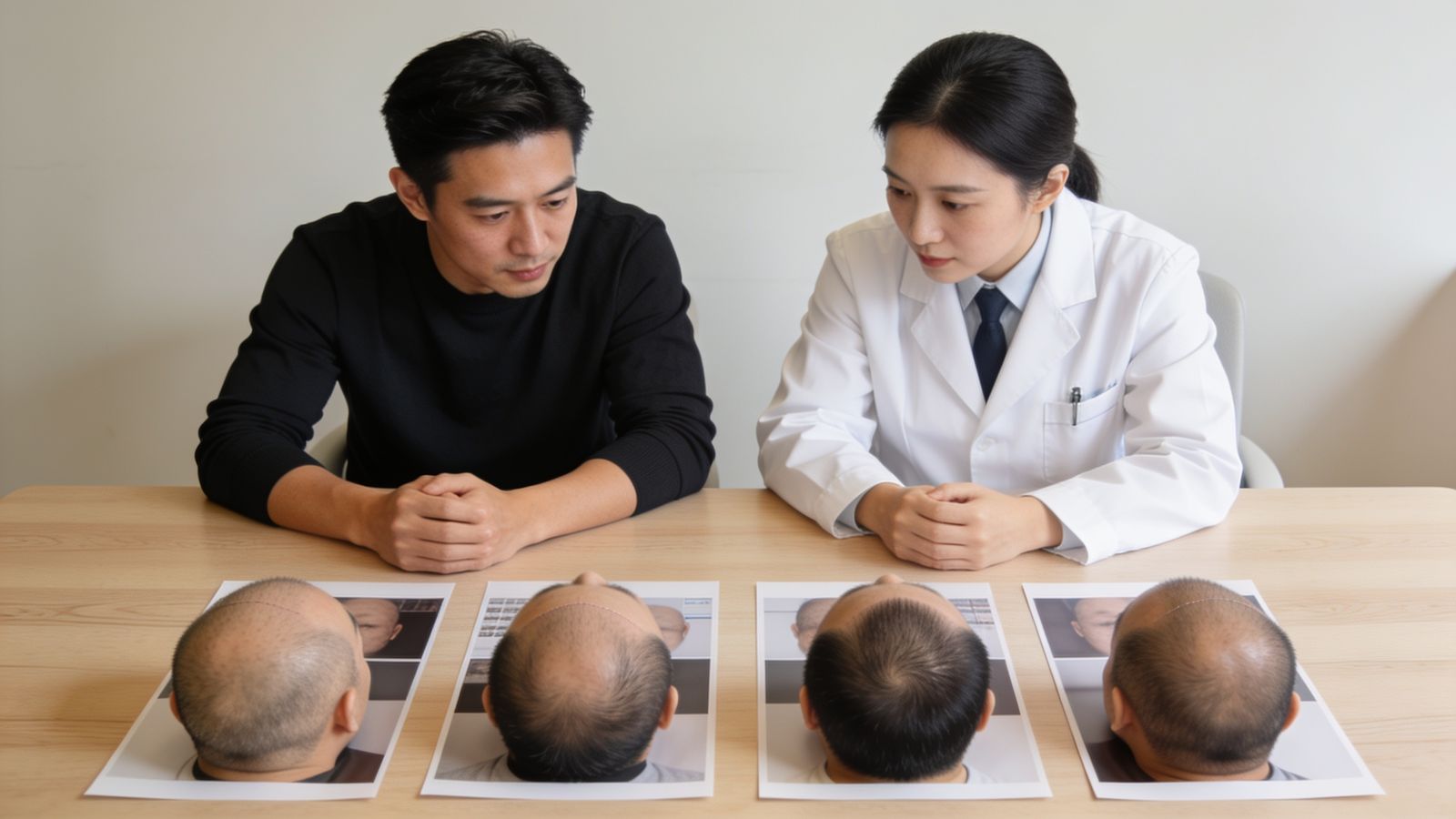
Who Regenera Activa suits, and who it does not
- Suits: early to moderate androgenetic alopecia in men and women, roughly Norwood II to IV and Ludwig I to II, where thinning follicles are still visible on close examination; people who want to add a non-drug option to medical treatment, or who cannot take certain medicines.
- Less suited: advanced loss with a smooth, shiny scalp, where few follicles remain to respond; very high expectations of regrowth on bald areas.
- Treated differently first: shedding after illness, childbirth or stress (telogen effluvium), patchy alopecia areata, thyroid or iron problems, and scarring alopecias, which need diagnosis rather than micrografting.
- Postponed or avoided: active scalp infection or inflammation, bleeding disorders, pregnancy, and some autoimmune and medical conditions.
If micrografting is unlikely to help, that is said at the assessment, and the plan is built from the options that can. The full picture is on hair loss treatment Singapore.
How many Regenera Activa sessions, and when results show
Many plans begin with a single session, followed by reviews over the following months. Hair grows slowly and follicles change gradually, so any effect is judged against baseline photographs taken in the same position and light, usually from around three months and more clearly later. Whether a further session is worthwhile is decided at review, based on how your hair has responded.
| Stage | What usually happens |
|---|---|
| Session day | Sampling, processing and injection in one visit; you go home the same day. |
| Days 1 to 3 | Tenderness settles; a little swelling can track towards the forehead. |
| Week 1 | Donor sites heal with small scabs. |
| From around three months | Response judged against baseline photographs, and more clearly later. |
| At review | Whether a further session or maintenance is worthwhile is decided. |
Regenera Activa compared with other hair loss treatments
| Option | How it works | Usually suits | At IN Eternity Clinic |
|---|---|---|---|
| Topical minoxidil | Prolongs the growth phase and supports follicle blood flow | Most pattern loss, men and women | Prescribed and reviewed; see hair loss medicines |
| Prescription anti-androgen tablets | Reduce the hormonal driver of pattern loss | Suitable men; selected women | Prescribed after assessment |
| H2LT laser therapy | Low-level laser directed at scalp perfusion and the follicle environment | Thinning hair, alone or combined | Hair restoration (H2LT) |
| Regenera Activa | Autologous micrografts acting on miniaturising follicles | Early to moderate pattern loss | This page |
| Hair transplant | Surgically moves intact follicles to thinning areas | Stable, advanced loss with good donor hair | Referral discussed where appropriate |
More on the laser programme is on H2LT laser hair regrowth therapy.

“Regenera Activa does not move a single follicle. It is for hair that is thinning, not hair that has already gone, which is why staging comes before anything else.”
Regenera Activa side effects and risks
Regenera Activa is a minor procedure under local anaesthetic, and the published case series report few complications. These are the effects to expect and the ones to report.
Common and expected
- Stinging from the anaesthetic injections, then pressure and tugging during sampling.
- Tenderness, pinkness and mild swelling of the scalp for a day or two; swelling can occasionally track towards the forehead.
- Small scabs at the three sampling sites, healing over about a week.
Uncommon
- A small visible mark at a sampling site, noticeable mainly if the hair is clipped very short.
- Infection at a sampling or injection site.
- Bruising, headache or a brief faint feeling during the procedure.
- Little or no change in density, particularly where few follicles remain.
When to call the clinic
- Fever, spreading redness, pus or increasing pain at the back of the scalp after Regenera Activa sampling.
- A rash, hives or swelling of the face after starting any topical or oral hair medicine: stop it and contact the clinic the same day.
- Chest pain, a racing heart, fainting or marked ankle swelling while on hair medicine: seek urgent medical care first, then tell the clinic.
- Sudden patchy loss, a painful or burning scalp, or shedding that keeps worsening after three months: these point to a different cause and need re-examination.
Medicines used alongside it have their own side effects, set out on anti-hair-loss medications.
More questions answered
How long does stem cell hair treatment last?
Autologous micrografting is usually a single session with changes judged at six to twelve months; many people repeat it yearly and continue medical hair treatment, because the underlying thinning process continues.
Does stem cell hair treatment actually work?
True stem cell hair therapy is not an approved treatment in Singapore. What is offered is autologous micrografting such as Regenera Activa, which uses your own scalp tissue to support thinning follicles, with evidence of improved density in early to moderate thinning. Results vary.
Is Regenera Activa a stem cell hair treatment?
Regenera Activa is sometimes called a stem cell hair treatment because the micrografts, taken from a small sample of your own scalp, contain progenitor cells and growth factors. It is an autologous micrograft treatment, not a cultured stem cell therapy.
Is Regenera Activa available in Singapore?
Yes. At IN Eternity Clinic on Orchard Road, Medical Director Dr Sin Yong stages the hair loss first and performs Regenera Activa himself under local anaesthetic, in a single session. The technology is CE-certified for androgenetic alopecia. It suits early to moderate pattern thinning in men and women and is usually combined with medical or laser treatment.
Does Regenera Activa use PRP or blood?
No. Regenera Activa uses tissue, not blood: three 2.5 mm samples are taken from the back of your own scalp and mechanically broken down into micrografts suspended in saline. No enzymes or culturing are involved. The suspension contains progenitor cells, signalling factors and extracellular matrix from your own tissue, and is injected into thinning areas in the same session.
What is Rigenera technology?
Rigenera is the processing technology behind Regenera Activa. The scalp samples are mechanically disaggregated and filtered into micrografts of about 80 microns, producing a suspension of progenitor cells, signalling factors and extracellular matrix. It is not a hair transplant, because no follicles are moved, and it is not accurately a stem cell treatment, since progenitor cells are more restricted.
What should I expect in the first days after Regenera Activa?
You go home the same day. The scalp may look pink and slightly puffy where it was injected, and the donor sites and treated scalp can feel tender or tight for a day or two. A little swelling can occasionally track towards the forehead and fades on its own. Strenuous exercise, swimming and hair colouring are avoided for the time advised.
Will I need to shave my head for Regenera Activa?
No. The three small samples are taken from the back of the scalp, and at most a very small patch of hair there is trimmed, which the surrounding hair covers. The thinning areas are injected through the existing hair. Most people leave the clinic with their hairstyle largely unchanged.
Can I go back to work the same day after Regenera Activa?
Many people return to work the next day, and some the same afternoon. The scalp may be pink and tender, and the donor sites have small dressings or scabs hidden under the hair. Strenuous exercise, swimming and hair treatments such as colouring are postponed for the period advised at your visit.
Will people notice I had a hair treatment?
Usually not. The donor sites at the back are tiny and hidden by hair, and any redness on the treated scalp fades within a few days. Because any change in the hair is gradual, people tend not to notice a sudden difference, which many patients prefer.
Does Regenera Activa work?
Studies of autologous scalp micrografts report improved hair density in many people with early to moderate pattern loss, though results vary and the studies are smaller than for established medicines. It is aimed at thinning follicles that are still present, and is usually combined with medical or laser treatment.
How long until I see results from Regenera Activa?
Change is gradual because hair grows slowly. Progress is usually judged from around three months and more clearly later, against photographs taken at the start. Shedding or slow change in the first weeks does not mean it has failed.
Can Regenera Activa be combined with H2LT laser or medication?
Yes, and it often is. Medication acts on the hormonal driver and blood flow, H2LT laser on the scalp environment, and micrografting on the follicles themselves. Combining routes suits a progressive condition; the mix is set at assessment.
Does Regenera Activa leave scars at the back of the scalp?
The three 2.5 mm sampling sites heal over a week or so with small marks that are usually hidden by surrounding hair. A very small scar can remain at each site, but it is rarely noticeable unless the hair is cut very short.
Frequently Asked Questions
Regenera Activa is an autologous micrografting treatment for hair loss. Three small 2.5 mm punch biopsies are taken from the occipital scalp, mechanically disaggregated and filtered to produce a suspension of progenitor cells, signalling factors and extracellular matrix, which is then injected into the thinning areas. Because the tissue comes from the patient, donor and recipient are the same person within one session.
No. A hair transplant moves intact follicular units from a donor area to a recipient area, and the transplanted hairs are the result. Regenera Activa does not move follicles. It introduces a cellular suspension intended to act on follicles already present in the thinning area. The two are different procedures answering different situations, and in some cases they are used alongside one another.
Female pattern hair loss is one of the presentations Regenera Activa is used for. Female pattern loss usually presents as diffuse thinning over the crown with the frontal hairline preserved, staged on the Ludwig scale, and behaves differently from male pattern loss. Suitability is decided by assessment rather than by pattern alone.
The Norwood scale is the standard classification for male pattern hair loss, running from Type I to Type VII. It describes the progression from minimal temporal recession through to loss of the bridge between the frontal and vertex regions. Staging matters because earlier stages retain more miniaturising follicles capable of responding to treatment.
The Ludwig scale classifies female pattern hair loss in three grades. Grade I is perceptible thinning over the crown with the hairline preserved; Grade II shows pronounced widening of the central parting; Grade III shows diffuse thinning with the scalp readily visible. Unlike male pattern loss, the frontal hairline is typically maintained throughout.
They are related but not identical, and the distinction is worth making because the treatment is often described loosely as a stem cell procedure. Progenitor cells are more restricted in what they can become than stem cells are. The suspension produced by micrografting contains progenitor cells alongside signalling factors and extracellular matrix. Describing it as a stem cell transplant overstates what the procedure does.
Not necessarily. Topical minoxidil acts on follicular perfusion and prescription anti-androgen medication blocks the conversion of testosterone to DHT, addressing the hormonal driver. Micrografting acts through a third route. Because androgenetic alopecia is progressive, plans commonly combine approaches rather than relying on one, and what is appropriate is decided at consultation.
Local anaesthetic is used at both the donor and recipient sites. Most patients describe pressure rather than pain. Tolerance varies between individuals, and comfort is discussed and managed during the session.
Cost depends on the extent of the area treated, the stage of hair loss identified at assessment, and whether the plan combines micrografting with medical or laser management. Because these differ between patients, a figure quoted before assessment would not be meaningful. Pricing is set out clearly at consultation at IN Eternity Clinic.
Suitability is assessed in person. Scarring alopecia, active scalp infection or inflammation, certain autoimmune and medical conditions, bleeding disorders, and pregnancy are among the things considered. Very pronounced hair loss with few remaining follicles is also unlikely to benefit, and saying so is part of an honest assessment.
Regenera Activa works gradually and is delivered as a spaced course, with maintenance thereafter. The number of sessions depends on your degree of hair loss and response, and is planned at consultation.
Regenera Activa works gradually and is maintained over time rather than being a one-off fix, since hair loss is progressive. The maintenance pattern is planned individually at IN Eternity Clinic.
A hair transplant surgically relocates intact follicles; Regenera Activa does not move follicles at all. It takes small scalp samples, processes them into a suspension of progenitor cells and signalling factors, and injects that into thinning areas to act on follicles already present. They answer different situations and are sometimes combined, decided at assessment at IN Eternity Clinic.
For suitable patients it is generally well tolerated. The material is your own scalp tissue, processed in the same session, so there is no donor or foreign product, and it is done under local anaesthetic. Expected effects are tenderness and small scabs at the sampling sites; infection and visible marks are uncommon. Bleeding disorders, scalp infection and pregnancy are reasons to postpone or avoid it. Other causes of thinning are covered under hair concerns.
Colouring, rebonding and perming are usually postponed for a week or two while the sampling sites heal and the scalp settles, because the chemicals can sting and irritate treated skin. If a colour appointment is due, it is often easier to have it a week before the procedure. The exact timing is given at your visit.
It can be, where the hairline is thinning rather than bare. Micrografts act on miniaturising follicles, so temples with fine, short hairs may respond, while smooth temples that have been bare for years are less likely to. Recession is common in early male pattern loss, and the plan usually pairs Regenera Activa with medicine; see receding hairline treatment.
Usually not. Prescription and topical hair loss medicines are generally continued, because stopping them can let shedding restart and blur the assessment of the procedure. Topicals may be paused on the scalp for a day or two around the visit. Blood thinners and supplements that affect bleeding are discussed in advance and changed only with your own doctor’s agreement.
Regenera Activa is often described as a stem cell treatment; see stem cell hair treatment explained.
References
- Gentile P, Scioli MG, Cervelli V, Orlandi A, Garcovich S. Autologous micrografts from scalp tissue: trichoscopic and long-term clinical evaluation in male and female androgenetic alopecia. Biomed Res Int 2020;2020:7397162. doi:10.1155/2020/7397162
- Zari S. Short-term efficacy of autologous cellular micrografts in male and female androgenetic alopecia: a retrospective cohort study. Clin Cosmet Investig Dermatol 2021;14:1725-1736. doi:10.2147/CCID.S334807
- Ruiz RG, Rosell JMC, Ceccarelli G, et al. Progenitor-cell-enriched micrografts as a novel option for the management of androgenetic alopecia. J Cell Physiol 2020;235(5):4587-4593. doi:10.1002/jcp.29335
- Kanti V, Messenger A, Dobos G, et al. Evidence-based (S3) guideline for the treatment of androgenetic alopecia in women and in men - short version. J Eur Acad Dermatol Venereol 2018;32(1):11-22. doi:10.1111/jdv.14624
- Singapore Medical Council. Guidelines on Aesthetic Practices for Doctors (2016 edition). healthprofessionals.gov.sg/smc
These sources describe mechanisms and general evidence. They are not a promise of any individual result; suitability is decided at an in-person assessment.
Consult at IN Eternity Clinic
Every treatment plan is set by Medical Director Dr Sin Yong, tailored to your specific concern for a natural outcome. Consultations are by appointment at 9 Scotts Road, #12-01 Pacific Plaza, Singapore 228210.
Book My Appointment →Preparation, women and repeat treatment
How should I prepare for Regenera Activa?
Wash your hair the morning of treatment, avoid blood thinners such as aspirin and fish oil for about a week if your doctor agrees, and avoid alcohol the day before. Tell the doctor about scalp conditions, infections and medicines. Wear a button-up top so nothing pulls over your head afterwards.
Can women have Regenera Activa?
Yes. Regenera Activa is used for female pattern hair loss and diffuse thinning, often with other treatments. Women with hair loss are usually checked for iron deficiency, thyroid problems and hormonal causes first. It is postponed during pregnancy and breastfeeding.
Can Regenera Activa be repeated?
Yes. Many people have one session and review the result over six to twelve months. A repeat session may be considered after about a year if thinning continues or the effect fades. Ongoing medicines or laser help maintain the result between sessions. Results vary.