
Back Acne Scars: Treatment in Singapore
Scars on the back, shoulders and chest behave differently from facial scars, and raised scars are more common there. Medical Director Dr Sin Yong sorts marks from scars at our Orchard Road clinic before choosing any treatment.
WhatsApp to Enquire →Key facts ↓Back acne scar treatment is matched to scar type and zone. Indented scars on the back are usually treated with a course of RF microneedling or fractional CO2, with subcision for scars tethered from below. Raised scars, common on the shoulders and chest, are flattened rather than resurfaced. Flat brown or red marks are not scars and fade with time and sun care. Active back acne is controlled first.
This page covers scars on the back, chest and shoulders. For acne scars on the face, see acne scar treatment in Singapore.
Back acne scar treatment at a glance
| Question | Back acne scar treatment |
|---|---|
| What it is | A course of treatment for scars left by acne on the back, shoulders and chest, matched to scar type and zone. |
| Used for | Indented (rolling and boxcar) scars, and raised hypertrophic scars or keloids; flat brown or red marks are treated separately. |
| How it works | Indented scars: RF microneedling on Secret Duo, fractional CO2 on the DEKA Tetra PRO and subcision for tethered scars. Raised scars: flattened with injections into the scar and silicone, sometimes laser. |
| Typical sessions | Typically 3–6 sessions, depending on severity, six to eight weeks apart; raised scars may need repeated injections a few weeks apart. |
| Downtime | Redness and a sandpaper feel after RF microneedling; small crusts after CO2 that shed in about a week, a little more slowly than on the face. |
| When results show | The surface looks normal within weeks while collagen remodels; scars are compared with the first photographs at about six to eight weeks. |
| Who should avoid or wait | Active back acne or fungal folliculitis (treated first); a keloid tendency needs extra care and sometimes a test area; resurfacing of raised scars is avoided. |
| Who performs it | Dr Sin Yong, who maps and photographs the scars and sets the plan. |
Dr Sin Yong, Medical Director of IN Eternity Clinic, explains that on the shoulders and chest he checks for raised scars before anything else, because resurfacing a scar that wants to thicken can make it worse rather than flatter.
On this page
- What counts as a scar: a change in the structure of the skin, either indented (atrophic) or raised (hypertrophic or keloid). Flat brown or red marks are pigment or small vessels, not scars.
- Why the back is different: the dermis on the back is thicker, the skin is under constant tension from movement, and it heals more slowly than the face, so plans and recovery differ.
- Raised scars: more frequent on the upper back, shoulders and chest. They are treated to flatten them; aggressive resurfacing can aggravate a scar that tends to thicken.
- Indented scars: mostly rolling and boxcar on the back, treated at IN Eternity Clinic with RF microneedling on Secret Duo, fractional CO2 on the DEKA SmartXide Tetra PRO and subcision.
- Before starting: active acne is brought under control and fungal folliculitis is excluded, so new spots are not forming while old scars are treated.
- Where: IN Eternity Clinic, 9 Scotts Road, #12-01 Pacific Plaza, Singapore.
- In a study of fractional radiofrequency microneedling, acne scar grade and large pores improved in more than 70% of patients, with measured gains in skin roughness and dermal density (Dermatol Surg 2012)
- A widely used classification sorts atrophic acne scars into ice-pick, rolling and boxcar types, each suited to different treatments (J Am Acad Dermatol 2001)
Mark, indented scar or raised scar: which is on your back?
Most people who ask about back acne scars have a mixture of three different things. Flat marks are the commonest: brown patches of post-inflammatory hyperpigmentation where inflammation stirred up pigment cells, or red and purple spots where small vessels stayed dilated. They have no change in texture and usually fade over months. Indented scars are dips where collagen was destroyed by deep inflammation and not fully replaced. Raised scars are firm, shiny ridges or bumps where the skin made too much collagen while healing.
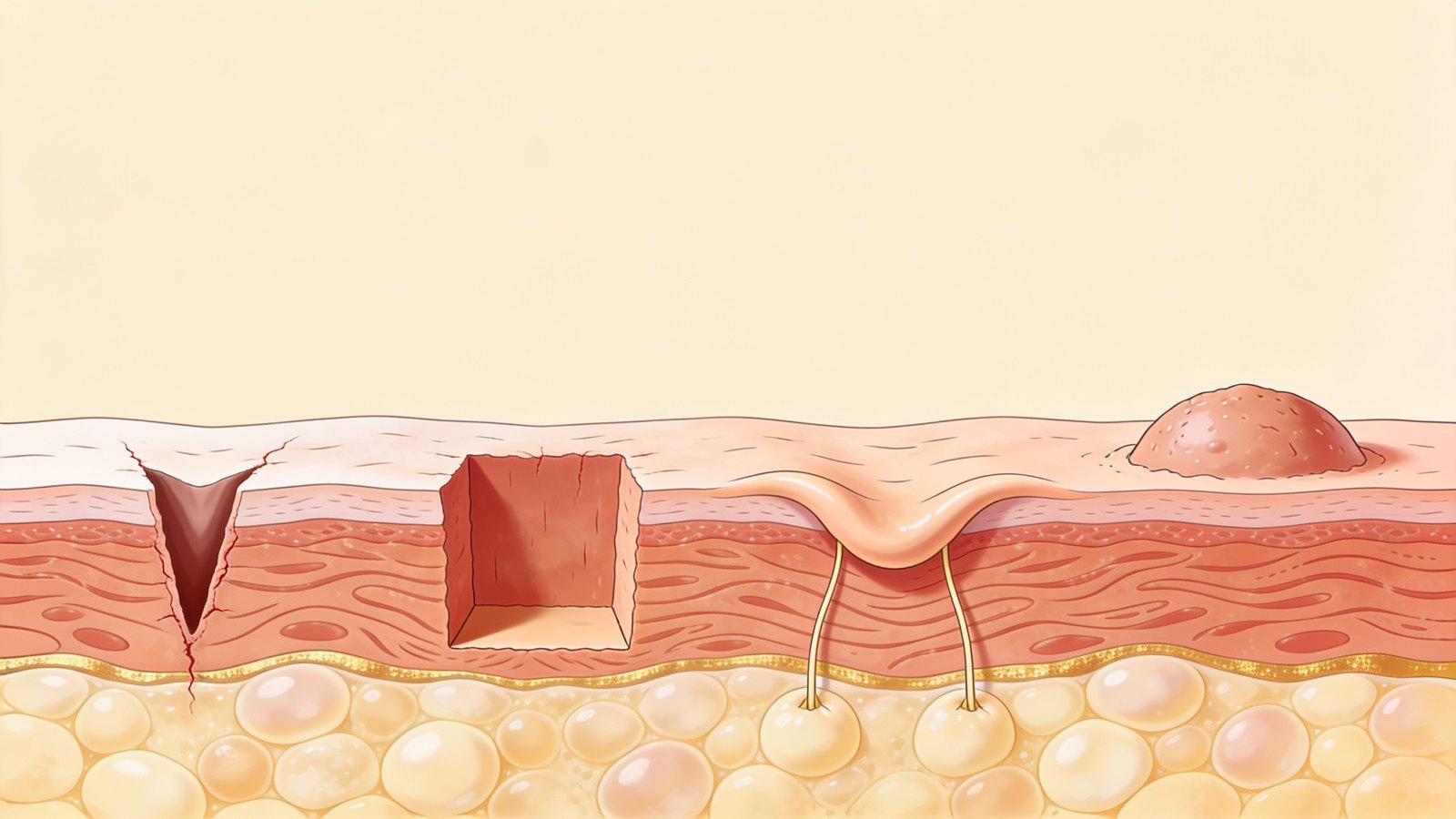
Raised scars matter most on the back. Hypertrophic scars stay within the boundary of the original spot and often soften over a year or two. Keloids grow beyond it, can itch or hurt, and do not settle by themselves. Both are more likely on the upper back, shoulders and front of the chest, where skin is under tension, and keloids are more common in people with a personal or family history of them.
Dr Sin Yong examines the back in good side lighting, feels each scar, and checks whether indented scars soften when the skin is stretched, a sign of tethering underneath. He asks about previous keloids, ear-piercing scars and any isotretinoin (a prescription medicine) taken recently, because each changes the plan. See post-inflammatory pigmentation for flat brown marks.
Acne scars on the back: what differs, zone by zone
Back acne scars follow the same rules as facial scars, with three differences: the skin is thicker, it heals more slowly, and raised scars are far more common, especially on the upper back, shoulders and chest. A plan that works on the cheek can therefore be wrong for the shoulder.
| Zone | Scars usually seen | Usual first approach | Watch for |
|---|---|---|---|
| Upper back and shoulders | Raised hypertrophic scars and keloids; rolling and boxcar dips | Flatten raised scars first; RF microneedling for indented ones | Keloid tendency; tension from movement |
| Front of the chest | Keloids, often from small spots; brown marks | Injections into the scar, silicone; no aggressive resurfacing | Keloids that grow, itch or hurt |
| Mid and lower back | Shallow rolling and boxcar scars; marks | RF microneedling or fractional CO2 at conservative settings | Slow healing; backpack and chair friction |
| Back of the arms | Marks and shallow scars; often mixed with bumpy skin | Mark treatment and skin care first | Keratosis pilaris mistaken for scarring |
Singapore adds its own pressures. Heat and humidity mean sweat sits on the back for long periods, and gym training, tight synthetic tops and backpacks keep the skin warm, occluded and rubbed, all of which keep back acne active and slow healing after treatment. Sessions are timed so the first week after treatment can be spent in loose cotton, away from the gym, swimming and heavy bags.
New scars stop forming only when the spots stop, so active back acne, and any fungal folliculitis that looks like it, is treated first; see back acne treatment in Singapore. The full range of scar treatments, and how they are matched to scar type, is on acne scar treatment in Singapore.

How are back acne scars treated at IN Eternity Clinic?
Indented scars. RF microneedling on Secret Duo releases heat at a set depth beneath the surface, which suits the thicker skin of the back and limits surface injury. Fractional CO2 laser on the DEKA SmartXide Tetra PRO resurfaces scar edges and texture, with settings kept conservative on the trunk because it heals more slowly than the face. Broad rolling scars held down by fibrous bands may need subcision first, so the scar floor can rise before resurfacing.
Raised scars. These are flattened rather than resurfaced. Options include corticosteroid injections into the scar (a prescription medicine), silicone gel or sheeting, and in some cases laser to reduce redness and thickness. Large, painful or growing keloids may need specialist care, and Dr Sin Yong will say so if referral is the right step. He will tell you at assessment which option he recommends and why.
Flat marks. Brown marks can be faded with picosecond laser such as T2 Frax Radiance on DEKA TORO or with laser toning, together with sun protection on any exposed shoulders. Red marks often settle on their own. Because marks and scars respond to different tools, they are planned separately even when they sit side by side.
“On the shoulders and chest, I check for raised scars before anything else. Resurfacing a scar that wants to thicken can make it worse, not flatter.”
Does it hurt? Comfort and numbing
The back is a large area, so it is usually treated in zones. Numbing cream is applied for 30 to 45 minutes before RF microneedling or CO2 laser, and the treated area is kept cool. RF microneedling feels like prickling with a short burst of heat at each pass; CO2 laser feels hot and snappy, and the skin feels sunburnt for some hours afterwards.
Subcision is done under local anaesthetic, which stings briefly as it goes in; after that most people feel pressure and tugging rather than sharp pain. Injections into raised scars sting because the scar tissue is dense, and a fine needle and slow injection help. Lying face down for the session is the main inconvenience, and breaks are given when needed.
What to expect: day by day
Day 0. Scars are mapped and photographed in the same lighting. After RF microneedling or CO2, the back is red, warm and may show a fine grid pattern. Loose cotton clothing is advised.
Days 1–3. Redness and a sandpaper feel after RF microneedling; after CO2, small crusts form over the treated columns. Shower gently, avoid scrubbing, and skip the gym, swimming and backpacks on the treated area.
Week 1. Crusts shed, usually a little more slowly than on the face. Bruising from subcision changes colour and fades. Avoid sun exposure on treated shoulders.
Weeks 2–4. The surface looks normal again while collagen remodelling continues underneath. Any new darkening is reported early so it can be treated.
Review at about six to eight weeks. Scars are compared with the first photographs and the next session is planned. Most back scar plans run as a course of typically 3–6 sessions, depending on severity.
Risks, and who should wait
The main risks are post-inflammatory pigmentation in Asian skin, prolonged redness, infection and, on the chest and shoulders in particular, a scar thickening after treatment. People with a history of keloids are assessed with extra care; a small test area may be treated first, and energy and density are kept low. Treatment waits while acne is still active, during pregnancy, in the presence of skin infection, and around isotretinoin according to the timing guidance. Results vary: scars are remodelled, not erased.
How is back acne scar treatment done, step by step?
The back is a large area, so it is treated in zones, and each visit follows the same order.
- Mapping with Dr Sin Yong: scars are examined in side lighting, raised scars are identified first, marks are separated from scars and tethering is checked.
- Preparation: photographs in the same lighting, then numbing cream for 30 to 45 minutes; local anaesthetic is used for subcision.
- Treatment by zone: tethered scars are released with subcision, then RF microneedling or fractional CO2 at conservative settings; raised scars are injected rather than resurfaced.
- Straight after: the back is red and warm and may show a fine grid; loose cotton clothing is advised.
- The next days: shower gently without scrubbing, and skip the gym, swimming and backpacks on the treated area; keep treated shoulders out of the sun.
- Review: at about six to eight weeks scars are compared with the first photographs and the next session is planned.
How many sessions do back acne scars need?
Most back scar plans are a course of typically 3–6 sessions, depending on severity, spaced six to eight weeks apart.
| Scar type | Usual approach | Course |
|---|---|---|
| Indented (rolling, boxcar) | RF microneedling or fractional CO2; subcision first if tethered | Typically 3–6 sessions, six to eight weeks apart |
| Raised (hypertrophic, keloid) | Injections into the scar and silicone | Repeated injections a few weeks apart |
| Flat brown marks | Pico laser or laser toning, with sun protection | Planned separately |
| Active acne | Controlled first | Before the scar course starts |
What back acne scar results look like over time
Back skin heals more slowly than the face, so change is judged over months.
| When | What you may notice |
|---|---|
| Day 0 | Red, warm skin, sometimes a fine grid pattern. |
| Week 1 | Crusts shed, a little more slowly than on the face; bruising from subcision fades. |
| Weeks 2–4 | The surface looks normal while collagen remodels underneath. |
| Six to eight weeks | Scars compared with the first photographs; the next session planned. |
| Across the course | Indented scars can become shallower and smoother and raised scars flatter; no treatment erases a scar. |
What affects the cost of back acne scar treatment in Singapore
Back scar plans vary more than facial ones, because the area can be a small patch or the whole upper back, chest and shoulders. These factors set the total. How fees work is on fees and consultation, and published prices for single steps are compared in the acne scar removal cost guide.
| What affects the cost | Why it matters |
|---|---|
| Areas treated | Upper back, shoulders, chest and lower back differ in size, and surface area drives the time each session takes. |
| Scar types present | Indented scars are resurfaced and raised scars are flattened with injections, so each runs as its own course. |
| Number of sessions | The trunk heals more slowly than the face, so sessions are spaced further apart; the count is set after mapping. |
| Method used | RF microneedling, fractional CO2 on the DEKA Tetra Pro, subcision and injections into raised scars differ in time and materials. |
| Acne and mark treatment | Active back acne treatment and pigment laser for brown marks are planned and priced separately. |
| Assessment findings | A keloid tendency or a history of dark marks may mean a test area first and more conservative sessions. |
At IN Eternity Clinic a consultation fee applies, and it is waived if you go ahead with any medical treatment; the fee is S$120.
Prevention, peels for marks and preparation
Can back acne scars be prevented?
Treating back acne early is the most useful step, especially deep painful spots that are likely to scar. Shower after sweating, wear breathable clothing, avoid picking, and see a doctor if over-the-counter washes have not helped within a few months. People prone to raised scars on the chest and shoulders should treat acne there promptly.
Can chemical peels help back acne marks?
Yes. Peels can fade brown marks and help clear blocked pores on the back over a course of sessions. They do not lift indented scars much on their own, which need RF microneedling or laser. Body peels are chosen carefully in darker skin to avoid irritation and darkening.
How should I prepare for back acne scar treatment?
Avoid sunburn or a fresh tan on the back, stop exfoliating body washes and retinoids for a few days, and tell the doctor about keloids, cold sores, isotretinoin and pregnancy. Wear a loose, dark top to the appointment. Plan to avoid the gym and tight bra straps for a day or two after.
Frequently asked questions about back acne scar treatment Singapore
What is the recommended treatment for back acne scars?
Back acne scars are treated by type: fractional laser or RF microneedling for texture and boxcar scars, TCA CROSS for pits, laser toning for dark marks, and medical treatment to control active acne first. A course is planned after assessment.
Do back acne scars fade away?
Red or dark marks on the back fade over months to a year; true scars with texture change, pits or raised areas, do not fade on their own and need treatment such as fractional laser, RF microneedling or TCA CROSS.
What does back acne scar treatment in Singapore involve?
Back acne scar treatment at IN Eternity in Singapore depends on scar type: fractional laser or RF microneedling for texture and boxcar scars, TCA CROSS for pits, and treatment of dark marks with gentle laser. Active back acne is controlled first.
Can back acne scars be removed completely?
No treatment erases a scar. Indented scars can be made shallower and smoother over a course of RF microneedling, fractional CO2 or subcision, and raised scars can be flattened and softened. How much change is possible depends on scar type, depth, skin type and healing, and is discussed honestly at assessment.
How many sessions do back acne scars need?
Most people need a course of typically 3–6 sessions, depending on severity, spaced six to eight weeks apart, because collagen remodels slowly and back skin heals more slowly than the face. Raised scars may need repeated injections a few weeks apart. Dr Sin Yong estimates the number after mapping your scars, and adjusts it at each review.
Why do I get raised scars on my chest and shoulders?
Skin on the upper back, shoulders and chest is under more tension and movement, and healing there tends to produce excess collagen. Genetics also play a part, so a personal or family history of keloids raises the chance. Deep, inflamed acne and picking increase the risk, which is another reason to treat active acne early.
Is CO2 laser safe on the back for Asian skin?
It can be used with care. Asian skin carries a higher risk of post-inflammatory pigmentation after any laser, and the trunk heals more slowly than the face, so settings are conservative and aftercare, including sun avoidance on treated areas, matters. RF microneedling, which injures less of the surface, is often preferred for back scars.
Can I treat back scars while I still get spots?
It is usually better to wait until acne is controlled. Treating scars while new spots keep appearing means new marks and scars form during the course, and inflamed skin heals less predictably. Brown marks can sometimes be treated earlier. Your acne plan and scar plan can be made at the same visit and sequenced.
How much does back acne scar treatment cost in Singapore?
Cost depends on how large an area is involved, which scar types are present, which treatments are combined and how many sessions the plan needs. Raised scars and indented scars are planned differently. The full plan and its cost are explained after assessment, and the consultation fee is waived with any medical treatment.
Are back acne scars harder to treat than facial scars?
Often, yes. Back skin is thicker, heals more slowly and is more prone to raised scars, so energy is kept conservative, sessions are spaced further apart and raised scars are flattened before any resurfacing. Indented back scars can still improve over a course.
Can I go to the gym after back acne scar treatment?
Usually not for the first several days. Sweat, friction and heat on freshly treated skin raise the risk of irritation, infection and darkening. Light activity in loose cotton is fine; full training resumes once the skin has settled, as advised at review.
Can RF microneedling treat back acne scars?
Yes, and it is often the first choice for indented scars on the back. Insulated needles release heat at a set depth, which suits thicker back skin and leaves less surface injury than CO2, with a lower risk of darkening. It does not release tethered scars or flatten raised ones, so subcision or injections are added where needed. See RF microneedling.
When can I carry a backpack or wear a bra strap after treatment?
Usually after several days, once redness has settled and any crusts have shed. Straps rub the same spots again and again, and friction on freshly treated skin raises the risk of irritation and darkening. Loose cotton tops and a bag carried by hand help in the first week. The wait after CO2 is longer than after RF microneedling, and your written aftercare gives the timing.
Will the brown marks on my back fade without laser?
Usually, slowly. Brown marks are post-inflammatory pigmentation and tend to fade over months once spots stop, faster with sun protection on exposed shoulders. Laser toning or pico laser can speed up stubborn ones. Marks have no change in texture; if a spot still feels indented or raised, it is a scar. See post-inflammatory pigmentation.
Can keloids on the chest be removed?
They can usually be flattened and softened, most often with a course of injections into the scar and silicone. Cutting a keloid out on its own often leads to it returning, sometimes larger, so excision is only considered with an added treatment and, where needed, referral. Resurfacing lasers are avoided on growing keloids; see keloid and hypertrophic scar treatment.
Is subcision used on back acne scars?
For broad rolling scars on the back that soften when the skin is stretched, yes. Subcision cuts the fibrous bands that hold the scar down, so the floor can rise before RF microneedling or CO2 refines the surface. Bruising on the back can last a little longer than on the face. It is not used on raised scars; see subcision.
Book an assessment
IN Eternity Clinic, 9 Scotts Road, #12-01 Pacific Plaza, Singapore 228210. By appointment with Medical Director Dr Sin Yong. Monday to Saturday, 11am to 8pm. WhatsApp or call +65 8815 3008.
International KOL — CLASSYS · HIRONIC · DEKA · ALMA · FOTONA · LUTRONIC
References
- Jacob CI, Dover JS, Kaminer MS. Acne scarring: a classification system and review of treatment options. J Am Acad Dermatol 2001;45(1):109-117. doi:10.1067/mjd.2001.113451
- Ogawa R. Keloid and Hypertrophic Scars Are the Result of Chronic Inflammation in the Reticular Dermis. Int J Mol Sci 2017;18(3):606. doi:10.3390/ijms18030606
- Cho SI, Chung BY, Choi MG, et al. Evaluation of the clinical efficacy of fractional radiofrequency microneedle treatment in acne scars and large facial pores. Dermatol Surg 2012;38(7):1017-1024. doi:10.1111/j.1524-4725.2012.02402.x
- Orentreich DS, Orentreich N. Subcutaneous incisionless (subcision) surgery for the correction of depressed scars and wrinkles. Dermatol Surg 1995;21(6):543-549. doi:10.1111/j.1524-4725.1995.tb00259.x
- Singapore Medical Council. Guidelines on Aesthetic Practices for Doctors (2016 edition). healthprofessionals.gov.sg/smc
- Ogawa R, Akita S, Akaishi S, et al. Diagnosis and treatment of keloids and hypertrophic scars — Japan Scar Workshop Consensus Document 2018. Burns Trauma 2019;7:39. doi:10.1186/s41038-019-0175-y
- Kravvas G, Al-Niaimi F. A systematic review of treatments for acne scarring. Part 2: energy-based techniques. Scars Burn Heal 2018;4:2059513118793420. doi:10.1177/2059513118793420
These sources describe mechanisms and general evidence. They are not a promise of any individual result; suitability is decided at an in-person assessment.