
Face Lifting Treatment Singapore
Sagging comes from skin, fat, ligaments or lost support, and each needs a different lift. At IN Eternity Clinic, Dr Sin Yong matches energy, threads or injectables to the way your face is ageing. Each face lift treatment here is non-surgical: energy devices, threads or injectables, chosen after assessment.
Non-surgical facial lifting combines energy devices, threads and fillers according to what is sagging, as compared below. Results vary.
Each face lifting treatment targets a different layer: energy devices for skin and supporting tissue, threads for repositioning and injectables for lost support.
Comparing surgical and non-surgical options first? See facelift Singapore.
WhatsApp to Enquire →Key facts ↓Face lifting treatment in Singapore is non-surgical care that works on different layers: focused ultrasound (HIFU, Ultherapy) and radiofrequency (Thermage, VF Lift – Vertical Facelift) tighten deeper tissue; Time Freeze Laser LCLR® tightens and reduces fat that drags a fuller face down; threads reposition tissue; fillers and collagen stimulators restore support. Lean and full faces need different choices. Dr Sin Yong decides by examining where your face has changed. See also our guide to facial fat grafting cost. See also our guide to medi-facial.
Face lifting treatment at a glance
| Question | Face lifting treatment |
|---|---|
| What it is | Non-surgical treatment that lifts or supports sagging facial tissue, without the incisions of a surgical facelift. |
| Used for | Early to moderate laxity: jowls and a soft jawline, cheek descent, nasolabial folds, crepey skin, the under-chin and neck. |
| How it works | Focused ultrasound or radiofrequency tighten deeper layers; Time Freeze Laser LCLR® tightens and reduces fat in fuller faces; threads or RVR ProLift reposition tissue; fillers and collagen stimulators restore support. |
| Typical sessions | Energy treatments are often a single session reviewed at about three months and commonly repeated every year or so; threads and injectables are checked within about two weeks. |
| Downtime | Mild redness or tenderness for a day or two after energy treatment; swelling or bruising for several days after threads or injectables. |
| When results show | Threads and injectables show some change straight away; energy treatments build over two to three months or longer. |
| Who should avoid or wait | Heavy folds of excess skin, deep jowls hanging well below the jaw and marked laxity after major weight loss (a surgical opinion fits better); very lean faces are not given fat-reducing heat. |
| Who performs it | Dr Sin Yong, who assesses which layer has moved and plans the treatment. |
Dr Sin Yong, Medical Director of IN Eternity Clinic, explains that tightening is not lifting and adding volume is not lifting either, so the first question is which layer of the face has actually moved.
On this page
- Energy lifting: HIFU and Ultherapy (focused ultrasound), Thermage FLX and VF Lift – Vertical Facelift (radiofrequency), Time Freeze Laser LCLR® (laser).
- Mechanical lifting: absorbable thread lifts, and RVR ProLift using collagen-stimulating agents along vertical vectors.
- Support: fillers and collagen stimulators such as Sculptra, Radiesse, Ellansé and Juvelook.
- Lean vs full faces: lean faces need lift without losing volume; fuller faces may benefit from fat reduction with tightening.
- Limits: heavy skin excess and deep jowls are usually better treated surgically.
- Where: IN Eternity Clinic, 9 Scotts Road, #12-01 Pacific Plaza, Singapore.
- In a rater-blinded study of focused ultrasound for the face and neck, 86% of people had a clinically significant brow lift at 90 days, averaging 1.7 mm (J Am Acad Dermatol 2010)
What is a face lifting treatment?
A face lifting treatment is any procedure that aims to move sagging tissue back up, or to make it look as if it has moved, without the incisions of a surgical facelift. Some heat the deeper layers so they contract and rebuild collagen; some place threads that hold tissue in a new position; some restore the support underneath with fillers or collagen stimulators. Each works on a different layer, so the right one depends on why your face is sagging.

Non-surgical treatments give a moderate change with little or no time off, and the change builds over weeks to months. A surgical facelift repositions deeper tissue and removes excess skin, gives a larger change and involves an operation and recovery. Many people in their thirties to fifties with early to moderate laxity are well served by non-surgical options; heavy skin excess usually is not. The wider facelift question is covered in facelift Singapore: surgical vs non-surgical options.
Why does the face sag? The five layers that change
Facial ageing happens in every layer at once, and in Asian faces it often shows first in the lower face and jawline.
- Skin. Collagen and elastin fall from the late twenties; skin becomes thinner and less springy.
- Superficial fat. Fat pads in the cheek descend and some deflate, so the cheek flattens and fullness gathers above the jaw as jowls.
- The SMAS and ligaments. The fibrous layer and the ligaments that anchor it loosen, letting tissue slide.
- Deep fat. Deep pads that support the midface shrink, removing scaffolding from beneath.
- Bone. The eye sockets widen and the cheekbone and jaw recede slightly, so the overlying tissue has less to drape over.
A lean face that has lost volume and a full face with heavy jowls can show the same sag along the jaw, for opposite reasons. Treating both the same way is where many disappointing results come from.
Face lifting treatments compared: HIFU, RF, laser, threads and injectables
| Option | How it works | Layer it targets | Typical recovery | Often suits |
|---|---|---|---|---|
| HIFU and Ultherapy | Focused ultrasound heats small points deep in tissue | SMAS and deep dermis | Redness or tenderness for a day or two | Early laxity, jawline, under-chin, faces with some fullness |
| Thermage FLX | Monopolar radiofrequency heats the dermis broadly | Dermis and fibrous septa | Usually mild redness | Crepey, loose skin, including the eyelids |
| VF Lift – Vertical Facelift | Volnewmer monopolar RF passed along vertical vectors | Dermis and fibrous structure | Mild redness | Lean or hollow faces wanting lift without losing volume |
| Time Freeze Laser LCLR® | Dual-wavelength laser for tightening plus point-zone fat reduction | Dermis and superficial fat | Mild swelling or redness | Fuller faces with jowls or fat obscuring the jawline |
| Thread lift | Absorbable threads with cogs reposition tissue | Subcutaneous tissue | Swelling or bruising for days | Moderate jowling, cheek descent |
| Collagen stimulators and fillers | Restore support or stimulate new collagen | Deep fat and bone level | Swelling or bruising for days | Volume loss, flattened cheeks, hollow temples |
The detailed comparison of three of these is in thread lift vs HIFU vs filler for sagging, and the energy devices are compared in Thermage vs Ultherapy and HIFU.
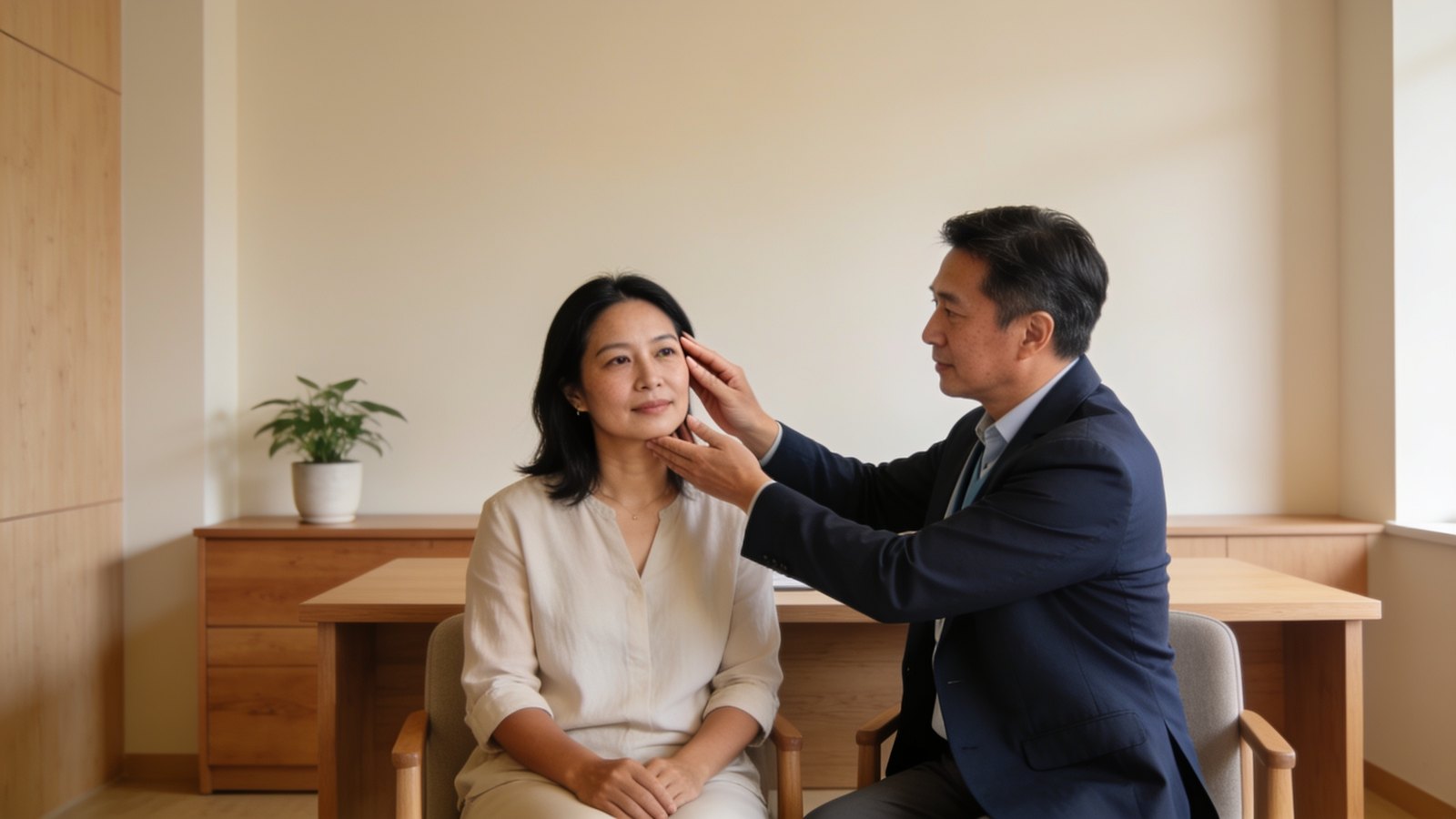
HIFU and Ultherapy: focused ultrasound face lifting
High-intensity focused ultrasound concentrates energy into tiny thermal points at set depths, including the SMAS, the layer a surgical facelift tightens. The heated points contract and then stimulate new collagen, so a mild lift and tightening build over two to three months. Ultherapy adds real-time ultrasound imaging so the practitioner can see the layers being treated; at IN Eternity Clinic, HIFU is also delivered on the CLASSYS Ultraformer MPT.
Focused ultrasound suits early laxity along the jaw, the under-chin and the brow. Because heat can also reduce fat, it is used more cautiously in very lean faces, where hollowing is a recognised side effect. Sensation is a deep prickling or ache over bone, managed with numbing and adjusted energy.
Thermage and VF Lift – Vertical Facelift: radiofrequency face lifting
Thermage FLX uses monopolar radiofrequency to heat the dermis and fibrous septa more broadly than ultrasound. Collagen contracts and then remodels over months, which firms crepey skin and can soften laxity on the face, neck and eyelids. It tightens more than it lifts, so it is often paired with a lifting step. Some lifting names describe gentle skin warming rather than lift; the titanium lift guide explains one of them.
VF Lift – Vertical Facelift is a protocol developed by Dr Sin Yong on the CLASSYS Volnewmer monopolar radiofrequency platform. Passes are planned along vertical vectors, against the direction in which that particular face has descended, rather than spread evenly. It is chosen particularly for lean or hollow faces, where the aim is lift and firmness without reducing volume that the face cannot spare. Change develops gradually over the following months, and the number of sessions is set at assessment. Threads are also used on the nose: the Hiko nose lift guide explains what PDO threads along the bridge and tip can and cannot change, and how long the effect lasts. What changes the face thread lift cost, from thread count to follow-up, is explained in a separate guide.
Time Freeze Laser LCLR®: lifting a fuller face
Time Freeze Laser LCLR® (Laser Collagen Lipo Remodelling) is Dr Sin Yong’s dual-wavelength laser protocol. It works at two depths in one session: tightening and collagen stimulation in the dermis, and a sculpting mode that reduces superficial fat where it has sagged into the jowls, nasolabial folds or under the chin, or where it blurs the jawline. It suits fuller faces with mild to moderate laxity, where removing a little of what drags the face down helps the lift.
The same protocol is used to take away the excess where collagen stimulators such as Sculptra or Ellansé have left too much fullness. Recovery is usually mild swelling or redness. Whether it, VF Lift – Vertical Facelift or another option suits your face is decided by examining where the weight sits.
“Tightening is not lifting, and adding volume is not lifting either. The first question is which layer of the face has actually moved.”
Thread lifts and RVR ProLift: repositioning tissue
A thread lift places absorbable threads with tiny cogs beneath the skin through fine entry points. The cogs grip the tissue so it can be repositioned upwards, and as the threads dissolve over months they leave a collagen response along their path. Threads give a more direct mechanical lift than energy treatments, which suits moderate jowling and cheek descent, at the cost of a few days of swelling, possible bruising and a period of tightness.
RVR ProLift (Refinement With Vertical Restoration) is Dr Sin Yong’s protocol in which biodegradable collagen-stimulating agents are placed along mapped vertical lifting vectors, aiming to reposition and support tissue rather than simply add volume. Thread complications and how they are avoided are covered in thread lift complications.
Collagen stimulators and fillers: lifting by restoring support
When the face sags because support has been lost, putting support back can lift the tissue above it. Hyaluronic acid filler placed deep over the cheekbone or along the jaw gives immediate structure; see cheek filler and dermal fillers. Collagen stimulators work more slowly, prompting the skin to make its own collagen over months: Sculptra (PLLA), Radiesse (CaHA), Ellansé (PCL) and Juvelook (PDLLA). Why the cheek drops, and how support and lifting combine there, is set out in sagging cheeks.
Injectables are placed with restraint. Adding volume to a face whose problem is laxity or heaviness can make it look larger and lower, not lifted. The difference between these products is in Sculptra vs Radiesse vs Ellansé.
Which face lifting treatment suits you?
The choice follows the face, not the device. As a broad guide:
- Lean or hollow face with early sagging: radiofrequency lifting such as VF Lift – Vertical Facelift, with conservative support from collagen stimulators or filler where volume is missing.
- Fuller face with jowls or a soft jawline: Time Freeze Laser LCLR® or focused ultrasound, sometimes with threads.
- Crepey, loose skin, including the eyelids: Thermage FLX, often with a skin-quality treatment.
- Moderate jowling or cheek descent: a thread lift or RVR ProLift, combined with an energy treatment for skin quality.
- Neck bands and a blurred jaw–neck angle: anti-wrinkle injections as a Nefertiti lift, and double chin treatment where fat is the issue.
For lifting around the eyes specifically, see eye lifting treatment. The wider picture of laxity and jowls is on sagging face treatment.
Lifting jowls, nasolabial folds, a sagging double chin and the neck
Jowls, nasolabial folds, a sagging double chin and a loose neck each have their own lifting option, and many faces need more than one. VF Lift – Vertical Facelift, Dr Sin Yong’s radiofrequency protocol on the CLASSYS Volnewmer, has three modes: Lift tightens and lifts the skin, giving a sharper jawline and softer nasolabial folds; Sculpt flattens areas that pouch or bulge, such as a puffy lower face, the bulge beside the nasolabial fold or a double chin; and Restore is customised to hollows and helps the patient’s own fat there regenerate, so volume develops over the following weeks. Nothing is injected.
| What you notice | Lifting options at IN Eternity Clinic | More |
|---|---|---|
| Jowls and a softening jawline | VF Lift – Vertical Facelift (Lift mode tightens and lifts the skin for a sharper jawline); focused ultrasound at the SMAS; threads or RVR ProLift for moderate descent; Time Freeze Laser LCLR® where fat weighs the jowl down | jowl treatment |
| Nasolabial folds and marionette lines | VF Lift – Vertical Facelift: Lift softens the folds, and Sculpt flattens the bulge beside the fold; Time Freeze Laser LCLR® where fat has sagged into the fold; support over the cheekbone where volume has been lost | marionette lines treatment |
| A sagging double chin | VF Lift – Vertical Facelift Sculpt mode flattens areas that pouch or bulge, with Lift for the skin above; Time Freeze Laser LCLR® or focused ultrasound where fat or laxity sits under the chin | double chin treatment |
| A loose neck | Volnewmer radiofrequency, Thermage or focused ultrasound for loose skin; a Nefertiti lift for bands; a surgical opinion for heavy loose skin | neck tightening · neck lines |
Which option suits your face, and in what order, is decided by examining where the weight sits and which layer has descended; VF Lift – Vertical Facelift and Time Freeze Laser LCLR® have their own pages.

When is a surgical facelift the better answer?
Non-surgical lifting has a ceiling. Heavy folds of excess skin on the neck, deep jowls that hang well below the jawline, and marked laxity after major weight loss are usually better addressed surgically, and repeated energy treatments will not substitute for removing skin. If that is the honest answer for your face, Dr Sin Yong will say so at assessment, and non-surgical treatment can still help skin quality before or after surgery.
Cost for non-surgical lifting depends on the treatment, the areas and how many are combined; the plan and its cost are set out after assessment, and the consultation fee is waived with any medical treatment.
Your face lifting treatment day, step by step
The tools differ, but a face lifting visit at IN Eternity Clinic follows the same order whichever is chosen.
- Consultation and assessment with Dr Sin Yong. He checks skin recoil, where the jowl sits, fat along the jaw and the bony support of the cheek and chin, then decides which layer has moved and whether energy, threads, injectables or a surgical referral fits.
- Preparation. Make-up is removed, photographs are taken and treatment lines or entry points are marked. Numbing cream is applied for focused ultrasound, threads and injectables.
- The treatment itself. An energy treatment of the full face usually takes under an hour. A thread lift is done under local anaesthetic through a few fine entry points and takes longer. Injectable support is placed deep over bone in small amounts.
- Straight after. After energy treatment, mild redness or tenderness is usual and most people return to work. After threads, expect swelling, small puckers at entry points and tightness on opening the mouth wide.
- The next days. Swelling and tenderness usually settle within days. After threads, wide mouth opening, facial massage and strenuous exercise are avoided for the period you are advised, often a week or two.
- Review. Energy treatments are reviewed at around three months as collagen builds; threads and injectables are checked earlier, usually within two weeks.
How many face lifting treatment sessions are needed?
It depends on the method: many energy treatments are a single session with maintenance, while threads and injectables are reviewed early.
| Method | Usual course | Review |
|---|---|---|
| HIFU or Ultherapy | Often a single session, repeated every year or so | About three months |
| Thermage FLX or VF Lift – Vertical Facelift | A single session or a short course, with maintenance | About three months |
| Time Freeze Laser LCLR® | Planned per face | Decided at assessment |
| Thread lift or RVR ProLift | One procedure; threads and collagen stimulators often last around one to two years | Within about two weeks |
| Fillers and collagen stimulators | One session, or staged | Within about two weeks |
What face lifting results look like over time
Mechanical and injectable change shows early; energy-based change builds as collagen remodels.
| When | What you may notice |
|---|---|
| Day 0 | Mild redness after energy treatment; swelling after threads or injectables. |
| First days | Swelling and tenderness settle; after threads, tightness on opening the mouth wide. |
| About two weeks | Threads and injectables checked; swelling no longer hides the result. |
| Two to three months or longer | Energy-based tightening builds and is judged on photographs at review. |
| A year or so | Maintenance planned, because the face keeps ageing. |
What affects the cost of face lifting treatment in Singapore
Face lifting is planned by layer, so cost depends on which tools your face needs rather than a set package.
| What affects it | How it changes the plan |
|---|---|
| Method | Energy devices, threads and injectables use different tips, cartridges, threads or product. |
| Areas | Full face, jawline, neck and eyes each add treatment time. |
| Sessions | A single session reviewed months later, or a short course with maintenance. |
| Combination | Many plans pair a lifting step, such as VF Lift – Vertical Facelift or a thread lift, with support from a collagen stimulator or filler. |
| Assessment findings | A lean face or folds of excess skin change the plan, or lead to a surgical opinion. |
At IN Eternity Clinic a consultation fee applies, and it is waived if you go ahead with any medical treatment; the fee is S$120.
Face lifting treatment risks and side effects
Non-surgical lifting avoids the risks of an operation but still carries its own. Reports of complications after microfocused ultrasound describe mostly temporary problems such as welts, bruising, swelling and short-lived nerve weakness (Friedmann et al., 2018).
Common and expected
- Redness and tenderness for a day or two after energy treatment.
- Bruising and swelling after injectables.
- Tightness and soreness on chewing after threads.
Uncommon
- Temporary numbness or weakness of a nerve branch after focused ultrasound, usually recovering over weeks.
- Loss of fullness in a lean face if heat reaches fat the face needs.
- A visible thread, dimpling or, rarely, a thread end working its way out.
- Rarely, a burn after radiofrequency, infection, or filler entering a blood vessel.
When to contact the clinic
- Fever, or pain or swelling that is increasing after the third day.
- A thread end you can feel through the skin, or an uneven smile.
- Skin turning pale or dusky after filler: contact the clinic immediately.
WhatsApp or call the clinic on +65 8815 3008, with a photograph if you can; Dr Sin Yong reviews concerns after treatment. Loose skin and its causes are explained on skin laxity; the problems that can follow threads are set out honestly in thread lift complications; and focused ultrasound has its own page, HIFU in Singapore.
Surgical facelift recovery, preparation and combining
What is the recovery after a surgical facelift?
After a surgical facelift, swelling and bruising usually last two to three weeks, with tightness and numbness that ease over months. Stitches are removed after about a week, and most people return to social activities after three to four weeks. Non-surgical face lifting usually allows a return to work the same day.
How should I prepare for a face lifting treatment?
Avoid sunburn and a fresh tan, stop retinoids and exfoliating acids for a few days, and tell the doctor about recent fillers, threads, implants, pacemakers, pregnancy and blood thinners. Plan treatments at least two to four weeks before an event so any swelling or redness can settle.
Can face lifting treatments be combined?
Yes. Many faces benefit from a combination, such as focused ultrasound or radiofrequency to tighten deeper layers, fillers or collagen stimulators to restore support, threads to reposition tissue, and skin boosters for skin quality. A doctor plans the order and spacing so each step targets a different layer.
Frequently asked questions about face lifting treatment
Which face-lifting treatment is right for me?
It depends on which layer has changed. Loose deep tissue, such as early jowls or a softer jawline, responds to focused ultrasound such as HIFU or Ultherapy. Crepey or loose skin responds to radiofrequency such as Thermage. Lost volume responds to fillers or collagen stimulators, and threads give a mechanical lift. Many people need a combination, planned after a face-to-face assessment.
Does face lifting really work?
For mild to moderate sagging, non-surgical face lifting can give a modest, gradual lift and firmer skin. Studies of focused ultrasound and radiofrequency report measurable brow and jawline lift in many patients, though less than surgery and with results that vary. It works best when the treatment matches the layer that has changed; heavy, loose skin is better served by a surgical opinion.
What is facial lifting without surgery?
Facial lifting without surgery uses energy or threads to tighten and reposition tissue: focused ultrasound for deeper layers, radiofrequency and laser for skin, and threads for mechanical lift. Facial lifting is usually planned in layers and builds over weeks. Results vary.
Can you get a face lift without surgery?
For early to moderate sagging, often yes. Non-surgical treatments tighten deeper layers, reposition tissue with threads or restore support with fillers and collagen stimulators, giving a moderate change that builds over weeks to months with little time off. Heavy folds of excess skin, jowls hanging well below the jaw and marked laxity after major weight loss are usually better served by a surgical opinion.
Why does the skin on the face sag?
Several layers change together. Collagen and elastin fall from the late twenties, so skin thins and loses spring. Cheek fat pads descend and some deflate, gathering above the jaw as jowls. The eye sockets widen and the cheekbone and jaw recede slightly, leaving less for tissue to drape over. Lean and full faces can sag for opposite reasons.
What is the difference between a non-surgical and a surgical face lift?
A surgical facelift repositions deeper tissue and removes excess skin, giving a larger change but involving an operation and recovery. Non-surgical treatments use heat, threads or injectables to tighten and support tissue, with a moderate change and little downtime. Many people in their thirties to fifties with early to moderate laxity suit non-surgical options; heavy skin excess usually does not.
How many face lifting treatment sessions are needed?
It depends on the method. HIFU or Ultherapy is often a single session, reviewed at about three months as collagen builds and repeated every year or so. Thermage FLX or VF Lift – Vertical Facelift is a single session or a short course with maintenance. A thread lift is one procedure, and fillers or collagen stimulators are one session or staged. Maintenance is planned because the face keeps ageing, and results vary.
What is the most effective non-surgical face lifting treatment?
There is no single answer, because faces sag for different reasons. Threads give a direct mechanical lift, focused ultrasound and radiofrequency tighten deeper layers, and injectables restore support. The right choice depends on whether your face is lean or full and which layer has descended.
How long does a non-surgical face lift last?
It varies with the treatment and how your face ages. Energy treatments such as HIFU, Ultherapy or Thermage are commonly repeated every year or so, threads and collagen stimulators often around one to two years. Ageing continues, so maintenance is planned rather than assumed.
Is HIFU or Thermage better for lifting?
They work differently. Focused ultrasound targets deeper points including the SMAS and suits the jawline and under-chin; Thermage heats the dermis more broadly and suits crepey, loose skin. Many plans use one for lift and another for skin quality.
Can face lifting treatments make my face look hollow?
In lean faces, heat-based treatments that also reduce fat can deepen hollows, which is a recognised side effect. This is why lean and full faces are treated differently, and why VF Lift – Vertical Facelift is often chosen for lean faces.
What is VF Lift – Vertical Facelift?
VF Lift – Vertical Facelift is a protocol developed by Dr Sin Yong on the CLASSYS Volnewmer monopolar radiofrequency platform. Passes are planned along vertical vectors for each face, aiming to lift and firm without removing volume, which suits lean or hollow faces.
Is there downtime after a face lifting treatment?
It depends on the method. Energy treatments usually leave mild redness or tenderness for a day or two. Threads and injectables can cause swelling or bruising for several days. Most people return to work quickly, and timing around events is planned at assessment.
At what age should I start face lifting treatments?
There is no set age. Many people first consider them in their mid-thirties to forties when the jawline softens. Starting earlier is not required; treatment is decided by what is happening in your face, not by your birthday.
Does face lifting treatment hurt?
Most people describe moments of discomfort rather than pain. Focused ultrasound can feel like a brief, deep ache over bone, radiofrequency like building warmth, and threads are placed after local anaesthetic, so you feel pressure. Settings are adjusted to what you report.
How soon will I see results from a face lifting treatment?
Threads and injectable support show some change straight away, although swelling hides the final result for a week or two. Energy treatments such as HIFU, Thermage and radiofrequency lifting work through collagen remodelling, so change builds over two to three months or longer and is judged on photographs at review. How much changes varies between people.
Can I wear make-up after a face lifting treatment?
After energy treatments, make-up can usually go on the same day once redness has calmed. After threads or injectables, it is better to wait until the next day so the entry points can close, and to apply it without pressing or massaging. Sunscreen should go on daily from the start.
Is face lifting treatment safe for darker skin?
Focused ultrasound, radiofrequency, threads and injectables do not depend on light absorbed by pigment, so they are generally used across skin types I–VI. The main concern in darker skin is marks left by inflammation, so energy is set conservatively, and laser-based lifting is planned with extra care.
Thread lift vs HIFU: which lifts more?
A thread lift repositions tissue mechanically, so it usually gives a more visible lift for moderate jowls and cheek descent, with more swelling and care afterwards. HIFU tightens the SMAS and dermis with heat and suits early laxity, with a gradual, subtler change. Many plans combine them, staged weeks apart. Which suits you depends on how far the tissue has descended.
How much does a face lift cost in Singapore?
Non-surgical face lifting is priced by the treatment used and the areas covered, so ultrasound, radiofrequency and thread lifts each differ. Surgical facelifts are performed by plastic surgeons and cost considerably more. See our price guide for published market ranges; the consultation at IN Eternity is S$120, waived when treatment proceeds.
Should I have a mini facelift or non-surgical lifting?
It depends on how much loose skin there is. Non-surgical lifting suits early to moderate sagging, while established jowls and excess skin usually need a surgical opinion. See mini facelift vs non-surgical facelift.
How do non-surgical face lifting treatments work?
They use controlled heat or threads to tighten and support tissue without cutting. Focused ultrasound such as HIFU heats the deeper support layer; radiofrequency and lasers heat the skin to tighten collagen; threads lift tissue mechanically and stimulate collagen as they dissolve. The heat triggers new collagen over two to three months, so results build gradually. The method follows which layer has loosened.
Book an assessment
IN Eternity Clinic, 9 Scotts Road, #12-01 Pacific Plaza, Singapore 228210. By appointment with Medical Director Dr Sin Yong. Monday to Saturday, 11am to 8pm. WhatsApp or call +65 8815 3008. The consultation fee is waived with any medical treatment.
International KOL — CLASSYS · HIRONIC · DEKA · ALMA · FOTONA · LUTRONIC
References
- Swift A, Liew S, Weinkle S, Garcia JK, Silberberg MB. The facial aging process from the “inside out”. Aesthet Surg J 2021;41(10):1107-1119 (online 2020). doi:10.1093/asj/sjaa339
- Mendelson B, Wong CH. Changes in the facial skeleton with aging: implications and clinical applications in facial rejuvenation. Aesthetic Plast Surg 2012;36(4):753-760. doi:10.1007/s00266-012-9904-3
- Fabi SG. Noninvasive skin tightening: focus on new ultrasound techniques. Clin Cosmet Investig Dermatol 2015;8:47-52. doi:10.2147/CCID.S69118
- Alam M, White LE, Martin N, et al. Ultrasound tightening of facial and neck skin: a rater-blinded prospective cohort study. J Am Acad Dermatol 2010;62(2):262-269. doi:10.1016/j.jaad.2009.06.039
- Sukal SA, Geronemus RG. Thermage: the nonablative radiofrequency for rejuvenation. Clin Dermatol 2008;26(6):602-607. doi:10.1016/j.clindermatol.2007.09.007
- Ayatollahi A, Gholami J, Saberi M, et al. Systematic review and meta-analysis of safety and efficacy of high-intensity focused ultrasound (HIFU) for face and neck rejuvenation. Lasers Med Sci 2020;35(5):1007-1024. doi:10.1007/s10103-020-02957-9
- Gülbitti HA, Colebunders B, Pirayesh A, Bertossi D, van der Lei B. Thread-lift sutures: still in the lift? A systematic review of the literature. Plast Reconstr Surg 2018;141(3):341e-347e. doi:10.1097/PRS.0000000000004101
- Singapore Medical Council. Guidelines on Aesthetic Practices for Doctors (2016 edition). healthprofessionals.gov.sg/smc
- Friedmann DP, Bourgeois GP, Chan HHL, Zedlitz AC, Butterwick KJ. Complications from microfocused transcutaneous ultrasound: case series and review of the literature. Lasers Surg Med 2018;50(1):13-19 (online 2017). doi:10.1002/lsm.22768
- Alhaddad M, Wu DC, Bolton J, et al. A randomized, split-face, evaluator-blind clinical trial comparing monopolar radiofrequency versus microfocused ultrasound with visualization for lifting and tightening of the face and upper neck. Dermatol Surg 2019;45(1):131-139. doi:10.1097/DSS.0000000000001653
These sources describe mechanisms and general evidence. They are not a promise of any individual result; suitability is decided at an in-person assessment.