Key takeaways:
-
Pico laser uses ultra-short laser pulses to break down pigment particles and stimulate the skin's repair response through a photoacoustic effect
-
Microneedling creates controlled micro-injuries with fine needles to trigger the skin's own collagen production — a mechanical, not optical, mechanism
-
Pigmentation concerns generally respond better to pico laser; textural and scarring concerns often benefit from microneedling, and the two are sometimes combined rather than chosen as either/or
The Mechanism Difference
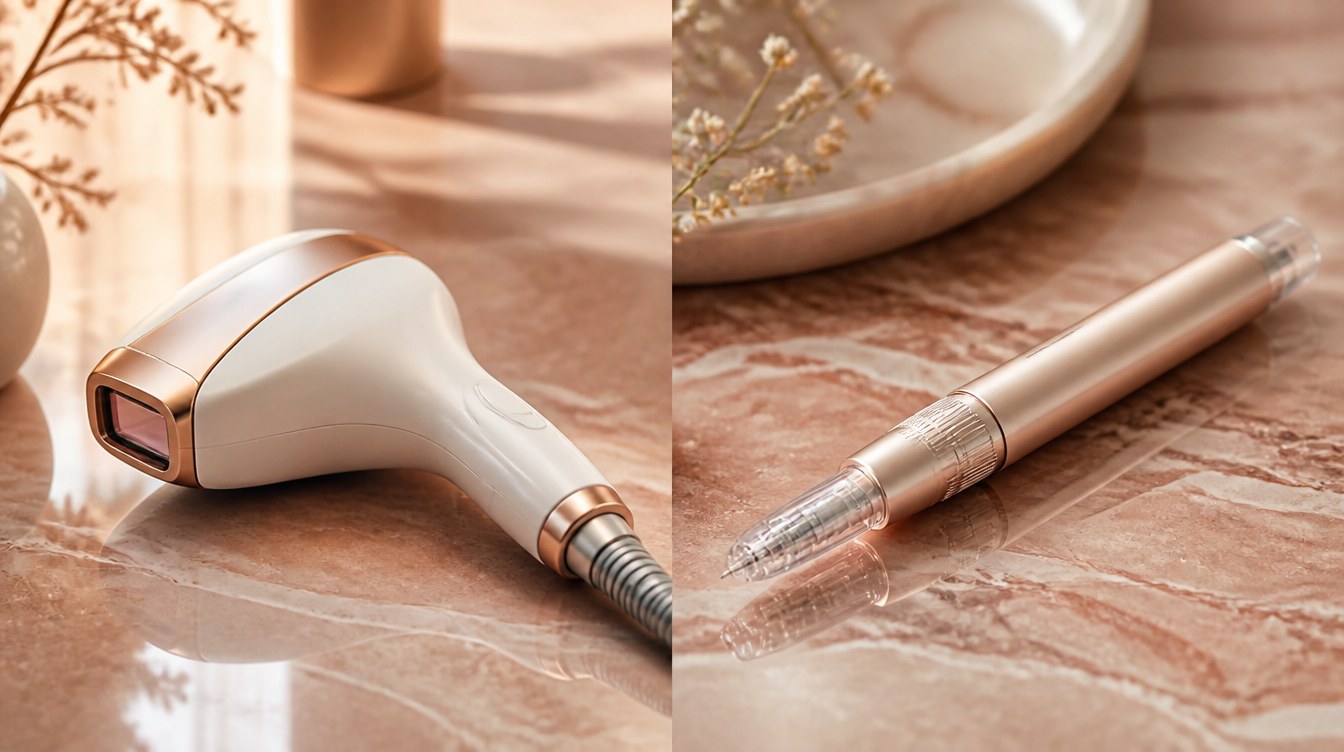
Pico laser delivers energy in picosecond pulses — extremely short bursts that create a photoacoustic (pressure-wave) effect rather than a purely thermal one. This shatters pigment particles into fragments the body clears naturally, and the pressure wave also stimulates a mild repair response in surrounding tissue.
Microneedling uses fine needles to create controlled, superficial channels in the skin. This physical micro-injury triggers the skin's wound-healing cascade, which includes new collagen and elastin production over the following weeks.
Neither mechanism is "better" in the abstract — they solve different problems.
| Pico laser | Microneedling / RF microneedling | |
|---|---|---|
| How it works | Ultra-short light pulses shatter pigment by pressure and, in fractional mode, create tiny zones that prompt collagen | Fine needles make controlled micro-channels; RF versions add heat at depth to remodel collagen |
| Main targets | Sun spots, freckles, post-acne marks, uneven tone, tattoo ink; mild texture in fractional mode | Rolling and boxcar acne scars, enlarged pores, mild laxity, overall texture |
| Typical course | 3 to 6 sessions, 3 to 4 weeks apart | 3 to 4 sessions, 4 to 6 weeks apart |
| Downtime | Redness for hours; small crusts for a few days on spots | Redness 1 to 3 days; pinpoint marks; RF versions slightly longer |
| Skin types | Suits Asian skin types III to V with settings matched to pigment | Suits all skin types; colour-blind because it does not target pigment |
| Can they be combined? | Yes: pico for tone, microneedling for texture, planned in alternating sessions | Yes, as above; the order depends on which concern leads |
General comparison; suitability is decided at an in-person assessment and results vary between people. No prices are listed; a written estimate follows assessment.
Which Concern Points Toward Which Treatment
-
Pigmentation, sun spots, uneven tone — pico laser's pigment-targeting mechanism is the more direct fit.
-
Acne scarring, textural irregularity, enlarged pores — microneedling's collagen-stimulation mechanism, sometimes combined with radiofrequency delivery, more directly addresses structural texture change.
-
Combined concerns — when marks and indented scars sit together, the two are often used in the same plan, usually on separate visits, with spacing set at assessment so the skin has settled in between.
“Pico laser and microneedling are not rivals. One answers a colour problem, the other a texture problem.”
By the Numbers: What the Research Shows
A 2021 systematic review of picosecond lasers found good evidence for pigmented lesions and tattoos and growing evidence for acne scars and texture. Reviews of microneedling describe a wound-healing response that builds new collagen over weeks to months, with most evidence in acne scars and skin rejuvenation.
Neither body of evidence says one is better. They describe two mechanisms aimed at two different targets: pigment for pico laser, dermal collagen for microneedling.
A Reasonable Question: Can They Be Done Together?
Yes, in the same plan, though not usually on the same day. Pico laser can lighten the marks that sit on top of scars, while microneedling or RF microneedling works on the scar depth beneath. Alternating them a few weeks apart lets the skin settle, which matters in skin types III to V where inflammation can leave pigment. The order and spacing are set at assessment.
What This Means Practically
The concern you're treating — not a general preference for "laser" or "needling" — should decide which treatment fits. A proper assessment identifies which mechanism actually addresses your specific skin issue.
Ready to Book a Consultation?
Doctor-led care by Dr Sin Yong at 9 Scotts Road, #12-01 Pacific Plaza, Singapore.
Frequently Asked Questions
Both can play a role depending on scar type. Rolling and boxcar scars often respond well to microneedling's collagen stimulation; associated pigmentation from old acne marks may respond better to pico laser. A proper assessment determines the right approach for your specific scarring.
Downtime varies by individual and by the specific settings/depth used in either treatment — this is worth discussing directly at consultation rather than assuming one is categorically shorter than the other.
This depends on individual skin condition and is assessed by your treating physician — not something to self-determine from general information online.
Pores that look larger because of oil and texture often improve with microneedling or RF microneedling, which remodel the skin around them. Fractional pico laser can also help texture. The cause of the pores decides, and oil control is part of the plan.
There is no fixed order. If marks are the main concern, pico laser often starts; if scar depth is, microneedling may. In combined plans they alternate with spacing set at assessment.
Both can be used safely in Asian skin when settings are conservative. Microneedling leaves the surface largely intact, and pico laser spreads less heat than older lasers; either can still cause temporary darkening, so spacing and sun care matter.
References
- Wu DC, Goldman MP, Wat H, Chan HHL. A Systematic Review of Picosecond Laser in Dermatology: Evidence and Recommendations. Lasers Surg Med 2021;53(1):9-49. doi:10.1002/lsm.23244
- Alster TS, Graham PM. Microneedling: a review and practical guide. Dermatol Surg 2018;44(3):397-404. doi:10.1097/DSS.0000000000001248
- Aust MC, Fernandes D, Kolokythas P, Kaplan HM, Vogt PM. Percutaneous collagen induction therapy: an alternative treatment for scars, wrinkles, and skin laxity. Plast Reconstr Surg 2008;121(4):1421-1429. doi:10.1097/01.prs.0000304612.72899.02
- Davis EC, Callender VD. Postinflammatory hyperpigmentation: a review of the epidemiology, clinical features, and treatment options in skin of color. J Clin Aesthet Dermatol 2010;3(7):20-31. PMID 20725554 pubmed.ncbi.nlm.nih.gov/20725554
These sources describe mechanisms and general evidence. They are not a promise of any individual result; suitability is decided at an in-person assessment.