
Skin Booster vs Filler: Skin Quality or Shape?
Both are injections, and both are often called “fillers” online. Dr Sin Yong at IN Eternity Clinic on Orchard Road explains what a skin booster treatment does that filler does not, and the reverse.
Treatment page: skin boosters in Singapore.
How Linerase, a collagen injectable, compares with the boosters used at the clinic is in Linerase explained.
WhatsApp to Enquire →Key facts ↓Skin booster vs filler is a question of layer and job. A skin booster sits in the dermis and improves hydration, texture, fine lines and resilience over a course of sessions, without changing face shape. A dermal filler sits deeper, under the skin or near bone, and adds volume or structure that shows the same day. Many faces need one; some need both, in order.
On this page
- Hyaluronic acid booster: in a pilot study of 19 women, a stabilised hyaluronic acid booster given in 3 sessions 4 weeks apart improved skin elasticity and surface roughness (Kerscher et al., Dermatol Surg 2008).
- Profhilo: in an open-label study of 64 women, two sessions 4 weeks apart improved skin measures, sustained to week 16 (Sparavigna and Tenconi, Clin Cosmet Investig Dermatol 2016).
- Booster side effects: a 2026 systematic review of 9 Profhilo studies (278 participants) found side effects were mild and usually resolved within 72 hours (Sparavigna et al., Plast Aesthet Nurs 2026).
- Filler and blood vessels: in a survey of 370 dermatologists covering about 1.7 million filler syringes, vascular occlusion occurred about once per 6,410 syringes with needles and once per 40,882 with cannulas (Alam et al., JAMA Dermatol 2021).
- Vision change: vision change after filler is rare: a review of the world literature found 98 reported cases, most often after injections between the brows and around the nose (Beleznay et al., Dermatol Surg 2015).
- In a survey of 370 dermatologists covering 1.7 million syringes, vascular occlusion occurred about once per 6,410 syringes with needles and once per 40,882 with cannulas (JAMA Dermatol 2021)
- In a 16-week study of a hybrid hyaluronic acid injectable given in two sessions, skin improvement was significant from week 4 or 8 and still significant at week 16; minor, temporary injection-site reactions occurred in 23% (Clin Cosmet Investig Dermatol 2016)
- Ultrasound before filler can show earlier filler and map blood vessels, and allows hyaluronidase to be placed precisely if a problem arises (J Cosmet Dermatol 2018)
What is a skin booster treatment?
A skin booster treatment places small amounts of an injectable into the dermis, the layer of skin that holds collagen, elastin and water. The aim is to change how the skin behaves: how hydrated it is, how fine lines sit on its surface, how it reflects light and how quickly it springs back. Nothing is added to lift a cheek or fill a fold. The skin booster page describes the families used at IN Eternity Clinic.
Hyaluronic acid boosters, which are lightly cross-linked or not cross-linked at all, bind water in the dermis; a pilot study of a stabilised hyaluronic acid gel in 19 women reported improvements in skin elasticity and surface roughness. Profhilo uses a high concentration of heat-stabilised hyaluronic acid that spreads through the tissue from a few points. Polynucleotides such as Rejuran support repair in thin or sensitised skin. PDLLA boosters such as Juvelook prompt gradual collagen change. A course is usually two to three sessions a few weeks apart, followed by maintenance.
Because a booster acts on the skin rather than on the shape beneath it, the change is subtle by design: skin that looks more rested, holds make-up more evenly and creases less at rest. People searching for skin booster treatment are often hoping for that kind of change, and are sometimes offered filler instead. Knowing which of the two your concern needs is the purpose of this guide.
What does a dermal filler do?
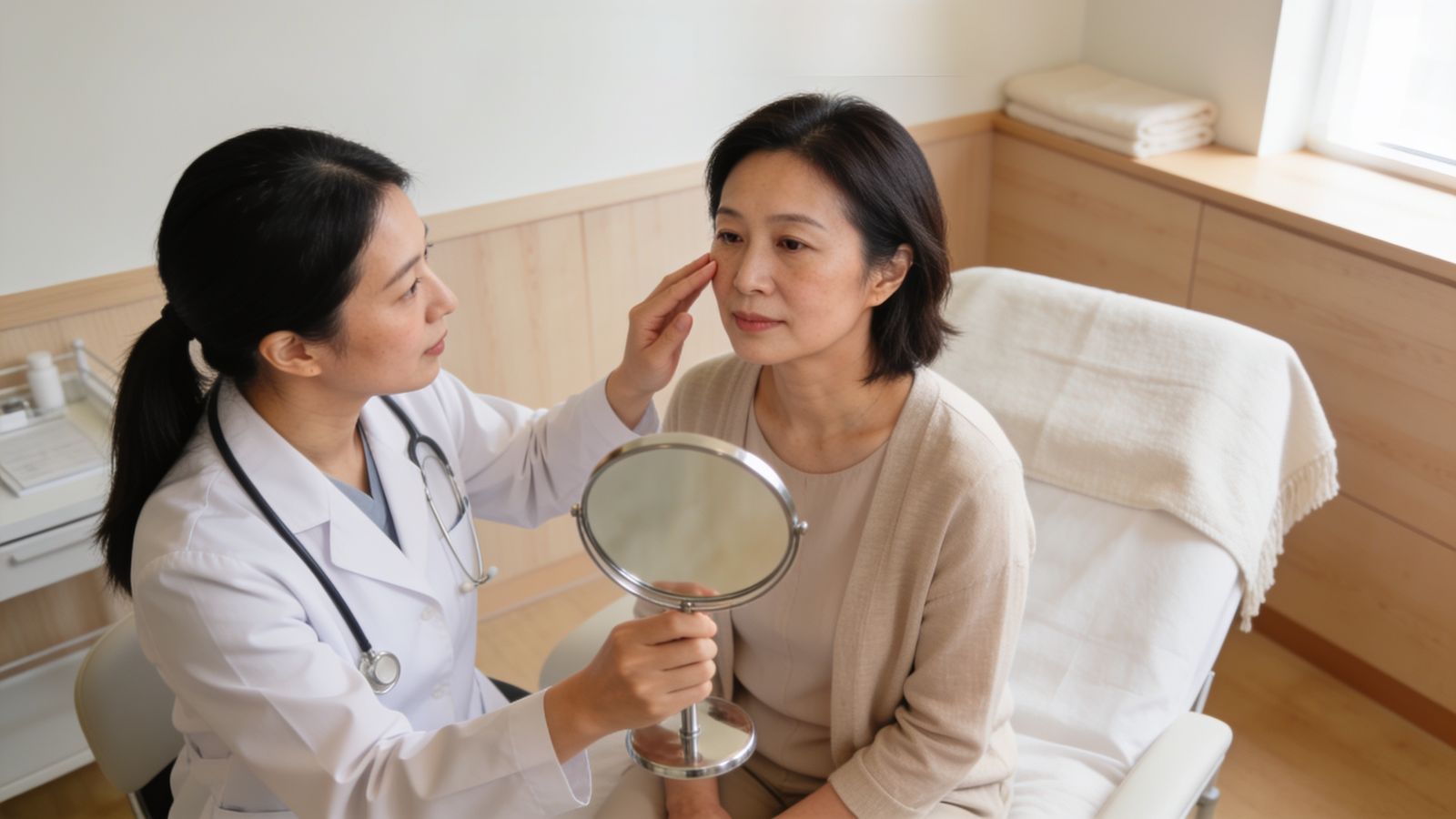
Dermal filler is a gel, most often hyaluronic acid that has been chemically cross-linked so it holds a shape and lasts longer. It is placed under the skin, in the fat compartments or close to bone, to replace volume that has been lost or to add definition, for example at the cheekbones, temples, chin or jawline. Because it occupies space, the change is visible the same day.
Filler does very little for the surface of the skin. It will not soften crepey texture, refine pores or make dull skin look fresher, and using it for those reasons tends to make the face heavier. Fillers and related structural products are covered on dermal fillers; where earlier filler has spread or been layered, filler correction comes before anything new is added.
For structural work on the nose, chin and jawline, Dr Sin Yong often prefers a structural product such as calcium hydroxylapatite or polycaprolactone over hyaluronic acid alone, because it holds projection with less product. For hollows such as the temples or tear trough, soft hyaluronic acid placed carefully, or gradual collagen stimulation, may suit better. Where earlier filler is present or suspected, it is mapped with ultrasound before anything is added.
“If the shape still looks like you but the skin does not, filler is the wrong answer. Adding volume to tired skin only gives you more tired skin.”
Skin booster vs filler compared
| Skin booster | Dermal filler | |
|---|---|---|
| Main job | Skin quality | Volume and shape |
| Depth | Dermis, many small points | Under the skin or near bone |
| When it shows | Gradually, over a course | Same day |
| Typical concerns | Dryness, crepiness, fine lines, dullness | Hollows, flat cheeks, weak chin |
| Dissolvable | HA types yes; PN and PDLLA no | HA filler yes |
Biostimulators such as Sculptra sit between the two: they can restore volume, but through your own collagen over months. Filler vs biostimulator vs skin booster covers all three families.
How do I know whether I need a skin booster or filler?
Ask what has changed. If your face has lost shape, such as hollower temples, flatter cheeks, deeper shadows under the eyes or a less defined chin, the problem is structure, and filler or a biostimulator is the usual answer. If the shape still looks like you but the skin looks thinner, drier, more crepey or slower to recover, the problem is quality, and a skin booster is the more direct tool.
A simple test helps. Look in the mirror in even light: a shadow that sits in the same place whatever your expression is often a volume issue. Pinch the skin on the cheek gently: if it tents and settles slowly, or shows fine crinkling, quality is a large part of the picture. Many faces have both, and in that case a staged plan is used, often restoring support first and then working on the skin, with time between steps to judge each one.
Age is a tendency, not a rule. In the late twenties and thirties, the first changes are often in skin quality, so boosters are a common starting point. Later, broader volume loss becomes more relevant. The face in front of the doctor decides.
When the answer is neither booster nor filler
Sagging is not a volume problem or a skin-quality problem; it is descent of tissue. Adding filler to lift a heavy lower face often makes it wider. Here Dr Sin Yong considers lifting instead, and face shape guides the choice: leaner or hollow faces are usually better matched to VF Lift – Vertical Facelift, which runs on CLASSYS Volnewmer, while fuller lower faces suit Time Freeze Laser LCLR® (Laser Collagen Lipo Remodelling). In lean faces, hollowing after some focused ultrasound or radiofrequency treatments is a known side effect worth discussing before any lifting plan.
Brown pigment, redness and active acne also need their own treatments; a booster will not clear melasma or sun spots. If your main concern is dull, congested skin rather than thin skin, a medical facial may be enough, as explained in Hydrafacial vs skin booster.
What does each feel like, and what are the risks?
Boosters are given as many small injections or through a few cannula entry points after numbing cream; they feel like quick pricks, and small bumps usually settle within a day or two. Filler is felt more as pressure, and most fillers contain local anaesthetic. Swelling after filler can last several days and bruising up to a week or so.
Both carry risks of bruising, lumps and, rarely, infection. The serious risk with any injectable is product entering or compressing a blood vessel, which can damage skin and, very rarely, affect vision; it is mostly linked to volumising filler in areas such as around the nose and between the brows. That is why anatomy, technique, an emergency plan and hyaluronidase on hand matter. Sudden pain, blanching, a dusky patch or vision change after any injection needs same-day medical attention.
Injectables of either kind are deferred during pregnancy and breastfeeding, over active skin infection or a flare of eczema or rosacea, and around dental work or illness. Your medicines and supplements are reviewed, because some increase bruising. At IN Eternity Clinic every injectable used is registered with HSA for its use and is given by the doctor.
If you need both, which comes first?
When a face needs both structure and skin quality, the order depends on what bothers you most and on how each step will be judged. Restoring a hollow first lets the skin be assessed over a stable base; starting with boosters first can sometimes show that less filler is needed than expected, because better-quality skin casts softer shadows. Either way, the two are usually spaced a few weeks apart, and each step is reviewed before the next is booked.
What is avoided is adding filler to chase every line. Lines that sit in the skin are a quality problem, and treating them with volume is how faces drift towards looking heavy. The pillow face page explains how that pattern develops and how it is corrected.
What are the side effects of a skin booster vs filler?
Both commonly cause short-lived bruising, swelling and small lumps; the rare serious risk, a blocked blood vessel, is mainly linked to volumising filler in higher-risk areas.
| Skin booster | Dermal filler | |
|---|---|---|
| Common, short-lived | Small bumps for hours to a day or two, redness, pinpoint bruises | Swelling for several days, bruising for up to a week or so, tenderness |
| Lumps | Uncommon; most settle, and persistent lumps are reviewed | Possible early or late; hyaluronic acid lumps can usually be dissolved |
| Blocked blood vessel | Rare; small, superficial amounts | Rare, but the main serious risk; higher around the nose and between the brows |
| Can it be reversed? | Hyaluronic acid boosters yes; polynucleotide and PDLLA no | Hyaluronic acid filler yes; CaHA, PCL and PLLA no |
Warning signs after any injection are blanching, severe or increasing pain, and mottled or dusky skin: contact the treating clinic immediately, and for any change in vision go to the nearest emergency department. At IN Eternity Clinic, Dr Sin Yong performs injectables himself, earlier filler can be mapped with ultrasound before anything is added, and hyaluronidase is kept on hand for hyaluronic acid filler vascular events. Early and late problems, common and rare, are explained in filler complications, and booster-by-booster effects in skin booster side effects. The booster families are on skin booster Singapore.
Common myths, answered
- Myth: A skin booster is just a lighter filler.
Fact: Boosters are placed in the dermis to change skin quality and are not designed to add shape. Filler adds shape and does little for texture. - Myth: Filler will fix crepey skin.
Fact: Filler sits beneath the skin and does not improve the dermis itself. Used for crepiness, it tends to add weight without smoothing texture. - Myth: Skin boosters work after one session.
Fact: Most boosters are given as a course of two to three sessions, and the change builds over weeks. - Myth: If my face looks tired, I need more volume.
Fact: Tiredness can come from skin quality, volume loss, sagging or pigment. Each needs a different tool, so the cause is worked out first.
Frequently asked questions
What is a skin booster treatment?
It is an injectable treatment placed in the dermis to improve hydration, texture, fine lines and resilience. Families include hyaluronic acid boosters, Profhilo, polynucleotides such as Rejuran and PDLLA boosters such as Juvelook. Boosters do not change face shape. They are usually given as a course of two to three sessions a few weeks apart, with maintenance afterwards.
Is a skin booster the same as a filler?
No. Both are injected, but a filler is a gel placed deeper to add volume or definition, and it shows on the day. A skin booster is placed in the dermis to improve the quality of the skin itself and works gradually. Some boosters contain hyaluronic acid, but in a form designed to spread and hydrate rather than hold a shape.
Can I have a skin booster and filler at the same time?
Sometimes, but they are often spaced apart so swelling from one does not hide the result of the other, and so each can be judged on its own. When both are needed, Dr Sin Yong usually restores structure first, then works on skin quality, or the reverse, depending on what bothers you most.
How long does a skin booster last compared with filler?
It varies with the product, the area and the person. Hyaluronic acid filler often lasts many months to over a year in less mobile areas. Skin boosters usually need maintenance every few months after the initial course. Metabolism, sun exposure and lifestyle all affect how long either lasts.
Which is safer, a skin booster or filler?
Both are generally well tolerated in experienced hands. Skin boosters are placed superficially in small amounts, so the risk of serious vascular events is mainly associated with volumising filler in higher-risk areas. Any injection can cause bruising, lumps or infection, which is why your history is reviewed and treatment is done by the doctor.
How much does a skin booster treatment cost compared with filler?
Cost depends on the product family, the number of syringes or vials, the number of sessions and whether ultrasound mapping or correction of old filler is needed first. Boosters are usually planned as a course; filler is planned by the amount needed for each area. Dr Sin Yong gives a written, itemised quote after assessment.
What is an ECM skin booster?
ECM stands for extracellular matrix, the collagen, elastin and water-holding framework of the dermis. “ECM skin booster” is a marketing label rather than a type of product, used for boosters said to support that framework. Ask what the active ingredient is, such as hyaluronic acid, polynucleotide or PDLLA, and whether the product is registered with HSA.
Is a PDLLA skin booster a filler?
Not in the usual sense. PDLLA boosters such as Juvelook are placed in or just under the dermis and prompt collagen over weeks to months, adding little immediate volume. Unlike hyaluronic acid filler, they cannot be dissolved. How PDLLA compares with deeper poly-L-lactic acid is set out in Sculptra vs Juvelook.
Can a skin booster replace under-eye filler?
Only if the problem is the skin. A booster made for the eye area can improve thin, crepey lower-lid skin, but it does not fill a hollow tear trough, which is a volume question. Many under-eye concerns are a mix of hollowing, pigment and thin skin, so the cause is worked out first; see under-eye filler.
Which shows results faster, a skin booster or filler?
Filler shows on the day, because the gel occupies space, although swelling takes a week or two to settle. Skin boosters work gradually: most are a course of two to three sessions, and the change builds over weeks. With an event coming up soon, filler or no treatment is usually more predictable than starting a booster course.
Can filler be dissolved if I do not like it?
Hyaluronic acid filler can usually be dissolved with hyaluronidase, an enzyme, ideally after the product has been located with ultrasound. Calcium hydroxylapatite, polycaprolactone and poly-L-lactic acid cannot be dissolved, which is why they are dosed conservatively. Correction is explained on filler correction, and fillers themselves on dermal fillers in Singapore.
Book an assessment
IN Eternity Clinic, 9 Scotts Road, #12-01 Pacific Plaza, Singapore 228210. By appointment with Medical Director Dr Sin Yong. Monday to Saturday, 11am to 8pm. WhatsApp or call +65 8815 3008.
International KOL — CLASSYS · HIRONIC · DEKA · ALMA · FOTONA · LUTRONIC
References
- Kerscher M, Bayrhammer J, Reuther T. Rejuvenating influence of a stabilized hyaluronic acid-based gel of nonanimal origin on facial skin aging. Dermatol Surg 2008;34(5):720-726. doi:10.1111/j.1524-4725.2008.34176.x
- Sparavigna A, Tenconi B. Efficacy and tolerance of an injectable medical device containing stable hybrid cooperative complexes of high- and low-molecular-weight hyaluronic acid: a monocentric 16 weeks open-label evaluation. Clin Cosmet Investig Dermatol 2016;9:297-305. doi:10.2147/CCID.S114450
- Signorini M, Liew S, Sundaram H, et al. Global Aesthetics Consensus: Avoidance and Management of Complications from Hyaluronic Acid Fillers - Evidence- and Opinion-Based Review and Consensus Recommendations. Plast Reconstr Surg 2016;137(6):961e-971e. doi:10.1097/PRS.0000000000002184
- Beleznay K, Carruthers JDA, Humphrey S, Jones D. Avoiding and Treating Blindness From Fillers: A Review of the World Literature. Dermatol Surg 2015;41(10):1097-1117. doi:10.1097/DSS.0000000000000486
- Schelke LW, Decates TS, Velthuis PJ. Ultrasound to improve the safety of hyaluronic acid filler treatments. J Cosmet Dermatol 2018;17(6):1019-1024. doi:10.1111/jocd.12726
- Alam M, Kakar R, Dover JS, et al. Rates of vascular occlusion associated with using needles vs cannulas for filler injection. JAMA Dermatol 2021;157(2):174-180 (online 2020). doi:10.1001/jamadermatol.2020.5102
- Sparavigna A, Cigni C, Tanzini L, Lualdi R, Grimolizzi F. A systematic review of the efficacy and safety of Profhilo and Profhilo Body. Plast Aesthet Nurs (Phila) 2026;46(2):80-92. doi:10.1097/PSN.0000000000000637
These sources describe mechanisms and general evidence. They are not a promise of any individual result; suitability is decided at an in-person assessment.