
Syringoma Removal Singapore
Syringomas are harmless sweat-duct growths that sit lower in the skin than they look. Medical Director Dr Sin Yong confirms what they are, then plans laser treatment around depth, skin type and healing.
WhatsApp to Enquire →Key facts ↓A syringoma is a small, harmless growth of sweat-duct tissue, usually a cluster of firm, skin-coloured bumps on the lower eyelids and upper cheeks. They are common in women and in Asian skin, often run in families and do not squeeze out like milia. Because the ducts sit deeper than the bump, CO2 laser is used in staged sessions to reach them while protecting thin eyelid skin. Recurrence is possible.
Syringoma removal at a glance
| What it is | Removal of syringomas, small harmless growths of sweat-duct tissue, usually on the lower eyelids and upper cheeks. |
|---|---|
| Used for | Clusters of firm, skin-coloured or yellowish bumps that do not squeeze out like milia. |
| How it works | CO2 laser reaches the deeper duct tissue: a pinhole method for scattered raised bumps, a fractional method for dense clusters, with depth controlled for thin eyelid skin. |
| Typical sessions | Scattered bumps may need one or two sessions; dense clusters usually several, spaced a few months apart. |
| Downtime | Small crusts for about five to seven days and puffiness of the lower lids, then pinkness that fades over weeks. |
| When results show | The area looks smoother once crusts settle; syringomas can recur over months to years. |
| Who should avoid or wait | Bumps that are not clearly syringomas, eyelid infection or inflammation, and sudden widespread bumps or symptoms such as thirst are checked first. |
| Who performs it | Medical Director Dr Sin Yong confirms the diagnosis and performs the laser. |
Dr Sin Yong, Medical Director of IN Eternity Clinic, explains that the visible bump is only the tip of a lesion that sits deeper, so treatment is staged to reach the duct tissue while protecting thin eyelid skin, and syringomas are reduced rather than removed for good.
On this page
- What they are: benign growths of eccrine sweat ducts, usually small, skin-coloured or yellowish bumps on the lower eyelids and upper cheeks.
- Who gets them: most often women, frequently of Asian descent, typically appearing from adolescence onwards; they can run in families.
- Why they are stubborn: the duct cells sit in the mid-dermis, below the visible bump, so surface treatment alone tends to let them return.
- Main treatment: CO2 laser, either pinhole-style on individual bumps or fractional across a cluster, with settings chosen for the thin eyelid skin.
- What to expect: small scabs for about a week, several sessions for dense clusters, and a real chance of some recurrence over time.
- Where: IN Eternity Clinic, 9 Scotts Road, #12-01 Pacific Plaza, Singapore.
- A review of post-inflammatory hyperpigmentation found it is common after inflammation of the skin and affects darker skin more often and more severely, which shapes how treatment is planned in Asian skin (J Clin Aesthet Dermatol 2010)
What is a syringoma, and who gets it?
A syringoma is a benign tumour of the eccrine sweat ducts, the tiny coiled tubes that carry sweat to the skin surface. In a syringoma, small duct structures multiply in the dermis, surrounded by fibrous tissue, and push up a firm bump of one to three millimetres. They are usually skin-coloured or slightly yellow, flat-topped, and appear in clusters, most often on the lower eyelids and the upper cheeks, sometimes on the upper lids, forehead, neck or chest.

They typically appear from adolescence into the thirties and slowly increase in number. Women are affected more often than men, and syringomas are particularly common in people of East and Southeast Asian descent. They frequently run in families. A systematic review of patients with multiple syringomas found associations with some medical conditions, including diabetes for one variant and Down syndrome, though most people who have them are otherwise well.
Syringomas are harmless and do not become cancerous; people treat them for appearance and because make-up sits unevenly over them. An overview is on syringomas.
Is it a syringoma, milia or something else?
Several common bumps cluster around the eyes. Milia are tiny keratin cysts that look pearly white and lift out through a small opening. Xanthelasma are soft yellow plaques linked to cholesterol deposits and sometimes to blood lipid levels. Sebaceous hyperplasia shows a small central dip. Syringomas are firm, flat-topped and skin-coloured, and they do not express.
Telling these apart matters because each is treated differently. Dr Sin Yong examines the bumps under magnification and asks how and when they appeared. Very widespread or sudden eruptions, or syringomas elsewhere on the body, are noted and may prompt further medical review.
Types of syringoma
| Type | Where and how it appears | Notes |
|---|---|---|
| Periorbital (localised) | Clusters on the lower eyelids and upper cheeks | By far the most common; the usual reason for treatment |
| Eruptive | Many small bumps appearing over a short period on the neck, chest, abdomen or arms | Often in young adults; may be mistaken for other rashes; examined to confirm |
| Familial | Multiple syringomas in several family members | Same appearance; family history supports the diagnosis |
| Clear-cell | Looks like ordinary syringomas | Seen under the microscope; associated with diabetes, so blood sugar is worth checking |
| Genital | Small bumps on the vulva or penis, sometimes itchy | Examined to exclude other conditions; treated cautiously |
Syringomas are often confused with milia, which are pearly white and can be released through a tiny opening, and with xanthelasma, which are soft yellow plaques near the inner corners of the eyes. Telling them apart is covered in the section above.
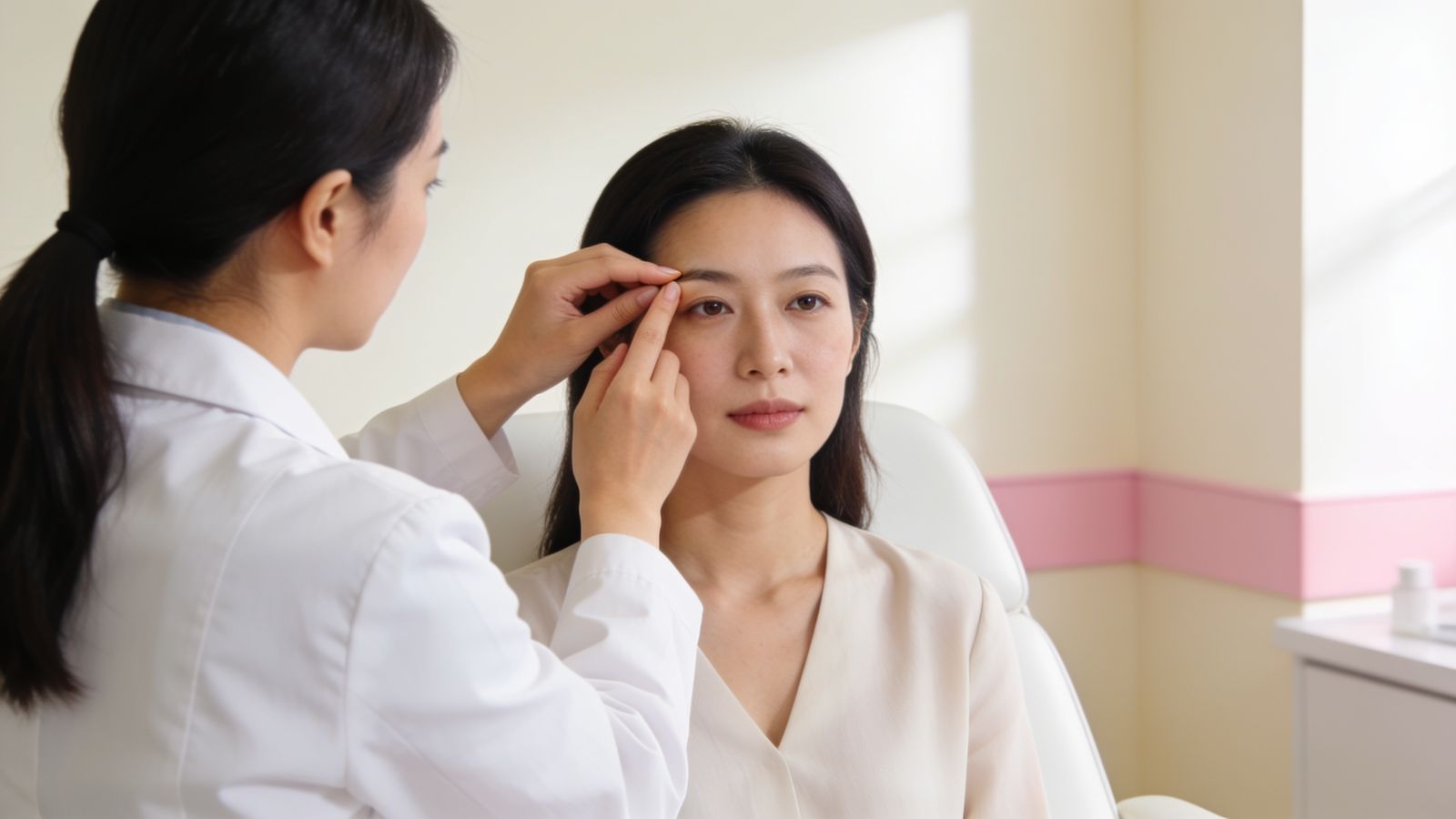
The bump is the tip, not the whole lesion
Under the microscope a syringoma is a nest of small ducts in fibrous tissue in the dermis. What you see is the surface of that nest. Shaving or burning only the top flattens it for a while, but ducts left behind can rebuild the bump.
Treatment therefore aims to reach the duct tissue while protecting the surrounding skin, which on the lower eyelid is among the thinnest on the body. That balance is why settings, spacing and the number of sessions are decided bump by bump.
“A syringoma is deeper than it looks. Treat only the surface and it usually comes back.”
How CO2 laser is used at IN Eternity Clinic
Pinhole method. A fine CO2 laser beam makes a narrow channel through each larger bump to reach the deeper duct tissue, sparing the skin between bumps. It suits scattered, raised syringomas.
Fractional method. Where bumps sit in a dense cluster, a fractional CO2 pattern treats the area in microscopic columns, with untreated skin left in between to speed healing. More than one session is usually needed.
Numbing cream is applied first. The eye is protected throughout. Some patients have a combination of both methods over a course, and radiofrequency may be used for very small lesions.
Syringoma treatment options compared
Many methods have been tried for syringomas, which tells you that none is perfect. The aim is to reach the duct tissue deep enough to reduce the bump and the chance of return, without scarring the thin skin around the eyes.
| Method | How it works | Trade-offs | At IN Eternity Clinic |
|---|---|---|---|
| CO2 laser, pinhole | A fine beam drills a narrow channel into each larger bump to reach the ducts | Precise for scattered raised bumps; small crusts for about a week | Yes |
| Fractional CO2 laser | Treats a cluster in microscopic columns with skin left between them | Suits dense clusters; several sessions; pinkness for weeks | Yes |
| Radiofrequency (electrosurgery) | Fine energy flattens very small lesions | Quick for tiny bumps; shallow, so recurrence is more likely | For very small lesions |
| Surgical excision | Cuts out individual lesions | Leaves stitched scars; impractical for clusters | Assessed case by case |
| Chemical cautery (strong acids) | Destroys tissue chemically | Depth hard to control on eyelids; pigment risk in Asian skin | Not recommended on eyelids |
| Creams | Topical retinoids and others have been tried | Little evidence of benefit for established bumps | Not a treatment for syringomas |
CO2 laser is the most widely reported treatment, used either on each bump or fractionally across a cluster, and studies in Asian patients describe improvement with acceptable rates of pigment change when sessions are spaced and sun protection is strict. The DEKA Tetra CO2 laser at IN Eternity Clinic is used for both approaches.

Healing, pigment and recurrence
Expect small crusts that settle over about five to seven days, followed by pinkness that fades over weeks. Sun protection is important because darker skin can develop post-inflammatory pigmentation after any laser treatment; this is planned for in advance. Scarring is uncommon when depth is controlled but is possible. Syringomas can recur, so a review visit is part of the plan.
Can syringomas be removed for good?
Usually not for good, and it is better to know that before starting. Treatment can flatten and reduce syringomas so that the under-eye area looks smoother and make-up sits better. But duct tissue left deeper in the skin can regrow over months to years, and new syringomas can appear nearby, since the tendency remains. Going deeper reduces recurrence but raises the risk of scarring and pigment change, so treatment is deliberately staged: a session, a few months of healing, a review, and further sessions where needed.
Clusters usually need more than one session, and people who form new bumps often return every year or two. To discuss yours, book an assessment with Dr Sin Yong.
What Dr Sin Yong looks for
- Is it a syringoma? Firm, flat-topped bumps that do not express, as opposed to milia, xanthelasma or sebaceous hyperplasia.
- Pattern and number. Scattered raised bumps suit pinhole treatment; dense clusters suit fractional treatment over several sessions.
- Depth. How raised and firm each bump is, which guides the depth of each pass.
- Eyelid skin. Thickness and laxity of the lower lid, which limit how aggressive treatment can be.
- Skin type and pigment history. Previous dark marks after spots or treatments, which change spacing and aftercare.
- Elsewhere on the body. Syringomas on the neck, chest or genitals, and general health such as diabetes.
General clinical observations used at consultation; they describe what is checked, not any individual result.
Does it hurt? Comfort and numbing
Numbing cream is applied to the treated area first, usually for 30 to 45 minutes, and the eyes are protected throughout with shields or covers. With the pinhole method, each bump receives a few short pulses from a fine CO2 laser beam; most people feel a quick, hot prick with each one. Fractional treatment over a cluster feels like rapid prickling and warmth. Where bumps are dense or deeper, a small amount of local anaesthetic may be added for comfort.
The lower eyelid is sensitive, so the session is paced and settings are adjusted as it goes. Afterwards the treated spots sting mildly and feel warm for a few hours. Cold compresses help, and the lower lids are often puffy the next morning, especially after treating a dense cluster.
What to expect, day by day
Healing around the eyes is quick but visible, so many people time treatment before a quieter week.
- Day 0. Tiny pinpoint wounds over the treated bumps, with redness. Apply the ointment provided and do not rub the eyes.
- Days 1–3. Puffiness of the lower lids is common, worse in the mornings. Small crusts form. Avoid eye make-up on treated spots.
- Week 1. Crusts settle and lift, usually over about five to seven days. Let them fall off on their own.
- Weeks 2–4. The skin is pink and fades over weeks. Daily sun protection matters, because darker skin can develop post-inflammatory pigmentation.
- Review. The review checks healing, pigment and any remaining bumps. Dense clusters are retreated in staged sessions spaced a few months apart.
Common myths, answered
- Myth: Syringomas are caused by heavy eye creams.
Fact: They are benign sweat-duct growths, with genetic and other contributing factors. Rich creams can cause milia, which are a different bump. - Myth: One quick laser zap removes them for good.
Fact: The duct tissue sits deeper than the visible bump, so staged sessions are usual and some recurrence is possible. - Myth: Laser near the eyes is too risky to consider.
Fact: The eye is shielded and settings are chosen for thin eyelid skin. Risks such as pigment change and scarring are discussed beforehand. Healing is reviewed at every stage. - Myth: Syringomas are a sign of a serious disease.
Fact: They are benign. Very widespread or sudden eruptions, or syringomas elsewhere on the body, are noted and may prompt further medical review.
When bumps around the eyes need a medical check
Syringomas are harmless. A few changes around the eyes or elsewhere should be checked before treatment.
- Many bumps appearing suddenly on the neck, chest or abdomen.
- Syringomas with thirst, frequent urination or weight loss: a blood sugar check is sensible.
- A single eyelid bump that grows, bleeds, crusts or causes lash loss: this is examined and sometimes biopsied.
- Yellow plaques near the inner corners of the eyes: likely xanthelasma, which prompts a blood lipid check.
- Eyelid swelling, pain or redness: possible infection or inflammation, treated first.
Where any of these apply, the cause is assessed first, with tests or referral where needed.

Your syringoma removal day, step by step
- Examination. Dr Sin Yong confirms the bumps are syringomas and not milia, xanthelasma or another growth, and checks your skin type and history of pigment after injury.
- Planning. Which bumps to treat in this session is agreed, and the depth and spacing are planned for thin eyelid skin. Dense clusters are usually treated in stages.
- Preparation. The area is cleansed and photographed, numbing cream is applied, and protective eye shields are placed.
- Treatment. The DEKA Tetra Pro CO2 laser is used pinhole-style on individual bumps or in a fractional pattern across a cluster. The laser time is usually short, commonly well under half an hour, though the whole visit is longer.
- Straight after. Ointment is applied. There may be pinpoint crusts and some swelling of the lower lids, which is often more noticeable the next morning.
- The next days and review. Crusts settle over about five to seven days and pinkness fades over weeks. The next stage is planned once the skin has fully settled, often six to eight weeks later.
What does syringoma removal look like over time?
Healing around the eyes is quick but visible, and dense clusters are treated in stages.
| Stage | What usually happens |
|---|---|
| Day 0 | Tiny pinpoint wounds over the treated bumps, with redness. |
| Days 1 to 3 | Puffiness of the lower lids, worse in the mornings; small crusts form. |
| About one week | Crusts fall away; eye make-up can usually resume. |
| Following weeks | Pinkness fades. |
| Months later | Further staged sessions for dense clusters; some bumps can regrow, which follow-up looks for. |
Before an event: because crusts and lid puffiness are visible for about a week, many people time treatment before a quieter week.
Syringoma removal: when to call the clinic
Crusting, pinkness, pigment and recurrence are covered above. A few less common effects are worth knowing about before treatment near the eyes.
Common and expected
- Swelling of the lower lids for a few days, usually worse in the mornings.
- Small milia forming in treated skin during healing.
Uncommon
- Prolonged redness lasting several weeks.
- Post-inflammatory darkening in skin types III to V, reduced by sun protection; see post-laser care in Singapore.
- Infection or a cold sore flare near the treated area.
- Rarely, a slight pull on the lower lid after aggressive treatment, which is why depth is staged.
When to call the clinic
- Eye pain, blurred vision or a red, watering eye.
- Increasing pain, spreading redness, yellow crusts or pus.
- Dark patches in the weeks after treatment; early treatment of pigment is easier.
What affects the cost of syringoma removal in Singapore?
Syringoma treatment is planned in stages, so cost follows the extent of the clusters and how many sessions are needed.
| What affects the cost | Why it matters |
|---|---|
| Number and density | A few scattered bumps differ from dense clusters across both lower lids. |
| Sites | Lower lids alone, or cheeks, forehead or other areas as well. |
| Sessions | Dense clusters are usually treated in stages weeks apart. |
| Skin type | Darker skin may need more conservative settings and more sessions. |
| Assessment findings | Bumps that turn out to be milia or another growth are treated differently. |
Background on the condition is on syringomas. See our fees page. At IN Eternity Clinic a consultation fee applies, and it is waived if you go ahead with any medical treatment; the fee is S$120.
More questions answered
How do you get rid of syringoma naturally?
There is no proven natural or home remedy. Syringomas are small, harmless growths of sweat-duct cells sitting deep in the skin, so creams, oils, scrubs and squeezing do not reach them, and picking can scar. They can safely be left alone; when removal is wanted, it is done in clinic, usually with a CO2 laser, after confirming they are syringomas and not milia or something else.
What does a syringoma look like?
Syringomas are small, firm, flat-topped, skin-coloured bumps, usually in clusters on the lower eyelids and upper cheeks. Unlike milia, which are pearly white and lift out through a small opening, they do not squeeze out. Xanthelasma, by contrast, are soft yellow plaques. Because several bumps around the eyes look alike, they are examined under magnification before any treatment is planned.
What types of syringoma are there?
The periorbital, or localised, type is the usual one: clusters on the lower eyelids and upper cheeks. The eruptive type appears as many small bumps over a short period on the neck, chest, abdomen or arms, often in young adults. The familial type means several family members are affected. Very widespread or sudden eruptions may prompt further medical review.
How is a syringoma diagnosed?
Usually by examination. Dr Sin Yong looks at the bumps under magnification and asks how and when they appeared, to tell syringomas from milia, xanthelasma and sebaceous hyperplasia, which are each treated differently. Where the diagnosis is unclear, a small biopsy can confirm it. Syringomas elsewhere on the body, or a sudden widespread eruption, are noted for further review.
What is the pinhole method for syringomas?
The pinhole method uses a fine CO2 laser beam to make a narrow channel through each larger bump to reach the deeper duct tissue, sparing the skin between bumps. It suits scattered, raised syringomas. Where bumps sit in a dense cluster, a fractional CO2 pattern may be used instead. Numbing cream is applied first, the eye is protected, and more than one session is usually needed.
Is syringoma removal safe?
With the eye shielded, settings chosen for thin eyelid skin and depth controlled, scarring is uncommon, though possible. Swelling of the lower lids for a few days and small crusts are expected. Uncommon effects include prolonged redness, post-inflammatory darkening in skin types III to V, and infection or a cold sore flare. Bumps that are not clearly syringomas, and eyelid infection or inflammation, are checked first.
How much does syringoma removal cost in Singapore?
Cost depends on how many syringomas there are, how densely they cluster, whether the pinhole or fractional method is used, and how many staged sessions are likely to be needed. Since these differ from person to person, IN Eternity Clinic sets out the plan and its cost after examining the bumps at consultation.
Can I go back to work the same day after syringoma removal?
Many people do, but the treated spots form small crusts for about a week and the lower lids may be puffy for a few days. If you prefer not to be seen with crusts, plan treatment before a quieter week. Eye make-up should stay off the treated spots until they have healed.
Will people notice I had syringomas treated?
For roughly a week, small crusts under the eyes are visible at close range, followed by pinkness that fades over several weeks. Glasses can help disguise them. Once healed, people tend to notice smoother skin under the eyes rather than signs of treatment.
Preparation, pregnancy and combining with under-eye treatments
How should I prepare for syringoma removal?
Avoid sun exposure and a fresh tan, stop retinoids and exfoliating acids around the eyes for a few days, and tell the doctor about cold sores, keloids, diabetes or isotretinoin use. Plan for small scabs for about a week, and come without eye make-up. Contact lenses may be removed during treatment.
Can syringomas be treated during pregnancy?
Syringoma removal is usually postponed during pregnancy and breastfeeding because it is a cosmetic procedure and healing and pigment can change during this time. Syringomas are harmless, so waiting is safe. Plan treatment a few months after birth.
Can syringoma removal be combined with other under-eye treatments?
Yes, but usually not on the same day. Syringomas are treated first so the skin can heal, then other treatments such as skin tightening, boosters or filler for hollows can follow a few weeks later. The doctor plans the order so each treatment works on healed skin.
Frequently asked questions
Are syringomas dangerous?
No. They are benign growths of sweat-duct tissue. They are treated for appearance, after the diagnosis has been confirmed.
Can syringomas be squeezed out like milia?
No. Milia are keratin cysts that can be released through a tiny opening; syringomas are solid growths in the dermis and do not express.
How many sessions will I need?
Scattered bumps may need one or two sessions. Dense clusters usually need several, spaced a few months apart so the skin can recover between them.
Will they come back?
They can. Laser reduces them, but ducts left deeper in the skin may regrow over time, which is why follow-up is planned.
Is there downtime?
Small scabs are usual for about a week on the treated spots, and the skin stays pink for some weeks afterwards. Most people plan treatment around social commitments.
Can darker skin be treated?
Yes, with care. Settings are adjusted and sun protection is essential, because post-inflammatory pigmentation is a known risk after laser in darker skin types.
What causes syringomas?
Syringomas come from an overgrowth of eccrine sweat-duct cells in the dermis. Why it happens is not fully known; they run in families, are more common in women and in Asian skin, and usually appear from adolescence onwards. Heavy eye creams do not cause them.
Can syringomas go away on their own?
Rarely. Syringomas usually persist and may slowly increase in number. They are harmless, so treatment is a matter of choice, and the aim is to flatten and reduce them rather than remove them for good.
Are syringomas linked to diabetes?
One variant, clear-cell syringoma, is associated with diabetes, and syringomas are also more common in Down syndrome. Most people with syringomas are otherwise well, but symptoms such as thirst or frequent urination are worth a blood sugar check.
Can creams remove syringomas?
No cream has good evidence of removing established syringomas, because the ducts sit in the dermis. Topical retinoids and others have been tried with limited effect. Laser treatment that reaches the duct tissue is the usual approach.
Does syringoma removal hurt?
Numbing cream is applied before treatment, and most people feel brief pricking or heat with each laser pulse. The eyelids are sensitive, so comfort is checked throughout and pulses are paused if needed. Afterwards the area can feel like mild sunburn for a day or two, with some swelling. Simple painkillers are usually enough.
How soon will I see results after syringoma treatment?
Treated bumps flatten as the crusts lift, usually within about a week, but the skin stays pink for some weeks and the final appearance is judged once it has settled, often after six to eight weeks. Dense clusters are treated in stages, so the overall change builds over several sessions. Some bumps can return over time.
Can I wear make-up after syringoma removal?
Eye make-up and concealer are usually avoided until the crusts have fallen away, often about a week, because rubbing and removers can disturb healing and increase the risk of pigment. After that, gentle make-up can usually cover any pinkness. Contact lenses can usually be worn, but the eyes are kept clean and the treated skin is not pulled.
Can syringomas on the cheeks, forehead or neck be treated?
Yes, though eruptive syringomas on the neck, chest or body are often more numerous and can be harder to clear. The same principle applies: confirm the diagnosis, then treat with the DEKA Tetra Pro CO2 laser in stages with settings chosen for the site. Thicker skin tolerates slightly different settings from the eyelids. Expectations are discussed before starting.
Book an assessment
IN Eternity Clinic, 9 Scotts Road, #12-01 Pacific Plaza, Singapore. By appointment with Medical Director Dr Sin Yong. WhatsApp or call +65 8815 3008.
International KOL — CLASSYS · HIRONIC · DEKA · ALMA · FOTONA · LUTRONIC
References
- Lee SJ, Goo B, Choi MJ, et al. Treatment of periorbital syringoma by the pinhole method using a carbon dioxide laser in 29 Asian patients. J Cosmet Laser Ther 2015;17(5):273-276. doi:10.3109/14764172.2015.1027224
- Cho SB, Kim HJ, Noh S, Lee SJ, et al. Treatment of syringoma using an ablative 10,600-nm carbon dioxide fractional laser: a prospective analysis of 35 patients. Dermatol Surg 2011;37(4):433-438. doi:10.1111/j.1524-4725.2011.01915.x
- Davis EC, Callender VD. Postinflammatory hyperpigmentation: a review of the epidemiology, clinical features, and treatment options in skin of color. J Clin Aesthet Dermatol 2010;3(7):20-31. PMID 20725554
- Singapore Medical Council. Guidelines on Aesthetic Practices for Doctors (2016 edition). healthprofessionals.gov.sg/smc
- Health Sciences Authority, Singapore. Infosearch — registered medical devices and health products. hsa.gov.sg
- Williams K, Shinkai K. Evaluation and management of the patient with multiple syringomas: a systematic review of the literature. J Am Acad Dermatol 2016;74(6):1234-1240.e9. doi:10.1016/j.jaad.2015.12.006
- Wang JI, Roenigk HH Jr. Treatment of multiple facial syringomas with the carbon dioxide (CO2) laser. Dermatol Surg 1999;25(2):136-139. doi:10.1046/j.1524-4725.1999.08111.x
These sources describe mechanisms and general evidence. They are not a promise of any individual result; suitability is decided at an in-person assessment.